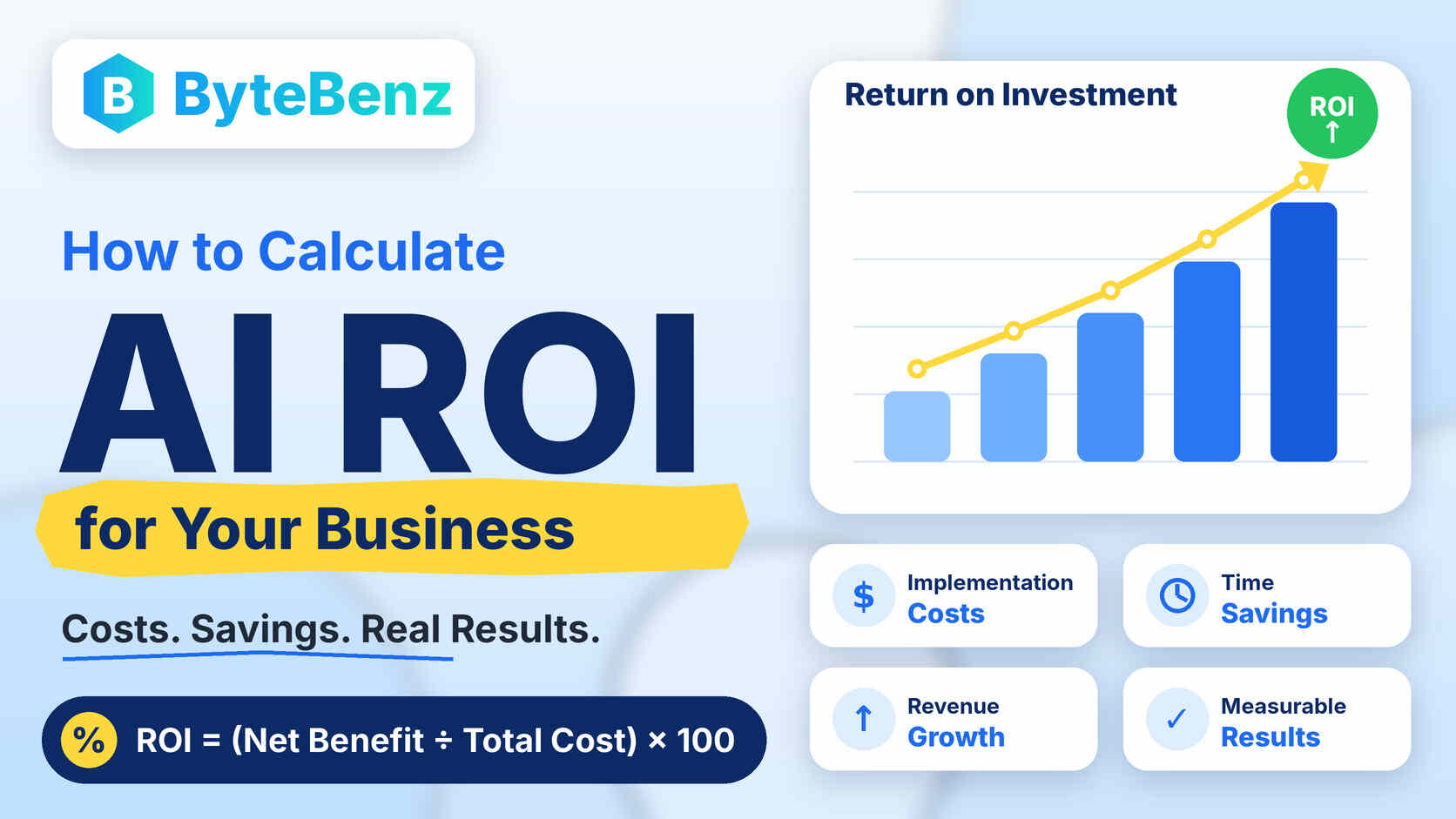

Artificial intelligence is changing how businesses operate, make decisions, and serve customers. From automating repetitive tasks to improving marketing campaigns, AI technologies are helping organizations save time and improve productivity. However, adopting new technology also requires investment, and businesses need to understand whether that investment is delivering meaningful results.
This is where measuring AI ROI for Your Business becomes important. Return on Investment (ROI) helps organizations evaluate the financial and operational value generated by artificial intelligence compared with its implementation costs.
Whether a company uses AI chatbots, automated marketing tools, predictive analytics, or intelligent workflow systems, measuring performance helps decision-makers understand what is working and where improvements are needed.
What Is AI ROI?
AI ROI refers to the return a business receives from investing in artificial intelligence technologies. It measures the benefits generated by an AI solution compared with the total amount spent on purchasing, implementing, maintaining, and operating it.
These benefits are not always limited to direct financial gains. Businesses may also experience improved productivity, faster customer service, fewer errors, better decision-making, and increased customer satisfaction.
For example, a company investing in an AI chatbot may reduce the workload of its customer service team. If employees spend less time answering repetitive questions, they can focus on more valuable activities.
Understanding these improvements helps businesses evaluate whether their AI investment is successful.
Why Should Businesses Measure AI ROI?
Investing in artificial intelligence without tracking its performance can lead to unnecessary expenses. Measuring returns helps businesses make informed decisions and use their technology budgets effectively.
1. Understand Financial Performance
ROI calculations help companies determine whether an AI solution is generating enough value to justify its cost.
Businesses can compare expected savings and additional revenue against implementation expenses.
2. Improve Business Productivity
AI automation can reduce the time employees spend on repetitive activities. Measuring saved working hours helps organizations understand the productivity improvements generated by their investment.
3. Make Better Investment Decisions
Companies often have multiple AI tools available. Measuring their performance makes it easier to identify which solutions offer the greatest business value.
4. Identify Areas for Improvement
Performance tracking can reveal problems such as low adoption rates, inaccurate outputs, or higher-than-expected operating expenses.
Businesses can use these insights to improve their AI implementation strategy.
Important Factors That Influence AI ROI
Several factors determine how much value an organization receives from artificial intelligence.
Implementation Costs
Initial expenses may include software subscriptions, system integration, employee training, infrastructure, and customization.
Businesses should calculate these expenses before evaluating potential returns.
Employee Productivity
AI tools can automate repetitive work and help employees complete certain activities more efficiently. The time saved can be measured to estimate productivity improvements.
Operational Savings
Automation may reduce manual processing, administrative expenses, and avoidable errors. These savings can contribute directly to business performance.
Revenue Growth
AI-powered recommendations, customer analytics, and marketing automation may help companies improve conversions and identify new revenue opportunities.
Customer Experience
Faster responses, personalized recommendations, and improved service quality can strengthen customer relationships. Although these benefits may not produce immediate financial returns, they can contribute to long-term business growth.
How to Calculate AI ROI for Your Business
Businesses can use a simple financial formula to calculate the return generated by an AI investment.
AI ROI Formula:
ROI (%) = [(Total Benefits – Total Investment Cost) / Total Investment Cost] × 100
Here is a practical example.
Suppose a company invests ₹2,00,000 in an AI automation system. After one year, the company estimates that the system generates ₹3,00,000 in measurable financial benefits through reduced operating expenses and improved productivity.
Using the formula:
- Total Benefits = ₹3,00,000
- Total Investment Cost = ₹2,00,000
- Net Return = ₹1,00,000
ROI = [(₹3,00,000 – ₹2,00,000) / ₹2,00,000] × 100
AI ROI = 50%
This means the company generated a 50% return on its initial investment during the measured period.
Businesses should use actual financial savings and attributable revenue gains rather than counting the same benefit multiple times.
Practical Ways to Measure AI Business Value
Not every AI benefit can be measured through revenue alone. Organizations should consider several performance indicators.
1. Time Saved Through Automation
Calculate how many working hours are saved after implementing AI.
For example, if an automated system saves employees 10 hours every week, businesses can estimate the financial value of that time using the relevant employee costs.
2. Reduction in Operational Expenses
Compare expenses before and after implementing AI. Look for reductions in manual processing, customer support workload, administrative activities, and avoidable errors.
3. Improvement in Conversion Rates
Marketing teams can evaluate whether AI-powered recommendations, customer segmentation, or campaign optimization improve conversion rates.
4. Customer Satisfaction
Monitor customer feedback, satisfaction scores, complaint rates, and response times to understand how AI affects service quality.
5. Employee Adoption
An AI solution delivers limited value when employees do not use it properly. Tracking adoption rates and usage frequency can help businesses identify training requirements.
Real-World Examples of AI ROI Across Industries
Artificial intelligence creates different types of value depending on the industry and business objectives.
E-commerce
Online retailers can use AI recommendation systems to suggest relevant products. Better product discovery may improve conversion rates, average order value, and customer engagement.
Healthcare Administration
Healthcare organizations can use AI for administrative scheduling, document processing, and routine communication. These applications may reduce administrative workload and improve operational efficiency.
Digital Marketing
Marketing agencies can use AI tools for content research, customer segmentation, campaign analysis, and reporting. These systems can reduce manual work and help teams make faster decisions.
Banking and Finance
Financial organizations can apply AI to fraud detection, document analysis, and customer service automation. These applications may improve risk monitoring and reduce manual processing costs.
Common Mistakes to Avoid When Measuring AI ROI
Businesses sometimes struggle to calculate accurate returns because they overlook important expenses or benefits.
- Ignoring hidden costs: Include employee training, integration, maintenance, and subscription expenses.
- Expecting immediate returns: Some AI projects require time to produce measurable results.
- Using unrealistic estimates: Base calculations on actual data instead of overly optimistic assumptions.
- Ignoring employee adoption: Poor usage can reduce the value of an otherwise useful system.
- Measuring only financial gains: Consider productivity, customer satisfaction, and operational improvements as well.
- Failing to monitor performance: Review results regularly to identify changes in costs and benefits.
Avoiding these mistakes helps organizations develop a more realistic understanding of AI investment performance.
Best Practices for Improving AI ROI
Businesses should follow a structured approach to maximize the value of their artificial intelligence investments.
- Set Clear Objectives: Identify the specific business problem that AI should solve.
- Choose Suitable Tools: Compare software features, pricing, scalability, and integration capabilities.
- Start With Small Projects: Test AI solutions on limited workflows before expanding implementation.
- Train Employees: Ensure teams understand how to use AI tools effectively.
- Track Relevant Metrics: Monitor costs, time savings, productivity, and revenue improvements.
- Review Results Regularly: Compare actual performance with the original business objectives.
- Optimize Continuously: Update workflows and improve implementation based on performance data.
A well-planned strategy can help businesses avoid unnecessary spending and achieve more sustainable results.
Conclusion
Artificial intelligence can create significant opportunities for business growth, but investing in new technology does not automatically guarantee success. Organizations need to measure financial returns, productivity improvements, operational savings, and customer experience to understand the actual value of their investments.
Calculating AI ROI for Your Business provides a practical way to evaluate performance and make better technology decisions. By setting clear objectives, tracking measurable results, and improving implementation strategies, businesses can turn AI investments into meaningful long-term value.
Frequently Asked Questions (FAQs)
1. What does AI ROI mean?
AI ROI measures the financial and operational benefits a business receives from artificial intelligence compared with the total cost of its investment.
2. What is the formula for calculating AI ROI?
The formula is: ROI (%) = [(Total Benefits – Total Investment Cost) / Total Investment Cost] × 100.
3. Which costs should be included when calculating AI ROI?
Include software subscriptions, implementation, employee training, infrastructure, integration, maintenance, and other relevant operating expenses.
4. Can small businesses measure AI ROI?
Yes. Small businesses can measure saved working hours, reduced operating expenses, improved conversion rates, and increased productivity.
5. How long does it take to see returns from AI investments?
The timeline depends on the technology, business objectives, implementation complexity, and adoption rate. Some automation projects show improvements quickly, while larger projects may take longer.