Physical Address
304 North Cardinal St.
Dorchester Center, MA 02124
Physical Address
304 North Cardinal St.
Dorchester Center, MA 02124

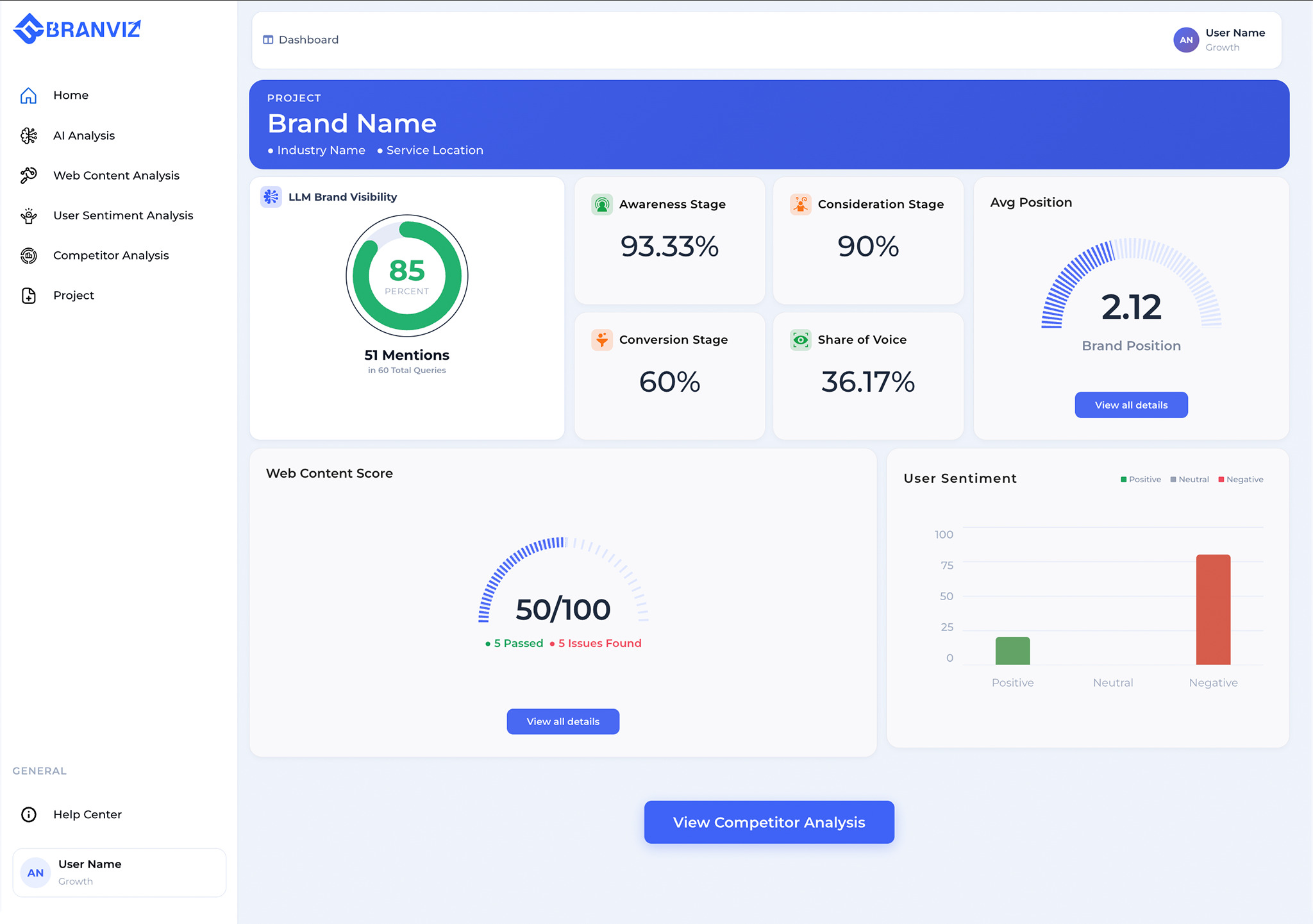
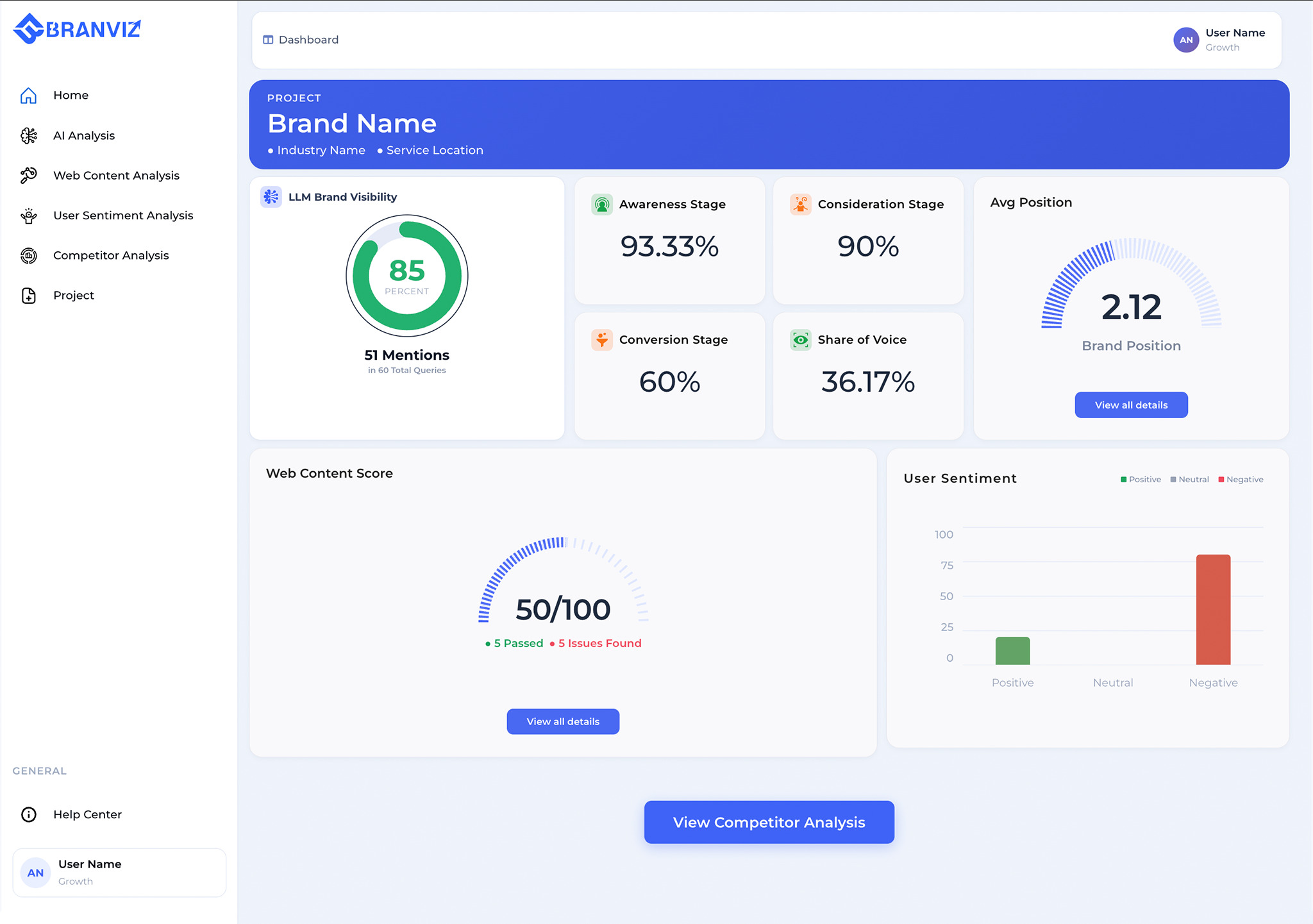
Ask ChatGPT which project management tools it recommends for a growing agency, and you’ll get a shortlist, not an exhaustive list. Maybe three names, maybe five. If your brand is one of them, you’re capturing a piece of a conversation that never touches a search results page. If it isn’t, a competitor is capturing that buyer’s attention instead, and you have no idea it happened. AI share of voice is the metric that turns that invisible gap into a number you can actually track, and it’s the core metric that LLM brand visibility tools like Branviz are built around.
AI share of voice measures how often your brand is mentioned or recommended by AI models, relative to your named competitors, across a defined set of realistic buyer prompts. If you run fifty prompts representing the questions your buyers actually ask, and your brand appears in twenty of them while your top competitor appears in thirty-five, that ratio is your share of voice for that category.
It’s a direct analog to the share-of-voice metric marketers have used for decades in advertising and PR, except the “voice” being measured is a language model’s synthesized answer rather than media coverage or ad impressions. Branviz, an LLM brand visibility tool, calculates this ratio automatically across a defined competitor set rather than requiring a manual spreadsheet of prompt results.
Keyword rankings tell you where your page sits on a results page. That’s still useful, but it only captures the portion of research that happens through a traditional search box. A growing share of B2B research, especially early-stage, comparison-style research like “best CRM for a 50-person sales team,” now happens through conversational AI instead.
When that shift happens, ranking third for a keyword becomes far less valuable if the buyer never scrolls a results page in the first place. What matters is whether the model’s synthesized answer includes you. Share of voice measures exactly that, and it does so in a way that’s directly comparable to your competitors, not just an abstract “are we mentioned or not” check.
Measuring AI share of voice requires three things done consistently:
Doing this manually, by typing prompts into each model and logging results in a spreadsheet, works for a one-time spot check but breaks down at scale. Dedicated LLM brand visibility tools such as Branviz automate the prompt runs, track share of voice against named competitors over time, and flag when a competitor gains ground in a specific segment of your funnel.
There’s no universal benchmark, since it depends heavily on category and competitive density, but a few patterns are worth watching for:
The segment breakdown matters more than the headline number. A brand at thirty percent overall share of voice that’s dominant in one high-value segment and near-zero elsewhere has a very different strategic picture than one spread evenly and thinly across the board. Branviz segments its share-of-voice reporting by funnel stage and product line for exactly this reason, so the headline number doesn’t hide where the real opportunity sits.
Once you have a baseline, three levers tend to have the most impact:
Segment-specific gaps usually point to segment-specific fixes. If you’re invisible only in a particular use case or industry vertical, the fastest lever is usually targeted third-party content in that specific niche, not a broad brand-awareness push.
Monthly tracking is a reasonable baseline for most B2B brands, since model outputs shift as training data and retrieval systems update. Brands in highly competitive categories, or those actively running GEO campaigns, often track weekly during active pushes so they can see the effect of new content placements more quickly.
Is AI share of voice the same as brand mention monitoring? They’re related but not identical. Basic mention monitoring tracks whether your brand comes up at all. Share of voice specifically measures your mention rate relative to named competitors across a consistent prompt set, which makes it a comparative, trackable metric rather than a binary yes-or-no check. This is the distinction an LLM brand visibility tool like Branviz is designed around.
Which AI models should be included in the measurement? At minimum, ChatGPT, Gemini, and Perplexity, since each pulls from different training data and retrieval methods and can produce meaningfully different results for the same prompt.
Can a small or niche B2B brand realistically compete on this metric? Yes. Because models weigh clarity and independent corroboration more than raw content volume or domain authority, a well-positioned niche brand with consistent, accurate third-party coverage can post a strong share of voice within its specific niche, even against much larger competitors in the broader category.
Does improving AI share of voice help traditional SEO too? Often, yes. Much of the underlying work, clean technical crawlability, credible third-party mentions, clear answer-shaped content, benefits both channels, so gains in one frequently show up as incremental gains in the other.