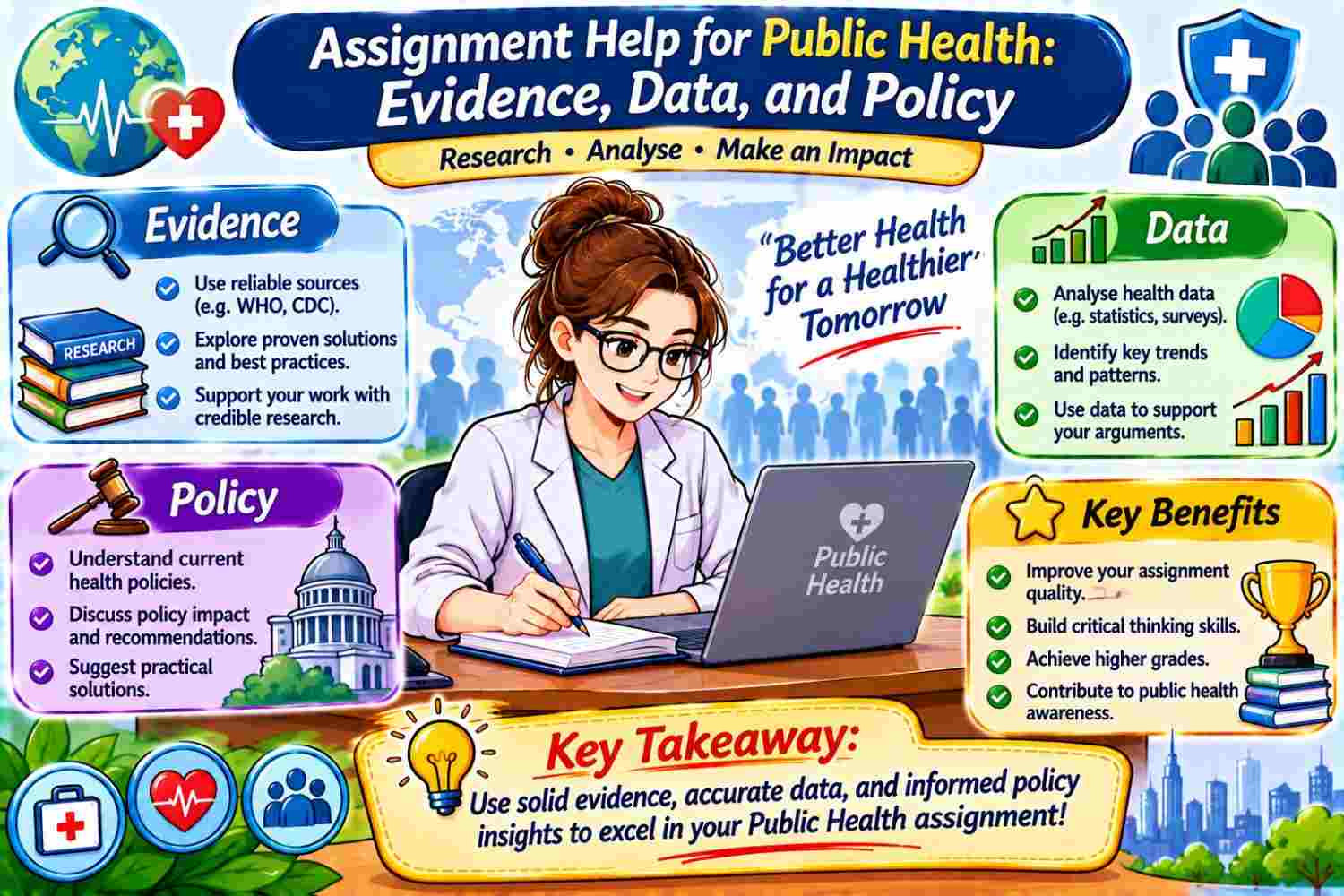

Assignment Help for Public Health: Evidence, Data, and Policy – A Complete Guide for Students
Public health assignments require students to understand health issues from a population perspective rather than focusing only on individual experiences. These assignments involve analysing health data, applying theoretical frameworks, evaluating healthcare programs, and recommending effective policies. Students must demonstrate critical thinking, research skills, and the ability to connect evidence with real-world public health challenges. However, many students find it difficult to interpret statistical information, understand epidemiological concepts, and develop practical policy recommendations. With the right approach and reliable Assignment Help, students can improve their academic writing, strengthen their analytical abilities, and develop a better understanding of public health principles.
Understand Public Health from a Population Perspective
Public health focuses on improving the health and well-being of entire populations. Unlike individual healthcare, which primarily addresses personal medical needs, public health examines the wider factors that influence community health outcomes. These factors include income, education, housing, employment, environmental conditions, healthcare accessibility, and lifestyle choices.
When writing a public health assignment, students should explain how these factors influence different communities. For example, limited access to nutritious food may contribute to higher rates of obesity and other health conditions in disadvantaged populations. Similarly, poor housing conditions and environmental pollution can increase the risk of respiratory illnesses.
A strong assignment connects individual health experiences with broader population trends. Students should explain who is affected by a particular health issue, identify its underlying causes, and discuss possible interventions. Assignment Help can provide guidance on organising these ideas and developing clear, evidence-based arguments.
Understand Important Public Health Frameworks
Public health frameworks help students organise their research and explain complicated health challenges. Understanding these frameworks makes it easier to analyse health problems and recommend suitable interventions.
Some important frameworks include:
-
Social Determinants of Health: Explains how social, economic, and environmental conditions influence health outcomes and inequalities.
-
Ottawa Charter: Provides a foundation for developing health promotion strategies through community action, supportive environments, and healthy public policies.
-
Epidemiological Triad: Examines the relationship between the host, agent, and environment in the development of diseases.
-
Levels of Prevention: Divides prevention into primary, secondary, and tertiary approaches.
-
Logic Models: Explain how program resources and activities connect with expected outcomes.
-
RE-AIM Framework: Helps evaluate public health programs through reach, effectiveness, adoption, implementation, and maintenance.
Students should not simply mention these frameworks in their assignments. They should explain their meaning and demonstrate how each framework applies to the selected health issue. This approach makes academic arguments more meaningful and demonstrates a deeper understanding of public health concepts.
Develop Strong Data Interpretation Skills
Data analysis is an important part of public health assignments. Students frequently work with statistical reports, research findings, tables, graphs, and population health surveys. However, presenting numbers without explaining their significance does not demonstrate strong analytical skills.
Before interpreting data, students should understand where the information comes from, who participated in the research, and when the data was collected. They should also distinguish between raw numbers, percentages, and population rates.
For example, a report showing an increase in reported diabetes cases may indicate a growing health concern. However, students should investigate whether the increase reflects population growth, improved screening, or a genuine rise in disease occurrence.
Assignment Help can support students by reviewing data interpretations, identifying unclear explanations, and suggesting ways to connect statistical findings with public health issues.
Ask Important Questions When Analysing Health Data
Before including statistical information in an assignment, students should consider several questions:
-
Who was included in the research, and which groups were excluded?
-
Does the information represent counts, percentages, or population rates?
-
What period does the data cover?
-
Is the research source reliable and scientifically appropriate?
-
What conclusions can reasonably be drawn from the findings?
-
Are there limitations or possible biases in the research?
These questions help students avoid misleading interpretations and develop more accurate academic discussions.
Understand Essential Epidemiology Concepts
Epidemiology examines how diseases and health conditions are distributed across populations and what factors influence their occurrence. Students need to understand several important terms when preparing public health assignments.
Incidence refers to the number of new cases of a disease occurring within a specific population during a particular period.
Prevalence describes the total number of existing cases within a population at a particular time or over a specified period.
Mortality refers to deaths within a population, while morbidity describes illness or disease within a population.
Other important concepts include risk factors, protective factors, confounding variables, and research bias. Students should also understand the difference between association and causation. Two factors may be connected without one directly causing the other.
Using epidemiological terminology correctly improves the accuracy and quality of academic writing.
Learn How to Write an Effective Public Health Policy Brief
A policy brief is a short document designed to communicate important research findings and recommendations to policymakers, healthcare professionals, and other decision-makers.
Public health students may be asked to prepare policy briefs that address issues such as vaccination programs, mental health awareness, obesity prevention, environmental pollution, or healthcare accessibility.
An effective policy brief generally includes:
-
Problem Statement: Clearly explain the public health issue and identify the population affected.
-
Evidence Summary: Present relevant statistics, research findings, and supporting information.
-
Available Options: Discuss possible interventions and approaches.
-
Policy Recommendation: Suggest the most suitable solution based on available evidence.
-
Implementation Considerations: Explain costs, feasibility, equity, and potential challenges.
Students should use straightforward language, informative headings, and relevant statistics. Recommendations must be realistic and supported by research.
Assignment Help can assist students with improving the structure, clarity, and presentation of their policy briefs while allowing them to develop their own recommendations.
Avoid Common Public Health Assignment Mistakes
Many students lose marks because their assignments contain unnecessary descriptions instead of meaningful analysis. Recognising common mistakes can help students improve their academic performance.
Some frequent problems include:
-
Describing health problems without examining their underlying causes.
-
Ignoring social determinants and health inequalities.
-
Using outdated statistics or unreliable research sources.
-
Mentioning theoretical frameworks without applying them.
-
Making recommendations without supporting evidence.
-
Confusing correlation with causation.
-
Failing to consider implementation costs and practical limitations.
To avoid these problems, students should carefully review assignment instructions, develop a clear structure, and support their arguments with credible academic evidence.
Understand Public Health Program Evaluation
Program evaluation helps determine whether a public health intervention achieves its intended objectives. Students may need to evaluate vaccination campaigns, community health education initiatives, disease prevention programs, or mental health awareness projects.
A systematic evaluation generally involves several steps:
-
Identify the program’s objectives and target population.
-
Explain how the program was designed and implemented.
-
Select appropriate measures to evaluate success.
-
Compare actual outcomes with expected results.
-
Examine program reach, cost, and sustainability.
-
Recommend improvements based on the findings.
For example, when evaluating a community health awareness campaign, students might examine participation rates, changes in health knowledge, and improvements in preventive health behaviours.
A good evaluation should explain both the achievements and limitations of the program. Balanced analysis demonstrates critical thinking and a practical understanding of public health interventions.
Consider Ethics and Health Equity
Ethics and equity are essential elements of public health research and academic writing. Public health policies can affect different communities in different ways, making it important to consider fairness, accessibility, and individual rights.
Students should examine who benefits from a particular intervention and whether certain groups face additional barriers. For example, rural populations may experience difficulties accessing healthcare services because of transportation problems, limited facilities, or financial challenges.
Academic writing should also use respectful language when discussing vulnerable communities. Avoid stereotypes, unsupported assumptions, and statements that blame individuals for wider social problems.
Privacy, informed consent, cultural safety, and responsible data handling should also be considered whenever relevant to the assignment.
Choose Reliable Sources for Public Health Research
Strong public health assignments depend on accurate and trustworthy information. Students should prioritise sources that provide scientific evidence, current statistics, and relevant healthcare information.
Useful research sources include:
-
Government health departments and national statistics agencies.
-
World Health Organization publications and reports.
-
Peer-reviewed public health journals.
-
Systematic reviews and clinical guidelines.
-
Research reports from reputable non-profit organisations.
Students should compare information from different sources rather than relying on a single report. They should also check publication dates, research methods, and the credibility of the authors.
Proper referencing is equally important. Every statistic, research finding, and theoretical concept taken from another source should be acknowledged using the referencing style required by the university.
Develop Better Study Habits for Data-Heavy Assignments
Public health assignments often involve extensive reading, research, statistical interpretation, and academic writing. Developing consistent study habits can make these tasks easier to manage.
Students can improve their preparation by maintaining a glossary of epidemiological terms, practising the interpretation of graphs, and recording the sources of important statistics. Explaining each figure in their own words before including it in an assignment can also improve understanding.
Creating a realistic study timetable is another effective strategy. Students should divide their work into research, data analysis, outlining, writing, and proofreading stages. Completing research early leaves more time for interpretation and critical analysis.
When students experience difficulties, Assignment Help can provide additional academic guidance and feedback on their work.
Conclusion
Public health assignments require students to combine research, evidence, data interpretation, theoretical frameworks, and policy analysis. Developing these skills helps students understand population health challenges and identify practical ways to improve community well-being. By applying relevant frameworks, interpreting statistics carefully, evaluating health programs, and considering ethics and equity, students can produce stronger academic work.
Reliable Assignment Help can support students by improving their understanding, strengthening their writing, and identifying weaknesses in their arguments. However, students should always develop their own analysis and make evidence-based recommendations. With effective planning, credible research, and consistent practice, students can build confidence, improve their academic performance, and develop valuable public health knowledge for their future careers.