Physical Address
304 North Cardinal St.
Dorchester Center, MA 02124
Physical Address
304 North Cardinal St.
Dorchester Center, MA 02124

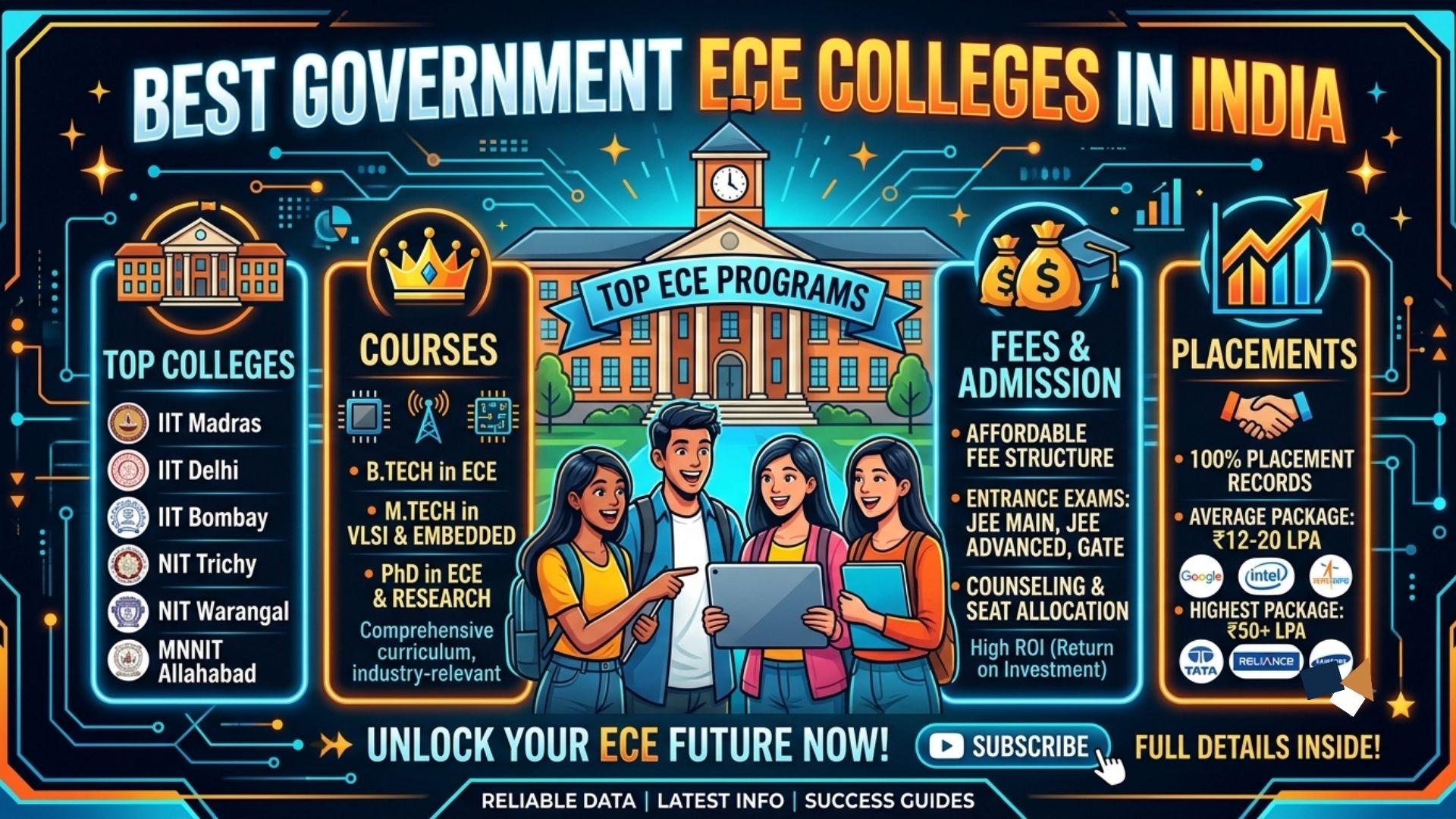
Electronics and Communication Engineering, commonly known as ECE, is one of the most popular engineering branches in India. The field covers electronics, communication systems, semiconductor technology, embedded systems, VLSI, signal processing, wireless communication and several areas of modern technology.
Government engineering colleges are among the most preferred choices for students looking for quality technical education at comparatively affordable costs. India’s government-funded institutions include IITs, NITs, centrally funded technical institutes, state universities and government engineering colleges offering ECE or closely related electronics programmes.
For students searching for the best government ECE colleges in India, factors such as academic reputation, curriculum, faculty, laboratories, placements, fees, entrance requirements and career opportunities should all be considered.
This guide covers some of the prominent government institutions for ECE and related electronics programmes, along with their admission process, fees, placements, career scope and important factors to consider before choosing a college.
Note: Programme names, fees, eligibility requirements and admission rules can change. Students should check the official college website and current admission brochure before applying.
The following are prominent government or government-funded institutions where students can pursue ECE or closely related electronics and communication programmes.
Indian Institute of Technology Roorkee is one of India’s leading public technical institutions and offers a dedicated B.Tech Electronics and Communication Engineering programme.
The programme provides exposure to electronics, communication systems, signal processing, digital systems and related technologies.
Students can develop foundations in areas such as:
Electronic circuits
Digital electronics
Communication systems
Signal processing
Microprocessors
Embedded systems
VLSI
Wireless communication
IIT Roorkee can also provide opportunities for students interested in research and higher education in electronics and related engineering disciplines.
In the official NIRF 2025 Engineering ranking, IIT Roorkee was placed at rank 6. NIRF rankings are institute-level rankings and should not be interpreted as branch-specific ECE rankings.
Admission to IIT Roorkee’s undergraduate engineering programmes is through JEE Advanced, followed by the JoSAA counselling process.
Students need to qualify for JEE Advanced and meet the applicable eligibility requirements for the academic year.
National Institute of Technology Karnataka, Surathkal, is a prominent government-funded technical institution in Karnataka.
The institute has a strong electronics and communication engineering ecosystem and is a popular choice among students interested in electronics, communication, embedded systems and related areas.
Students considering NIT Surathkal should check the current JoSAA programme list for the exact undergraduate programme name and admission details for the relevant year.
The institute was ranked 17th in Engineering in NIRF 2025.
Admission to NIT Surathkal’s undergraduate engineering programmes is primarily through JEE Main and JoSAA counselling.
Students can also participate in CSAB counselling for seats that remain available after the regular JoSAA rounds, subject to the applicable rules.
ECE graduates can explore careers in:
Semiconductor engineering
VLSI
Embedded systems
Telecommunications
Electronics
Software development
Research and development
National Institute of Technology Rourkela is a government-funded Institute of National Importance located in Odisha.
NIT Rourkela offers a four-year B.Tech in Electronics and Communication Engineering through its Department of Electronics and Communication Engineering. The programme is admitted through JEE Main.
The department covers areas including:
Electronics
Communication engineering
Signal processing
VLSI
Embedded systems
RF and microwave systems
Wireless communication
The department also offers postgraduate programmes in areas such as VLSI Design and Embedded Systems, Communication and Networks, Signal and Image Processing and RF and Microwave Systems.
This makes NIT Rourkela an option for students who want to continue into specialised electronics education after completing a B.Tech.
NIT Rourkela was ranked 13th in Engineering in NIRF 2025.
National Institute of Technology Warangal is one of India’s established NITs and is a government-funded Institute of National Importance.
The institute has a dedicated Department of Electronics and Communication Engineering, with academic and research activities covering several areas of modern electronics.
Research and academic areas include technologies related to:
Wireless communication
Antenna engineering
Signal processing
VLSI
Embedded systems
Electronic systems
Communication networks
The department also participates in research projects involving technologies such as antennas, sensors, wireless systems and artificial intelligence applications.
Students seeking undergraduate admission to NIT Warangal generally enter through JEE Main followed by JoSAA or applicable CSAB counselling.
NIT Warangal was ranked 28th in Engineering in NIRF 2025.
National Institute of Technology Calicut is another prominent government-funded engineering institution offering Electronics and Communication Engineering.
The Department of Electronics and Communication Engineering has offered its undergraduate ECE programme for several decades. The department also offers postgraduate programmes and conducts research in areas such as wireless communication, signal processing, VLSI and semiconductor technologies.
Students can explore areas including:
Analog electronics
Digital electronics
Communication engineering
Signal processing
Microelectronics
VLSI
Wireless communication
Semiconductor devices
The department’s research areas also include machine learning, biomedical signal processing, wireless networks, analog and mixed-signal IC design and semiconductor device modelling.
NIT Calicut was ranked 21st in Engineering in NIRF 2025.
National Institute of Technology Delhi is a centrally funded technical institution under the Ministry of Education.
The institute offers a dedicated B.Tech Electronics and Communication Engineering programme through its Department of Electronics and Communication Engineering.
NIT Delhi also offers a B.Tech programme in VLSI Design and Technology, providing another option for students specifically interested in microelectronics and chip design.
The ECE department focuses on areas including:
Electronics
Communication systems
Embedded systems
VLSI
Signal processing
Wireless technologies
Electronic system design
NIT Delhi’s undergraduate admissions take place through JEE Main and the JoSAA and CSAB processes.
The institute was ranked 65th in Engineering in NIRF 2025.
Motilal Nehru National Institute of Technology Allahabad, located in Prayagraj, is a government-funded technical institution and an Institute of National Importance.
The institute is a recognised option for students looking for engineering education in northern India.
Its electronics-related academic environment provides opportunities in areas such as:
Communication systems
Electronics
Embedded systems
VLSI
Signal processing
Digital systems
Admission to its undergraduate programmes is through JEE Main and the JoSAA counselling process.
MNNIT Allahabad was ranked 62nd in Engineering in NIRF 2025.
Students should check the latest programme list before applying because programme names and seat structures may change between admission cycles.
Malaviya National Institute of Technology Jaipur is another centrally funded technical institution in India.
The institute offers engineering education across multiple disciplines and provides opportunities for students interested in electronics and communication technologies.
ECE students can build knowledge in areas such as:
Digital electronics
Communication systems
Signal processing
Embedded systems
Microprocessors
VLSI
Wireless communication
Admission to undergraduate engineering programmes is conducted through JEE Main and JoSAA counselling.
Students interested in MNIT Jaipur should check the latest JoSAA programme information for the exact ECE programme, intake and eligibility requirements.
National Institute of Technology Durgapur is a government-funded Institute of National Importance in West Bengal.
The institute has a dedicated Department of Electronics and Communication Engineering that offers a four-year B.Tech programme in ECE.
The department has research and laboratory activities in areas such as:
VLSI
Electronic devices
Wireless communication
Microwave engineering
Antennas
Signal processing
Electronic systems
5G technologies
Its undergraduate curriculum includes subjects such as networks and transmission lines, electronic devices and circuits and other core electronics topics.
NIT Durgapur was ranked 49th in Engineering in NIRF 2025.
Delhi Technological University, commonly known as DTU, is a public technical university in Delhi.
Its Department of Electronics and Communication Engineering offers a B.Tech in ECE. According to the university’s annual report, the department also offers postgraduate programmes in areas including VLSI Design and Embedded Systems, Signal Processing and Digital Design, and Microwave and Optical Communication.
The ECE programme provides students with exposure to:
Electronics design
Communication technology
VLSI
Embedded systems
Signal processing
Wireless communication
DTU was ranked 30th in Engineering in NIRF 2025.
Admission to DTU’s B.Tech programmes is generally based on JEE Main followed by the applicable counselling process.
Students should check the latest DTU admission notification for eligibility, Delhi region criteria, seat allocation and other requirements.
Jadavpur University is a public state university in Kolkata, West Bengal, with a long-established engineering tradition.
Its Faculty of Engineering and Technology includes electronics and communication-related academic programmes.
Jadavpur University is also notable in national engineering rankings. It was ranked 18th in Engineering in NIRF 2025.
Students considering the university should check the current undergraduate programme structure and admission rules because the nomenclature of electronics-related programmes may differ from the simple term “ECE.”
The university can be relevant for students searching for public engineering education with comparatively competitive costs.
Jamia Millia Islamia is a central university located in New Delhi.
The university has engineering and technology programmes and is another public institution that students in Delhi and other parts of India may consider.
Jamia Millia Islamia was ranked 24th in Engineering in NIRF 2025.
Students interested in electronics and communication-related programmes should check the current undergraduate programme list, eligibility requirements and admission notification before applying.
Admission depends on the type of institution.
JEE Main is the primary entrance examination for undergraduate engineering admission to NITs and several other centrally funded technical institutions.
Students seeking admission to NITs generally participate in JoSAA counselling after qualifying through the relevant JEE Main process.
IIT undergraduate engineering admissions require qualification through JEE Advanced.
Students first need to meet the applicable JEE Main eligibility requirements before appearing for JEE Advanced.
After qualifying, candidates participate in JoSAA counselling for seat allocation.
Some government engineering colleges and state universities use state-level entrance examinations, counselling systems or Class 12 based admission criteria.
The exact process depends on the institution and state.
One of the major reasons students consider government engineering colleges is the comparatively lower cost of education at many institutions.
However, fees vary significantly.
Students should consider:
Tuition fees
Hostel fees
Mess charges
Examination fees
Registration charges
Student activity fees
Other institutional charges
IITs, NITs and other government institutions may have different fee structures and exemption or remission policies.
Students belonging to eligible categories may receive tuition fee remission or other financial support according to current government and institute rules.
Before admission, always check the latest official fee structure rather than relying on figures from older articles.
Placements are an important consideration when choosing an ECE college.
However, students should look beyond the highest package advertised by an institution.
When comparing government ECE colleges, check:
ECE-specific placement statistics
Median salary
Average salary
Number of students placed
Core electronics recruiters
Software recruiters
Internship opportunities
Research opportunities
Higher education outcomes
Placement figures can vary from year to year, so students should look at recent official placement reports whenever possible.
ECE graduates may receive opportunities in both core electronics and software companies.
Government ECE colleges can prepare students for a wide range of careers.
A strong college provides the foundation, but students should develop practical skills during their degree.
Programming – Learn C, C++, Python and other relevant programming technologies.
Digital Electronics – Develop strong knowledge of digital circuits, logic design and computer architecture.
Embedded Systems – Learn microcontrollers, sensors, communication protocols and embedded programming.
VLSI – Students interested in semiconductor careers can learn Verilog, SystemVerilog, FPGA development and digital design.
Communication Systems – Students interested in telecom and wireless technologies should strengthen their knowledge of signals, communication systems, antennas and RF concepts.
Projects – Build practical projects involving IoT, robotics, embedded systems, wireless communication or digital electronics.
There is no single factor that determines the right college for every student.
Consider the following points before making a decision.
Government and private engineering colleges offer different combinations of academic environment, fees, infrastructure and admission requirements.
Government institutions often have highly competitive entrance requirements and may provide lower tuition costs in many cases.
Private institutions may offer different specialisations, flexible programmes and varying infrastructure or industry partnerships.
Students should compare individual colleges rather than assuming that every government or private institution offers the same experience.
Government engineering colleges remain an important option for students looking for ECE education in India. Institutions such as IIT Roorkee, NIT Surathkal, NIT Rourkela, NIT Warangal, NIT Calicut, NIT Delhi, MNNIT Allahabad, MNIT Jaipur, NIT Durgapur, DTU and public universities such as Jadavpur University provide opportunities across electronics and related engineering disciplines.
When searching for the best government ECE colleges in India, students should not rely on rankings alone. NIRF rankings are institute-level indicators, not branch-specific ECE rankings. For example, the official NIRF 2025 Engineering ranking places IIT Roorkee at 6, NIT Rourkela at 13, NIT Calicut at 21, NIT Warangal at 28 and DTU at 30.
The final choice should also consider the exact degree programme, curriculum, faculty, laboratories, fees, admission process, placement data, location and the student’s long-term career goals.
For students interested in semiconductors, VLSI, embedded systems, telecommunications, electronics design or software, ECE can provide a flexible engineering foundation. Choosing the right government college and building practical skills during the degree can help students prepare for a wide range of technology careers.




