
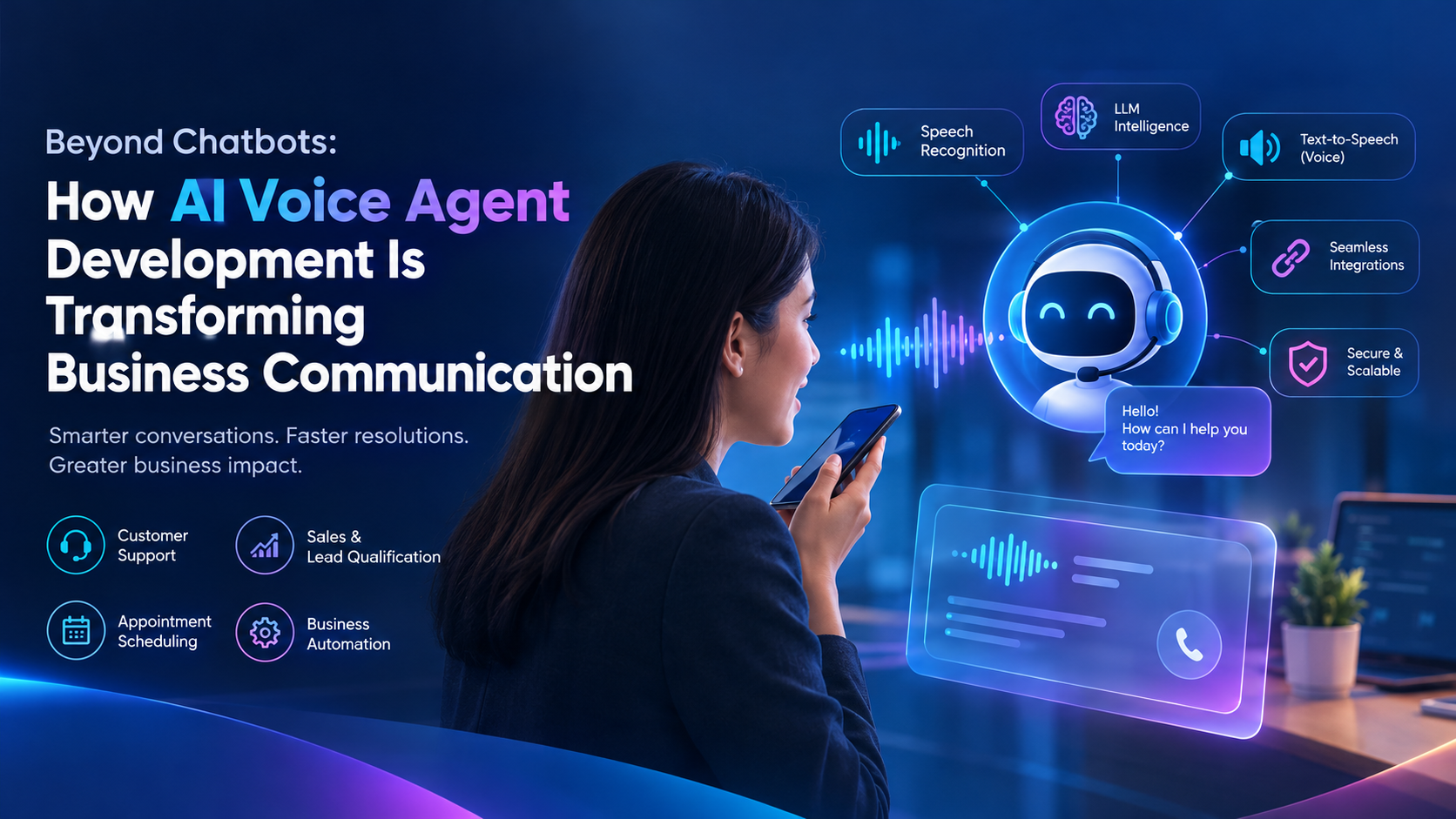

Business communication is evolving beyond text-based chatbots and traditional customer support systems. Customers expect faster responses, personalized interactions, and assistance whenever they need it. AI voice agents are helping businesses meet these expectations by enabling natural, real-time conversations that can understand requests, respond intelligently, and complete specific tasks.
Unlike basic automated phone systems, AI voice agents can understand spoken language, interpret customer intent, maintain conversational context, and connect with business applications to perform actions. From handling customer inquiries to scheduling appointments and qualifying sales leads, these systems are changing how organizations communicate with customers and employees.
For businesses looking to improve customer experience, reduce repetitive workloads, and scale communication operations, AI voice agent development services offer a practical opportunity to modernize existing workflows.
What Are AI Voice Agents and How Do They Work?
AI voice agents are intelligent software systems that communicate with users through spoken conversations. They combine speech recognition, language models, conversational logic, and text-to-speech technology to understand and respond to voice inputs.
A typical AI voice agent follows these steps:
- Speech recognition: Converts a customer’s spoken words into text.
- Intent understanding: Uses AI models to interpret the request and conversational context.
- Decision-making: Determines the appropriate response or action based on business rules and available information.
- System integration: Connects with CRM platforms, booking systems, databases, or other business applications.
- Voice response: Delivers a spoken answer using text-to-speech technology.
For example, an AI voice agent for an insurance company could answer policy questions, collect information for a claim, and route complex cases to a human representative. This creates a more efficient communication experience without requiring every interaction to involve a live employee.
Why Businesses Are Moving Beyond Traditional Chatbots
Traditional chatbots remain useful for answering frequently asked questions, guiding website visitors, and supporting simple customer interactions. However, text-based conversations are not always the most convenient option.
Customers may prefer speaking rather than typing, especially when they are driving, multitasking, or seeking immediate assistance over the phone.
This is where AI voice agents provide additional value.
- More natural customer interactions
Voice agents allow customers to explain their needs conversationally instead of navigating complex menus or typing multiple messages. Modern systems can use conversational context to deliver more relevant responses.
- Faster response times
AI voice agents can handle multiple routine inquiries simultaneously, reducing waiting times during busy periods. They can also collect relevant information before transferring a conversation to a human representative.
- Scalable customer support
As a business grows, customer communication volumes often increase. AI voice agents help organizations manage recurring questions and routine workflows without expanding support teams at the same rate.
- Better employee productivity
By automating repetitive calls, appointment reminders, and initial inquiries, voice agents allow employees to focus on complex customer issues, relationship building, and revenue-generating activities.
These benefits make voice automation particularly valuable for businesses that manage high call volumes or need consistent customer communication across multiple channels.
Key Business Use Cases of AI Voice Agent Development
AI voice agents can support a wide range of business functions. Their value depends on how well the solution aligns with a company’s communication needs and operational workflows.
1. Customer Support and Service Automation
Businesses can use AI voice agents to answer common questions, provide order updates, explain service options, and assist with basic troubleshooting. When an issue requires human judgment, the agent can transfer the conversation with relevant context.
This approach helps customer support teams manage routine inquiries while preserving human assistance for more sensitive or complicated situations.
2. Sales and Lead Qualification
Sales teams can use voice agents to contact inbound leads, ask qualifying questions, schedule sales meetings, and update CRM records.
For example, a software company could deploy an AI voice agent to understand a prospect’s business requirements, company size, and preferred meeting time before assigning the lead to the appropriate sales representative.
3. Appointment Scheduling and Reminders
Healthcare providers, service businesses, and consulting firms can automate appointment confirmations, rescheduling requests, and reminders. Integration with calendar or booking systems allows agents to check availability and complete supported scheduling tasks.
Businesses should apply appropriate consent, privacy, and industry-specific safeguards when handling sensitive customer information.
4. E-Commerce and Order Assistance
Online retailers can use AI voice agents to answer questions about shipping, product availability, returns, and order status. When connected to inventory and order management systems, these agents can provide information relevant to a customer’s actual transaction.
5. Internal Business Communication
Voice agents can also support employees by retrieving approved internal information, answering policy questions, and assisting with routine IT service requests. With suitable access controls, they can become a conversational interface for enterprise knowledge and workflows.
AI Voice Agents vs. AI Chatbots: What’s the Difference?
AI voice agents and chatbots both automate conversations, but they serve different interaction preferences and business requirements.
|
Feature |
AI Chatbots |
AI Voice Agents |
|
Primary interface |
Text-based conversation |
Spoken conversation |
|
User interaction |
Typing and clicking |
Speaking and listening |
|
Best suited for |
Website support and text-based assistance |
Phone support and hands-free interactions |
|
Common integrations |
Websites, apps, CRM systems |
Telephony, CRM, scheduling, and business systems |
|
Key consideration |
Clear written responses |
Speech accuracy, latency, and conversational flow |
Many organizations benefit from combining both approaches. AI chatbot development services can support website and messaging channels, while voice agents handle phone calls and spoken interactions. A unified conversational AI strategy allows customers to choose the channel that works best for them.
Essential Technologies Behind AI Voice Agent Development
Building an effective voice agent requires more than connecting speech recognition to a language model. Businesses need an architecture that supports accurate conversations, reliable actions, and secure data handling.
Key technologies include:
- Automatic speech recognition (ASR): Converts spoken input into text.
- Large language models (LLMs): Interpret requests, generate responses, and support conversational reasoning.
- Text-to-speech (TTS): Produces natural-sounding spoken responses.
- Agent orchestration: Coordinates conversation state, tool usage, business rules, and task execution.
- APIs and enterprise integrations: Connect the agent with CRM, ERP, booking, and support platforms.
- Monitoring and security: Help track performance, protect information, and identify failures.
Successful custom AI agent development also requires safeguards against incorrect responses, unauthorized actions, and inappropriate access to business data. Human handoff, audit logs, permission controls, and evaluation of real-world conversations should be part of the implementation plan.
How to Implement AI Voice Agents in Your Business
A structured implementation process helps businesses reduce development risks and focus on measurable outcomes.
Step 1: Identify the right use case. Start with a recurring communication task, such as appointment scheduling or answering order-status questions.
Step 2: Define business goals. Establish measurable targets, including reduced average handling time, improved response rates, shorter waiting times, or increased appointment completion.
Step 3: Select the technology stack. Choose speech recognition, language models, voice synthesis, telephony infrastructure, and integration tools based on your requirements.
Step 4: Integrate business systems. Connect the agent to approved data sources and applications, with appropriate authentication and access permissions.
Step 5: Test real-world conversations. Evaluate accents, background noise, interruptions, ambiguous requests, response latency, and failure scenarios before deployment.
Step 6: Monitor and improve. Review conversation quality, task completion, customer feedback, escalation rates, and operating costs to improve performance over time.
Partnering with an experienced AI voice agent development company can help organizations select the right architecture, integrate existing systems, and build a solution that supports long-term business goals.
Challenges Businesses Should Consider
Although voice agents offer significant opportunities, implementation requires careful planning.
Speech recognition may struggle with background noise, regional accents, or industry-specific terminology. Language models can generate inaccurate responses, while poorly designed integrations may fail to complete customer requests.
Businesses should also evaluate response latency, data retention, consent requirements, security controls, and applicable privacy regulations. High-risk or sensitive interactions should include clear escalation paths to trained human employees.
Starting with a limited use case, testing performance, and expanding gradually is often more effective than automating every communication workflow at once.
How Albiorix Technology Can Help Build AI Voice Agents
Businesses that want to modernize customer communication need solutions designed around their workflows, technology infrastructure, and customer expectations.
Albiorix Technology can support organizations exploring conversational AI, business automation, and intelligent application development. From identifying suitable use cases to integrating AI capabilities with existing systems, the focus should be on building secure, scalable solutions that deliver measurable business value.
Organizations looking to hire AI Developers can prioritize expertise in conversational AI, LLM integration, speech technologies, API development, and enterprise software integration to build voice agents that go beyond answering questions and help complete real business tasks.
Ready to transform your business communication with AI voice agents? Explore how custom AI development can help automate routine interactions, improve customer experiences, and support business growth.
Frequently Asked Questions
1. What is AI voice agent development?
AI voice agent development is the process of building software that understands spoken language, responds conversationally, and performs tasks through integrations with business systems.
2. How can AI voice agents benefit businesses?
They can reduce repetitive workloads, improve response times, support round-the-clock service, automate routine calls, and help employees focus on complex customer needs.
3. What is the difference between AI voice agents and traditional chatbots?
Traditional chatbots primarily communicate through text, while AI voice agents use spoken conversations. Both can use AI models and business integrations to provide automated assistance.
4. Can AI voice agents integrate with CRM and ERP systems?
Yes. With appropriate APIs, authentication, and permissions, voice agents can retrieve approved information and perform supported actions in CRM, ERP, scheduling, and customer support systems.
5. How long does it take to develop an AI voice agent?
The timeline depends on conversation complexity, integrations, security requirements, and testing needs. A focused prototype may take weeks, while a production-ready enterprise solution can require several months.
6. How do I choose an AI voice agent development company?
Evaluate its conversational AI expertise, integration capabilities, security practices, testing process, scalability, and ability to demonstrate measurable business outcomes.
7. Can businesses use AI voice agents alongside AI chatbots?
Yes. Combining AI voice agent development services with AI chatbot development services helps businesses provide consistent support across phone calls, websites, and messaging channels.



