
Across Indian cities, homes are getting smaller while expectations are getting bigger. A two-bedroom flat in a busy metro might need to serve as a family home, a work-from-home office, a guest room and an entertainment space, all within a modest footprint. In that situation, every piece of furniture has to earn its place.
The good news is that a small space does not have to feel cramped or characterless. With the right proportions, materials and layout, compact homes can feel warm, personal and surprisingly spacious. This guide explains how to choose and place furniture in a small apartment, and why well-made timber and resin pieces are a smart fit. If you are browsing Solid wood furniture online for a compact home, start with the principles below.
Principle 1: Fewer Pieces, Better Quality
In a small home, clutter is the enemy. Instead of filling every corner, choose fewer, better pieces that you will use daily.
- One well-built dining table beats a table plus extra side tables you rarely use.
- A single, sturdy console can serve as storage, display and entry drop zone.
- A good bed with storage reduces the need for bulky wardrobes.
Solid timber suits this approach, since it is durable enough to handle daily use without needing replacement every few years.
Principle 2: Measure Like a Designer
Small spaces leave little room for error. A few centimetres can decide whether a table feels comfortable or obstructive.
- Measure the room and mark the furniture footprint on the floor with masking tape.
- Leave walking paths of at least 75 to 90 cm in main routes.
- Check door swings and drawer openings so nothing collides.
- Measure entry routes, including lifts, staircases and doorways, before ordering large items.
- Consider vertical space for tall units and wall-mounted storage.
Principle 3: Choose the Right Shape
Shape changes how a room feels.
- Round and oval tables have no sharp corners, so people can move around them more easily and sit closer together.
- Slim rectangular tables fit along walls and in narrow dining spaces.
- Rounded edges on coffee tables and consoles reduce bumps in tight layouts.
- Slightly raised legs let light and floor show underneath, so the piece looks lighter.
For dining, a round solid wood table for four, or a compact rectangular table around 120 to 150 cm long, often suits a small flat well. Confirm the final size with your maker based on your room.
Principle 4: Let One Hero Piece Do the Talking
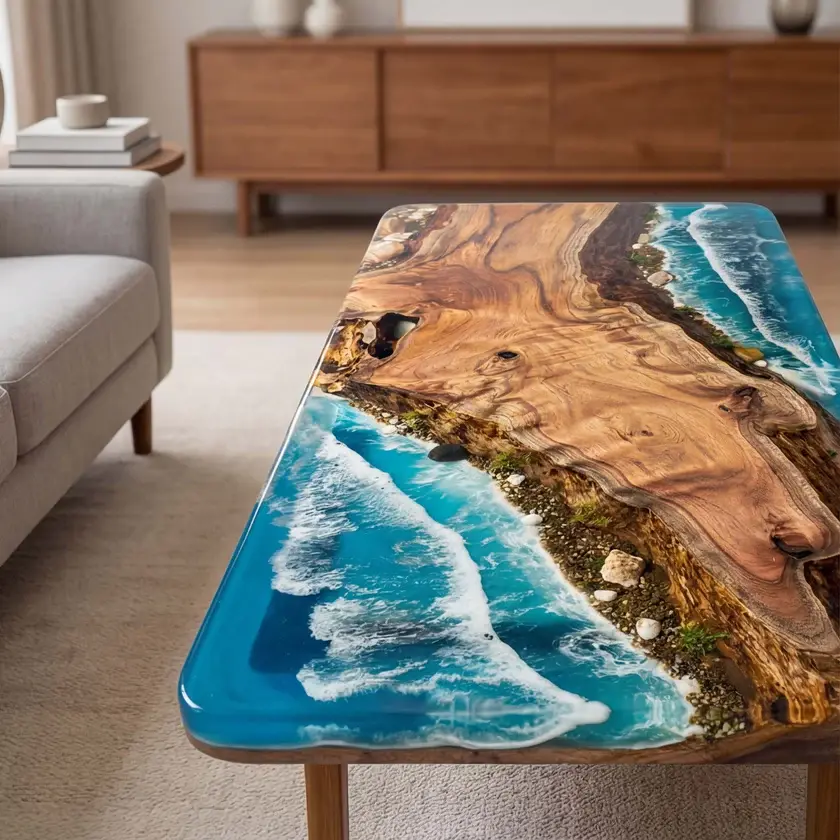
A small room can carry a bold element if it is the only one. Instead of decorating every surface, pick one statement piece, such as a resin-and-timber coffee table or a river dining table, and keep everything else calm.
Resin adds depth and visual interest without needing extra decor. A clear or lightly tinted channel, for instance, gives the table a lively surface while keeping the room feeling open. Deep, dark colours can look dramatic but may feel heavy in very small rooms, so consider your lighting and wall colours.
When you explore Epoxy Furniture online, ask for photos of similar pieces in real homes so you can judge scale and colour more accurately.
Principle 5: Choose Multi-Use Furniture
Compact homes benefit from pieces that do more than one job.
- Dining table as workstation. A sturdy table with a smooth, durable finish can serve meals by evening and laptops by day.
- Console as multi-tasker. A slim console can function as an entry table, bar counter, display shelf or study desk.
- Bench with storage. Use it for seating at the dining table, as an entryway perch or at the foot of the bed.
- Nesting tables. Two small tables that tuck together offer flexible surfaces.
Principle 6: Keep the Palette Cohesive
A calm, consistent colour story makes a small space feel larger.
- Stick to two or three wood tones across the room.
- Choose lighter timber such as mango wood or ash for very compact rooms, and richer tones for spaces with ample light.
- Echo the resin colour in a cushion, rug or artwork to tie things together.
- Avoid mixing too many finishes, since variety can quickly look busy.
Principle 7: Use Light to Your Advantage
Light makes timber and resin look their best and helps a small room feel open.
- Place furniture so it does not block windows.
- Use warm white lighting to bring out the grain and resin depth.
- Add a pendant or wall light above the dining table or console.
- Use mirrors opposite windows to bounce light around.
Room-by-Room Ideas for Compact Homes
Living room: A compact sofa, a resin-top coffee table with rounded edges, and a slim console along the wall. Keep the floor space around them clear.
Dining area: A round or slim rectangular solid wood table with a bench on one side and chairs on the other, so it tucks neatly against a wall when not in use.
Bedroom: A solid wood bed with storage underneath, slim bedside tables and one bench or small dresser. Avoid oversized headboards.
Workspace: A compact solid wood desk in a corner, a good task light and a simple shelf above. Keep cables tidy.
Entryway: A narrow console and a mirror, perhaps with a small tray for keys. It sets the tone without taking space.
Working with a Maker for Compact Spaces
One of the biggest advantages of ordering from a workshop is that furniture can be built to your exact dimensions, rather than forcing your room to fit standard sizes. A skilled Epoxy Furniture Manufacturer can often adjust length, width, thickness, leg style and edge profile for compact layouts. Share your room measurements and photos, and ask for recommendations.
Questions to ask:
- Can the table be made to my exact measurements?
- What timber and finish do you recommend for a small, bright room?
- How thick will the top be, and how will that affect visual weight?
- How will the piece be packed and delivered to my building?
- What support do you offer for repairs and re-polishing?
Buying Online for a Small Home
Online furniture shopping is well suited to compact homes because you can compare sizes, request custom dimensions and take your time with layout decisions. To avoid mistakes:
- Share a rough sketch or photo of the room with the seller.
- Confirm exact dimensions, including thickness and height.
- Check lift and staircase access in writing, especially for larger tops.
- Ask for real photos of finished work, not only design renders.
- Get timber, resin, finish, price and delivery timeline confirmed in writing.
If you decide to Buy furniture online, inspect the piece carefully on arrival and report any concern quickly, with photos.
Common Mistakes in Small Spaces
- Choosing oversized pieces that dominate the room.
- Ignoring walking space, which makes the room feel tight and awkward.
- Buying too many small items that create visual clutter.
- Mixing too many woods and colours in one room.
- Forgetting access routes and discovering the piece will not fit through the door.
Care Tips for Everyday Use
Compact homes see heavy daily use, so simple care matters.
- Use coasters, mats and trivets.
- Wipe spills promptly with a soft, slightly damp cloth and dry the surface.
- Avoid abrasive cleaners and harsh chemicals.
- Keep pieces away from direct heat and prolonged strong sunlight.
- Dust regularly, especially in dry or dusty seasons.
- Follow your maker’s advice on re-oiling or re-polishing.
Final Thoughts
A small home is not a limitation; it is an invitation to be thoughtful. Choose fewer pieces, measure carefully, select shapes and colours that keep the room open, and let one beautifully made solid wood or resin piece carry the character. With the right maker and a clear plan, even a compact apartment can feel warm, generous and entirely your own.