Physical Address
304 North Cardinal St.
Dorchester Center, MA 02124
Physical Address
304 North Cardinal St.
Dorchester Center, MA 02124

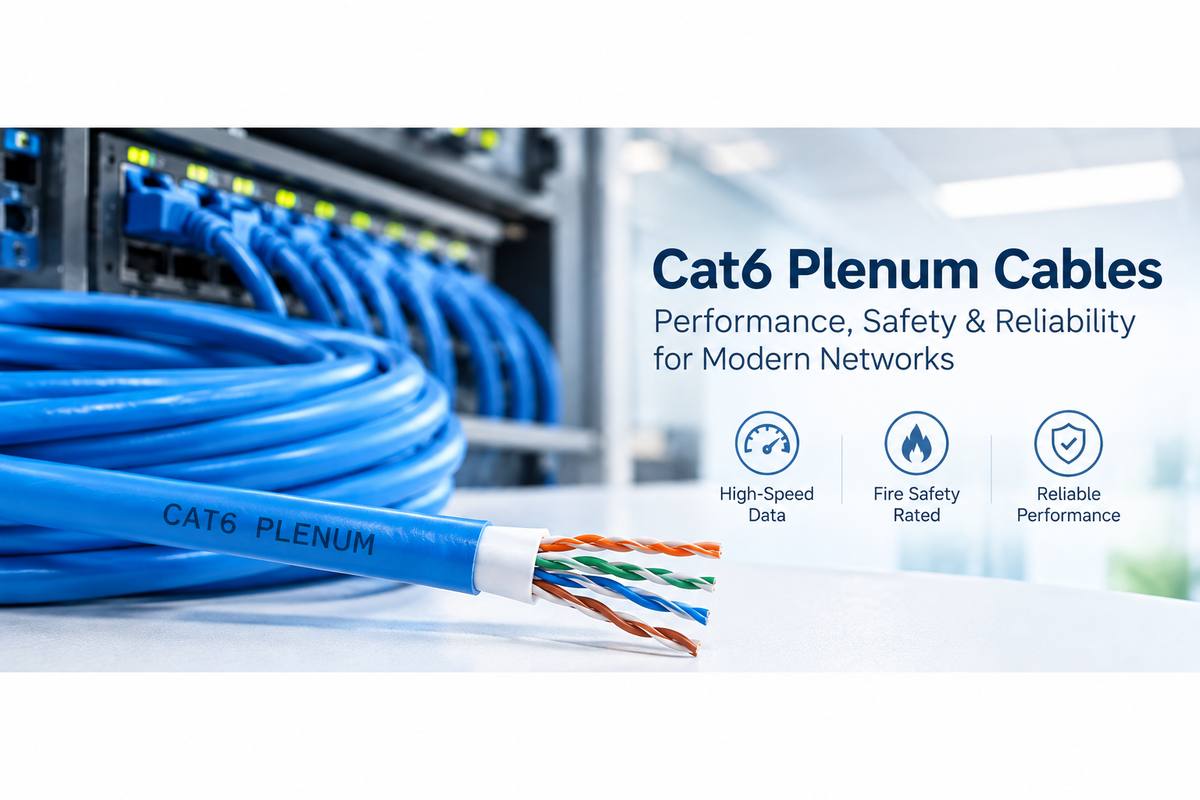
A network is only as dependable as the cabling underneath it. Switches, routers, and access points get most of the attention, but every one of them relies on cable that has to deliver a clean signal, fit the building, and keep working for years.
Choosing that cable involves more than picking a category number. Performance, installation suitability, and long-term reliability all depend on how the cable is built and where it will run. Cat6 Plenum Cables are a common choice for installations that need solid Ethernet performance in spaces with specific fire and smoke requirements.
This guide explains what to look for, from conductor quality and shielding to certifications and installation practices, so you can make an informed decision before you buy.
Cat6 is a category of twisted-pair Ethernet cable. It supports Gigabit Ethernet and, over shorter distances, 10 Gigabit Ethernet. Inside the jacket, four pairs of copper wires are twisted together to help limit interference, and many designs add a separator that keeps the pairs apart.
“Plenum-rated” refers to the outer jacket and insulation, not the data capability. A plenum-rated Ethernet cable is made from materials tested to limit flame spread and smoke production. In the United States, this is generally linked to the CMP rating under the National Electrical Code (NEC).
You’ll typically find Cat6 Plenum Cables above drop ceilings, under raised floors, and in other air-handling spaces within commercial buildings. They can also be used in general areas, so some installers choose them for mixed routes that pass through several types of space.
A plenum is a part of a building that carries air as part of the heating, ventilation, and air conditioning (HVAC) system. The space above a suspended ceiling is a familiar example when it is used for air return.
Air circulates through these spaces, so if a fire occurs, smoke and combustion byproducts can travel to other areas of the building. Building and fire codes therefore often require cables in plenum spaces to meet stricter flame and smoke tests.
The jacket is where the plenum rating comes from. Plenum jackets use low-smoke, flame-retardant compounds, commonly FEP or similar materials, and they are tested against recognized standards. Requirements differ by region and project, so confirm what applies locally. Your installer or the authority having jurisdiction (AHJ) can tell you.
Cat6 supports Gigabit speeds across full channel lengths and 10GBASE-T over shorter distances, generally up to about 55 meters depending on conditions. Check the distance limits against your plans if you expect to use 10 Gigabit.
Cat6 is specified up to 250 MHz, compared with 100 MHz for Cat5e. That extra headroom helps the cable carry higher-frequency signals with less degradation, which matters for busy networks.
Conductors affect both performance and longevity. Look for solid bare copper for permanent, in-wall runs. Be careful with copper-clad aluminum (CCA), which has higher resistance and is not the same as pure copper. Wire gauge (commonly 23 AWG for Cat6) also influences how the cable handles heat and distance.
Twisted pairs cancel out much of the electrical noise they pick up. Tighter twist rates and an internal separator further reduce crosstalk between pairs. In a bundle of many cables, that design helps keep signals stable.
Beyond the fire and smoke characteristics, a well-made jacket protects the conductors during installation and while in service. Plenum jackets tend to be a little stiffer than standard PVC, so plan for that when routing.
Consistency matters as much as peak speed. A cable that meets its published specifications and tests well after installation is more likely to give you stable, predictable results.
When installed within their specifications, Cat6 Plenum Cables can offer:
Consistent network connectivity: Quality construction and proper termination help maintain stable links.
Support for demanding applications: Video conferencing, cloud services, VoIP, IP cameras, and large file transfers are all well within Cat6 capability.
Fewer signal-related issues: Twist design and pair separation help reduce crosstalk and noise.
Reliable data transmission: Staying within length limits and following installation standards helps the cable perform as intended.
Suitability for modern infrastructure: Cat6 is a widely used standard that works with current switches, access points, and devices.
It’s worth remembering that real-world speeds depend on the whole system, including connected equipment, cable length, and installation quality. A cable cannot exceed its rated specifications.
| Environment | Why plenum-rated Cat6 may be suitable |
|---|---|
| Office buildings | Suspended ceilings often serve as air return spaces, so code may call for plenum-rated cable above them. |
| Commercial facilities | Retail, hospitality, and mixed-use properties often have shared air-handling systems and varied cable routes. |
| Schools and universities | Large numbers of occupants and growing device counts make dependable, code-compliant cabling important. |
| Healthcare environments | Reliable connectivity supports clinical and administrative systems, and safety standards are rigorous. |
| Data centers | Dense cabling and strict safety practices make low-smoke jackets and stable Cat6 performance a common pairing. |
| Buildings with plenum air-handling spaces | Wherever cabling passes through these spaces, plenum-rated cable is typically what codes require. |
Neither type is better in every situation. The right choice depends on the installation environment and the rules that apply to it.
| Factor | Cat6 Plenum (CMP) | Standard Cat6 (PVC, CM/CMR) |
|---|---|---|
| Jacket construction | Low-smoke, flame-retardant compounds such as FEP | Polyvinyl chloride (PVC) |
| Installation environments | Plenum spaces and, generally, other areas as well | Non-plenum areas such as walls and risers (if riser-rated) |
| Fire and smoke characteristics | Designed to meet stricter flame-spread and smoke tests | Meets general-purpose or riser requirements; typically produces more smoke |
| Performance | Same Cat6 data performance when built to the same specifications | Same Cat6 data performance when built to the same specifications |
| Cost | Usually higher | Usually lower |
| Handling | Often somewhat stiffer | Often more flexible |
Use plenum-rated cable when the run passes through a plenum space or when local code or building policy requires it.
Consider standard Cat6 for non-plenum runs where code allows it and budget or flexibility is a priority.
As a general rule, a higher-rated cable can substitute for a lower-rated one, but not the reverse. Verify with local requirements before deciding.
Before purchasing, check the following:
Cable specifications. Look for published details on category, bandwidth rating, gauge, and the CMP marking printed on the jacket.
Conductor material and construction. Solid bare copper is the usual choice for permanent horizontal runs. Stranded cable suits patch cords, not long in-wall installs.
Required cable length. Measure the actual route, not the straight line. A permanent link is limited to 90 meters, and 100 meters for the full channel including patch cords. Allow for some slack.
Shielded or unshielded design. Unshielded twisted pair (UTP) suits most standard environments. Shielded options (such as F/UTP or S/FTP) can help where interference is a concern, but they need proper grounding and compatible components to work as intended.
Certifications and standards. Look for third-party listing (such as UL or ETL) and compliance with TIA/EIA-568 category requirements. Be wary of vague or missing certification claims.
Manufacturer and product quality. Choose suppliers that provide clear documentation, consistent quality, and responsive support.
Compatibility with networking equipment. Make sure jacks, patch panels, and switches are rated for Cat6 or higher so the weakest component doesn’t limit the channel.
Follow applicable standards and local requirements. Installations should comply with the NEC, local fire codes, and TIA cabling standards. If you’re unsure, a qualified installer can help.
Avoid excessive bending, pulling, or crushing. Keep to the manufacturer’s minimum bend radius (commonly around four times the cable diameter), pull gently, and don’t over-tighten cable ties.
Maintain proper cable routing. Use supports, J-hooks, or trays rather than letting cables rest on ceiling tiles or pipes. Neat routing also makes future changes easier.
Keep cables separated from interference sources. Maintain distance from power cabling, fluorescent lighting, and motors, following code-required clearances.
Use compatible connectors and patch panels. Cat6-rated components help preserve the cable’s performance across the whole channel.
Terminate carefully. Keep the untwisted length of each pair as short as possible at the termination point.
Test the completed installation. A certification tester can check continuity, length, and performance, so problems get caught before the network goes live.
TS Cables is a networking cable provider focused on delivering dependable cable solutions for network infrastructure. Its range supports a variety of installation needs, from small office upgrades to larger commercial projects.
For buyers comparing Cat6 Plenum Cables, clear product information matters. Being able to review cable types, specifications, and intended uses makes it easier to match a product to a specific installation. TS Cables offers options that can be considered for different environments, whether you’re planning new network cabling or replacing existing runs.
You can explore the available products at TS Cables.
Reliable network installations start with informed cable choices. Cat6 Plenum Cables combine the performance of Cat6 Ethernet with a jacket designed for the fire and smoke requirements of plenum spaces, making them a practical option for many commercial and institutional buildings.
The features that matter most are conductor quality, bandwidth, interference control, a properly rated jacket, and compliance with relevant standards. Pair those with careful installation and testing, and you’re far more likely to end up with a network that performs consistently over time. As always, confirm local code requirements and match the cable to the building, the route, and the network’s needs.




