Physical Address
304 North Cardinal St.
Dorchester Center, MA 02124
Physical Address
304 North Cardinal St.
Dorchester Center, MA 02124

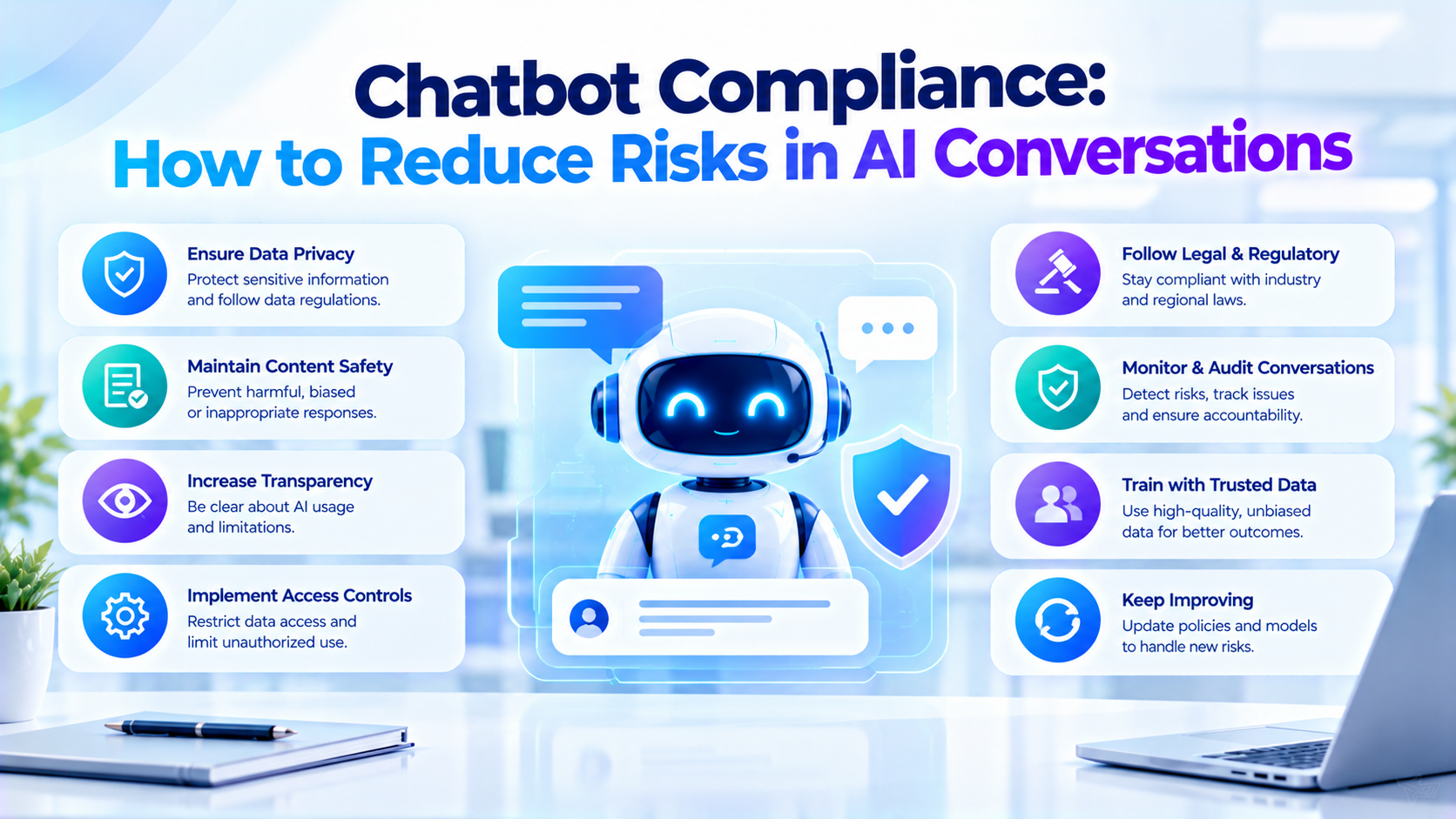
The AI chatbot has become an integral part of many business processes — including customer service, sales, healthcare, and finance. These tools can answer questions, make product recommendations, and automate routine tasks. However, as they handle more client interactions, privacy problems, response inaccuracies, security concerns, and regulatory obligations begin to surface.
This challenge can be addressed through chatbot compliance — a framework that gives organizations clear guidelines to manage AI-powered interactions in an efficient, lawful, and ethical way.
Chatbot compliance is the set of policies, controls, and practices that allow AI-powered conversations to align with applicable laws, industry regulations, and business standards. It covers several dimensions of chatbot behavior: data collection, response generation, handling user requests, and communication with customers.
Compliance standards vary across industries, types of information handled, and geographical locations. A financial services chatbot may require stronger measures around financial information and advice. An e-commerce chatbot might require more accountability regarding personal data and product claims.
A solid compliance framework provides structure to minimize legal risk, protect users, and build lasting trust.
Knowing what risks to anticipate is the first step toward building a compliant chatbot. When organizations implement AI systems without proper controls, a variety of issues can arise from inadequate testing, unclear boundaries, or insufficient supervision.
Common risks include:
If not addressed, these risks can harm customer relationships and carry regulatory or reputational consequences. Organizations offering AI chatbot services should treat compliance as a foundational requirement, not an afterthought.
Privacy needs to be integral to the chatbot design process — not an add-on applied later. Businesses must be conscious of what information their chatbots collect, why it is necessary, and how long it will be retained.
The more personal information gathered, the greater the exposure and the harder compliance becomes. Data should be collected only when it serves a clear organizational purpose, and access controls must be enforced.
Practical measures include:
Businesses may also be subject to local privacy laws such as the General Data Protection Regulation (GDPR). Working with experienced AI development services providers ensures these privacy controls are built into the system architecture from the start.
AI chatbots can sometimes generate wrong or inappropriate responses. They may miss the point of a question, fabricate details, or share information outside the intended scope of their role. These issues can be especially serious in financial, legal, medical, or other high-stakes contexts.
These risks can be mitigated by establishing clear guidelines for the chatbot’s interactions — defining what topics it can discuss and what falls outside its scope.
Effective protective measures include curated knowledge sources, response validation, topic restrictions, and escalation paths to human employees. Retrieval-augmented generation (RAG) can also be used to ground chatbot responses in approved documents rather than relying solely on training data.
These controls reduce inaccuracies but do not replace the need for regular testing and human review.
Organizations must determine which laws and standards apply to their chatbot use in order to remain compliant. Requirements may vary depending on geographic location, industry, intended use, and the risk level of the AI system.
The EU AI Act places transparency obligations on certain AI interactions and imposes additional requirements for high-risk use cases. GDPR may apply when chatbot responses involve personal data. Financial and healthcare sectors may face additional sector-specific rules, as may customer communication systems.
Organizations should maintain documentation of relevant policies, risk assessments, system changes, and testing results. Providers of artificial intelligence development services with compliance expertise can help interpret obligations and identify which controls are required for each deployment context.
Compliance is an ongoing process, not a one-time checklist. A well-built AI chatbot that performs accurately in initial tests may generate unexpected responses after software upgrades, knowledge base modifications, or shifts in user behavior.
Regular monitoring enables organizations to spot issues before they affect a large number of users. Teams should review conversations, investigate reported incidents, and test the chatbot against new security threats.
Monitoring efforts should focus on:
Monitoring practices should also respect privacy requirements and avoid collecting more user data than necessary. Teams working with AI app development services providers can build monitoring dashboards and alert systems that flag compliance issues in real time.
Automation must not eliminate human accountability. Organizations should have clearly defined procedures for situations where the chatbot cannot respond confidently, detects a sensitive issue, or receives a request that requires human judgment.
Human involvement can assist with complaints, conflicting operational demands, complex client requests, and critical decisions. A human agent can access the relevant context to resolve an issue without requiring the customer to repeat themselves.
Where the chatbot encounters requests it cannot handle appropriately, well-designed escalation paths prevent the conversation from continuing in a direction that could harm the user or expose the organization to risk.
Compliance is one of the most important factors for any organization using AI-enabled conversations sustainably and ethically. Core considerations include privacy controls, accurate responses, regulatory awareness, security testing, and human supervision.
All these factors can be built into the chatbot development and deployment process as a way to address potential risks and strengthen customer trust. Regular audits will provide ongoing assurance that AI conversations remain secure and aligned with evolving compliance requirements.




