Physical Address
304 North Cardinal St.
Dorchester Center, MA 02124
Physical Address
304 North Cardinal St.
Dorchester Center, MA 02124

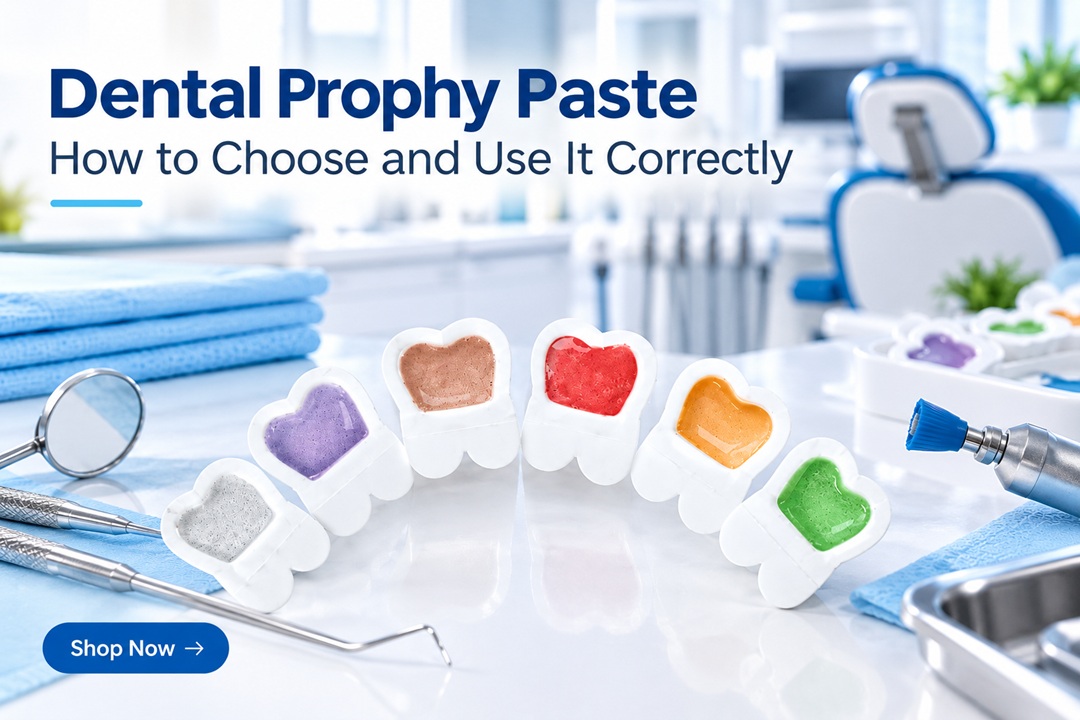
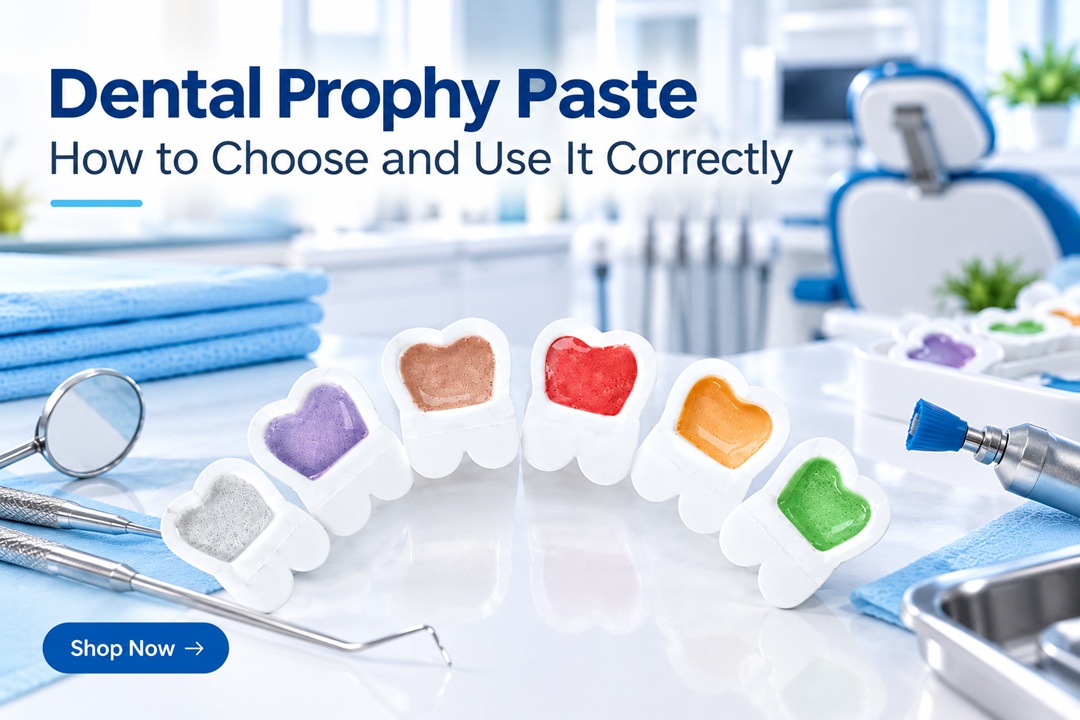
Polishing is the last step of most hygiene appointments, and the paste in the cup decides how well stain comes off, how comfortable the patient feels and how long the appointment runs. Choosing dental prophy paste well is less about habit and more about matching grit, format and flavour to the patient in the chair. This guide covers what prophy paste is, how it works, how to select the right option for UK practice and how to apply it properly. View the product range if you want to compare options as you read.
Dental prophy paste, also called prophylaxis paste, is a mildly abrasive polishing compound applied with a rubber cup or brush on a slow-speed handpiece after scaling. It removes extrinsic stain, residual plaque and biofilm, leaving enamel smooth so new deposits attach less readily. Most formulations combine an abrasive such as pumice or silica with a binder, humectant, flavouring and sometimes fluoride.
The abrasive particles do the work. Under light pressure and low speed, they shear stain and pellicle from the enamel without cutting into it. Grit size sets the balance: coarser particles remove heavy stain quickly but leave microscopic scratches, while fine particles remove less stain and produce a smoother, glossier finish. A thixotropic (non-drip) consistency keeps the paste in the cup rather than across the surgery.
Key Features and Benefits of a Well-Chosen Paste
It suits general practices, hygiene-led clinics, community dental services and teaching clinics alike.
Grit is the first decision. Coarse paste suits heavy extrinsic stain on sound enamel. Medium paste covers routine adult recalls. Fine paste is the safer choice for children, exposed dentine or cementum, orthodontic patients and anyone with composite or glass ionomer restorations that scratch easily. Where a manufacturer publishes a Relative Dentin Abrasivity (RDA) figure, a lower number means gentler polishing.
Current teaching favours selective polishing: polish where there is stain or biofilm rather than every surface at every visit. That protects enamel and shortens appointments.
Some pastes contain fluoride. It is not a substitute for topical fluoride varnish, but it helps replace ions disturbed during polishing. Check the pack designation rather than assuming. Flavour matters: a mint or fruit paste is easier for children and gag-prone patients to tolerate, and a range of six flavours lets you match the patient.
Single-use packs are the practical choice for UK practices working to HTM 01-05 decontamination guidance, because there is no shared tub to contaminate and no leftover paste to bin. Individual packs dispense exactly one patient’s worth, and a format that can be held without a finger ring gives a lighter setup.
Ready to compare grits and flavours? Explore the collection.
Air polishing has spread quickly through UK hygiene departments, but rubber cup polishing with paste still has a clear role.
|
Factor |
Prophy paste with rubber cup |
Air polishing |
|
Stain removal |
Strong on heavy extrinsic stain with coarse grit |
Fast on light to moderate stain, slower on heavy tobacco stain |
|
Equipment |
Slow-speed handpiece and disposable cups |
Dedicated unit, handpieces, nozzles and powder |
|
Aerosol |
Splatter only, easier to control |
Significant aerosol, needs high-volume suction |
|
Restorations |
Fine paste is gentle on composites |
Powder choice matters; sodium bicarbonate can mark some materials |
|
Patient comfort |
Familiar and quiet |
Some patients dislike the spray and salty taste |
|
Cost per patient |
Low, one single-dose pack |
Higher, powder plus consumable nozzles |
Many practices run both: air polishing for biofilm in periodontal patients, paste for stain and for surgeries without an air polisher.
|
Specification |
Detail |
|
Format |
Ready-to-use paste, no dilution required |
|
Packaging |
Individual single-dose packs, 50 per box |
|
Handling |
Can be used hand-held without a finger ring |
|
Flavours |
Ice-cream, Cinnamon, Blueberries, Cherry, Orange, Mint |
|
Intended use |
Routine professional polishing after scaling |
Pros: low cost per patient, minimal equipment, effective on stain, a technique every clinician already knows, and single-dose hygiene.
Cons: limited effect on subgingival biofilm, coarse grits can scratch restorations and exposed root surfaces, splatter still calls for eye protection and polishing every surface by habit wastes enamel and time.
Buy in single-dose packs unless throughput justifies tubs. Confirm the grit designation matches your patient mix and keep a fine paste in stock for paediatric and restorative cases. Compare dental prophy paste on cost per application rather than headline price; for a busy hygiene column a 50-piece box is a sensible unit to hold. If you also need cups, brushes or a slow-speed handpiece, the rapid product search page lists everything in one place, and you can register a practice account to save reorders. Request a quote if you are buying for several sites.
Tips
Mistakes to avoid
A hygienist sees a smoker with heavy lingual stain on the lower anteriors and two anterior composites. She scales, uses coarse paste on the stained lingual surfaces only, switches to fine paste for the composites and the remaining surfaces, rinses, then applies fluoride varnish. Two single-dose packs, one appointment, no scratched restorations.
Get the paste right and polishing becomes a quick, comfortable, predictable finish to every hygiene visit. Match grit to the patient, with coarse reserved for heavy stain on sound enamel and fine kept for children, restorations and exposed root surfaces. Polish selectively, at low speed, with light pressure and a moving cup. Prefer single-dose packs for cross-infection control and cost tracking, keep a choice of flavours on hand to improve patient acceptance, and treat air polishing as a partner to paste rather than a replacement. For ready-to-use dental prophy paste in 50-piece single-dose packs and six flavours, shop now at VSDent.