Physical Address
304 North Cardinal St.
Dorchester Center, MA 02124
Physical Address
304 North Cardinal St.
Dorchester Center, MA 02124

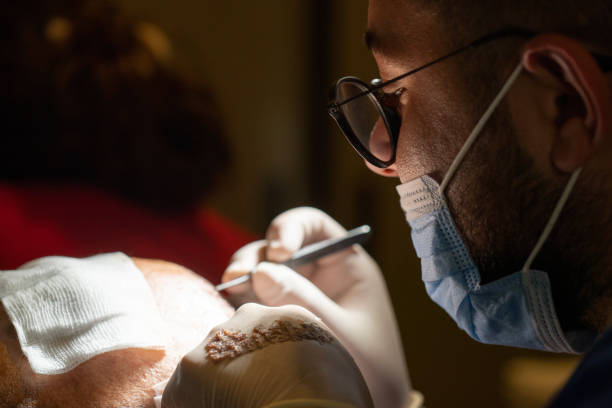
Temple recession can make a person’s hairline look wider even when the central frontal area still has reasonable density. DHI Direct Hair Implant in Dubai can be used in selected cases to restore strategically thinned temple areas with individual follicular units placed according to the surrounding hair direction.
Temple restoration requires precision because this region connects the frontal hairline with the side of the scalp. A poorly designed transition can be more noticeable than the original thinning.
The temple region has its own growth characteristics.
Hair becomes finer toward the front and changes direction as it moves toward the side. The natural temporal angle is also different from the orientation of hair farther back on the scalp.
The surgeon must therefore understand the three-dimensional architecture of the area before deciding where grafts should be positioned.
Simply filling the visible gap can produce an unnatural appearance if the transition is too dense or too sharply defined.
Patients sometimes identify the temple as a small bald area and assume only a few grafts are necessary.
The visual impact can be greater than the physical size of the area.
The temples influence forehead width and the transition between the face and side profile. Even subtle changes can affect facial balance.
For this reason, conservative restoration is often considered rather than aggressively rebuilding the entire temporal region.
Fine single-hair follicular units can be particularly useful around the leading edge.
They can create a gradual transition between bare skin and the stronger hair behind it.
Larger follicular units may be more appropriate farther back, depending on the patient’s natural growth pattern.
The clinician also needs to avoid damaging existing native follicles when implanting into areas where thinning hair is still present.
| Consideration | DHI | FUE | FUT |
|---|---|---|---|
| Individual follicular extraction | Yes | Yes | No |
| Suitable for selected temple restoration | Yes | Yes | Yes |
| Direct implantation device | Commonly used | Not required | Not required |
| Fine graft placement | Possible | Possible | Possible |
| Linear donor scar | No | No | Usually present |
| Existing hair must be considered | Yes | Yes | Yes |
The technique alone does not determine the final result. The design and execution of the restoration are equally important.
The clinician first examines the existing temporal points and determines how much recession has occurred.
The proposed design is then compared with the patient’s facial proportions.
The donor area is assessed to determine whether sufficient suitable follicles are available.
During treatment, individual follicular units are extracted and prepared for implantation. The grafts are positioned according to the planned direction and spacing.
Patients can review the DHI Direct Hair Implant service in Dubai when researching the technique before a consultation.
“Why not simply rebuild the original temple points?”
The original hairline may no longer be appropriate if the patient is experiencing ongoing pattern hair loss. A sustainable adult design may be preferable.
“Will temple grafts grow differently?”
Once successfully transplanted, the behavior of the follicle is influenced by its characteristics and the biological environment. However, surrounding native hair can continue to change.
“Can temple restoration make my forehead look narrower?”
Adding hair to recessed areas can change the visual frame of the forehead, but the outcome depends on the design, facial proportions, and amount of recession.
The temples can be visible during the early healing period because they are located close to the face.
Temporary redness and small crusts may therefore be noticeable.
Patients who have important social or professional events should consider this when scheduling treatment.
Direct sunlight is another consideration. Dubai’s strong sun makes it especially important to follow instructions concerning exposure during the healing phase.
Patients who regularly swim, exercise outdoors, or participate in water-based activities should also discuss their routine before treatment.
The mature appearance depends on several interacting factors:
No single factor determines the result.
Temple restoration does not need to involve a dramatic transformation.
For many patients, the objective is simply to soften recession and restore a more balanced transition between the frontal hairline and sides.
DHI can provide a controlled method for placing individual grafts in this delicate region, provided the patient is appropriately selected and the design is anatomically suitable.
Tajmeels Clinic approaches temple restoration with attention to facial proportions, donor availability, and the patient’s long-term hair pattern.




