Physical Address
304 North Cardinal St.
Dorchester Center, MA 02124
Physical Address
304 North Cardinal St.
Dorchester Center, MA 02124

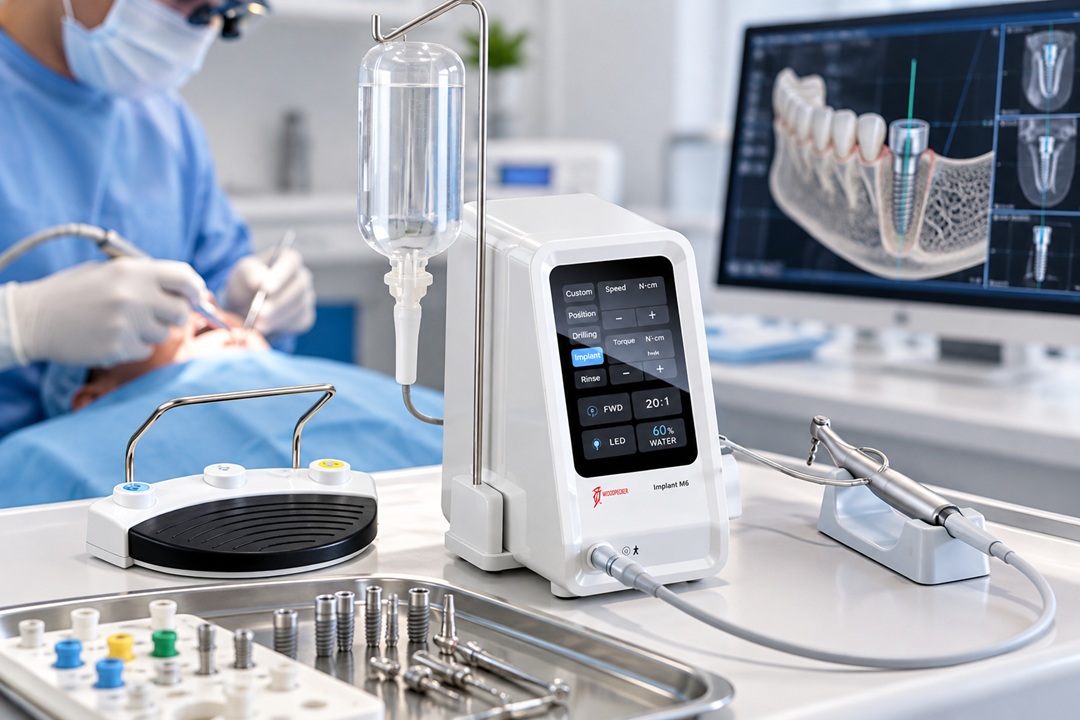
Placing implants leaves little room for guesswork. Torque, speed and irrigation all have to stay within protocol while your hands stay sterile, and your attention stays on the patient. That is the job a dedicated surgical motor does, and it is why more UK practices are taking a close look at the DTE motor from Woodpecker’s DTE brand before investing in implant equipment.
This guide explains how the unit works, which features matter chairside and what to check before you buy. It is written for general dentists moving into implantology, as well as oral surgeons, periodontists, practice owners and teaching clinics comparing options.
Quick answer: This DTE unit is a surgical motor for implant placement. It offers 5 to 80 Ncm of torque with a 20:1 handpiece, a 5-inch colour touchscreen with preset programmes, torque calibration on startup, a peristaltic irrigation pump delivering up to 135 ml per minute and a multi-function foot pedal. It is CE certified, with a 24-month warranty on the main unit.
An implant motor drives the handpiece used for osteotomy preparation and implant insertion. Unlike a standard restorative micromotor, it pairs low speed with high, controlled torque and delivers cooling irrigation to the drill site.
The DTE console brings these functions into one compact unit measuring 155 mm long, 167 mm wide and 227 mm high. That is small enough to sit on a surgical cart without crowding the working area.
A DTE implant motor with touch screen display changes how quickly you move between drilling steps. The 5-inch colour LCD shows speed, torque and programme settings briefly, so your nurse can confirm parameters without leaning over the tray.
Preset programmes and parameter memory are the real benefit. Once you have entered the drilling sequence for the implant system you use most, you can recall it for every case instead of rebuilding it. For multi-surgeon practices and dental service organisations, that helps standardise settings across clinicians.
Expert tip: programme and label your presets before the first surgical list, not on the day. Cross-check every step against the implant manufacturer’s drilling protocol.
Torque control is usually the first feature clinicians ask about, and for good reasons. Implant manufacturers specify insertion torque limits for their fixtures. Going over them risks excessive bone compression or damage to the implant connection, while too little can compromise primary stability.
As a Woodpecker implant motor with torque calibration, this unit calibrates on startup and then displays torque in real time. Calibration matters because handpiece wear, lubrication and internal friction change over time. A startup check helps the reading on screen reflect what reaches the drill or driver.
The working range runs from 5 Ncm to 80 Ncm with the 20:1 handpiece, covering the osteotomy and insertion steps of typical protocols. The live readout also gives you a figure worth recording in your clinical notes.
Surgical asepsis depends on keeping gloved hands away from anything non-sterile. A DTE implant motor with foot pedal control lets the operator adjust key functions without touching the console. The multi-function pedal handles:
In practice, you can step to the next drill, reverse out of an osteotomy or increase irrigation while your hands stay in the field. It also cuts the number of instructions your nurse has to act on mid-procedure.
Heat control during drilling is a core part of safe implant surgery. The built-in peristaltic pump works with irrigation supply lines and delivers up to 135 ml of coolant per minute, adjustable from the pedal.
The unit comes in three configurations:
The 20:1 handpiece uses integrated bearings, and its LED lights the surgical site.
|
Specification |
Detail |
|
Torque range |
5 to 80 Ncm (20:1) |
|
Display |
5-inch colour LCD touchscreen |
|
Programmes |
Presets with parameter memory |
|
Torque calibration |
On startup, with real-time display |
|
Irrigation |
Peristaltic pump, up to 135 ml/min |
|
Foot pedal |
Water volume, programme, forward/reverse, speed |
|
Dimensions (L x W x H) |
155 x 167 x 227 mm |
|
Handpiece |
LED 20:1 with integrated bearings |
|
Certification |
CE certified |
|
Warranty |
24 months main unit; 12 months contra angle, cable and motor |
If you are equipping a surgery from scratch, it is worth reviewing scalers, apex locators and curing lights at the same time. You can compare the wider range of DTE dental products UK clinics use in one place.
The unit suits clinicians and organisations that place implants regularly or teach surgical protocols:
Price matters, but the support behind a surgical motor counts as much as its spec sheet. Before ordering from any DTE dental equipment UK supplier, check these five points:
It delivers 5 Ncm to 80 Ncm of torque when paired with the 20:1 contra angle handpiece. That range covers the osteotomy and insertion steps of most implant protocols. Torque is shown in real time on the touchscreen, and the unit calibrates on startup to keep readings consistent as the handpiece wears.
Yes, the unit is CE certified. Keep the certification details and user manual on file with your practice equipment records. This supports compliance checks, makes warranty claims simpler and gives your team a reliable reference for set-up, cleaning and routine maintenance.
Yes, provided they are compatible. The motor-only option suits clinics that already own suitable surgical handpieces. If you are starting from scratch, the bundles with a 20:1 LED contra angle or a 1:1 E-type LED straight handpiece give you a matched set-up. Confirm compatibility with your supplier before ordering.
The built-in peristaltic pump delivers up to 135 ml of coolant per minute. You can adjust water volume from the foot pedal mid-procedure, so irrigation increases without touching the console. Consistent cooling helps manage heat at the drill site, an important part of protecting bone during osteotomy preparation.
For practices placing implants regularly, a dedicated motor usually earns its place through more predictable procedures and faster set-up. Presets, real-time torque and pedal control reduce manual adjustments during surgery. If you place implants only occasionally, weigh your case volume against the investment and consider whether a referral pathway suits you better.
A surgical motor is one of the most important purchases you make when building an implant service. The DTE motor brings together the features that matter most chairside, starting with 5 to 80 Ncm of torque, a real-time display and calibration on every startup.
Its 5-inch touchscreen stores preset programmes, the multi-function foot pedal keeps water, direction and speed under your control, and the peristaltic pump delivers up to 135 ml of irrigation per minute. With CE certification and a 24-month warranty on the main unit, it offers UK clinics a practical route into implantology.
Need help choosing the right bundle for your surgery? Contact our team for advice on handpiece compatibility and set-up, or create an account to order and track your equipment with VSDent.




