Physical Address
304 North Cardinal St.
Dorchester Center, MA 02124
Physical Address
304 North Cardinal St.
Dorchester Center, MA 02124

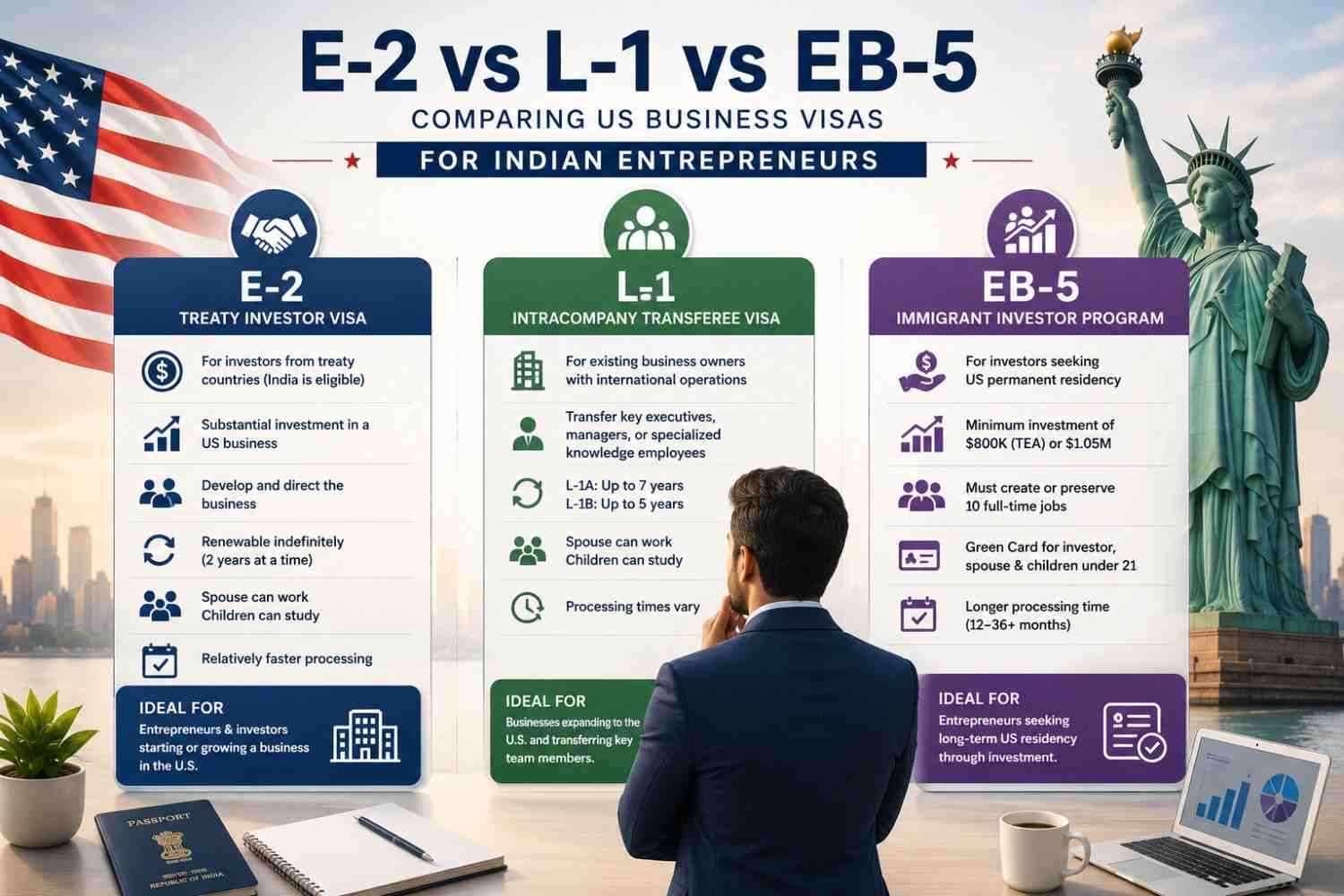
A side-by-side comparison of E-2, L-1, and EB-5 visas for Indian entrepreneurs to help you choose the right path for your US business goals.
When it comes to US business visas, Indian entrepreneurs often hear the same three names thrown around, E-2, L-1, and EB-5, without a clear sense of how they actually differ or which one fits their specific situation. Rather than treating these as interchangeable options, it helps to look at them side by side, since each serves a genuinely different purpose and type of entrepreneur.
The E-2 visa is designed for entrepreneurs making a substantial investment in a US business that they will actively direct and develop. It requires demonstrating that the investment is real, at risk, and sufficient to support a functioning business, though there is no fixed minimum amount, since sufficiency is judged relative to the type of business. One important caveat is that E-2 eligibility depends on treaty status between the applicant’s country and the US, which is worth confirming early, since it fundamentally determines whether this path is even available.
The L-1 visa serves a different purpose entirely, designed for transferring an executive, manager, or specialized employee from an established foreign company to a related US entity, such as a new branch or subsidiary. This route tends to suit Indian entrepreneurs who already run a functioning company in India and want to personally oversee a new US operation, using their existing business as the foundation for the transfer rather than starting from scratch.
The EB-5 visa takes a fundamentally different approach, centered on a significant capital investment in a US enterprise that creates a required number of jobs. Unlike the E-2 or L-1, which are generally temporary work visas, the EB-5 is specifically structured as a path toward permanent residency. This makes it a better fit for entrepreneurs or investors with substantial capital who are thinking long-term about relocating permanently rather than simply operating a business remotely or temporarily.
The three visas differ significantly in what they demand upfront. The E-2 requires a real, substantial investment but does not specify a fixed minimum, making it more flexible for smaller businesses. The L-1 does not require a specific investment amount at all, since it is based on the transfer of an existing business relationship rather than new capital. The EB-5 requires the largest and most clearly defined capital commitment, reflecting its role as a path toward permanent residency rather than a temporary operational visa.
Entrepreneurs starting a brand-new US business with meaningful capital to invest, and who want to actively run it, often find the E-2 the most natural fit. Those who already run an established Indian company and want to personally launch and manage a related US branch tend to align better with the L-1. Investors with significant capital who are focused on a long-term path to residency, rather than active daily operations, typically find the EB-5 more appropriate for their goals.
Regardless of which visa fits, all three require substantial documentation demonstrating the legitimacy and viability of the underlying business. Entrepreneurs who underestimate this documentation burden often face delays or rejections that could have been avoided with proper preparation from the start. Working through this process with proper immigration-related legal support significantly improves the odds of a smooth application, since experienced guidance helps ensure the business plan and supporting evidence meet what each visa category actually requires.
Visa applications are rarely the only challenge entrepreneurs face while establishing a presence in the US, and it helps to approach the broader journey with realistic expectations. A closer look at overcoming challenges in the US market offers useful perspective on navigating this process with the right support system in place, visa related or otherwise.
There is no universally best visa among the E-2, L-1, and EB-5. Each serves a distinctly different entrepreneur profile and business goal, and choosing correctly depends on being honest about your investment level, existing business assets, and whether you are seeking a temporary operational presence or a long-term path to residency.
If you are weighing these visa options and want clarity on which one genuinely fits your specific business plan, it helps to talk it through with people who work through these decisions regularly. Reach out to the team at Indam Advisors’ contact page for a clear, honest conversation.
An E-2 visa is based on a substantial new investment in a US business that the applicant will actively manage, while an L-1 visa is based on transferring an executive or manager from an already established foreign company to a related US entity.
Yes, the EB-5 is specifically designed as an investment-based path toward permanent residency, unlike the E-2 and L-1, which function as temporary work visas without a direct path to a green card.
There is no fixed minimum, but the investment must be substantial and sufficient relative to the type of business being established, which is typically assessed on a case-by-case basis.
No, the L-1 visa specifically requires an existing, related foreign company, since the visa is built around transferring an employee from that established business to a new US entity.
The EB-5 visa is generally the best fit for entrepreneurs seeking permanent relocation, since it is specifically structured as an investment-based path to a green card, unlike the E-2 or L-1.