Physical Address
304 North Cardinal St.
Dorchester Center, MA 02124
Physical Address
304 North Cardinal St.
Dorchester Center, MA 02124

The rapid adoption of electric vehicles (EVs) is creating a parallel need for responsible battery lifecycle management. Lithium-ion batteries contain valuable materials such as lithium, nickel, cobalt, copper, graphite, and manganese, making recycling important for both resource recovery and supply-chain resilience. The Electric Vehicle Battery Recycling Market is therefore becoming an increasingly important part of the global electric mobility ecosystem.
Global battery demand continues to rise. The International Energy Agency reported that EV battery demand exceeded 750 GWh in 2023, increasing by around 40% from 2022. As more EV batteries enter their later life stages, manufacturers, recyclers, governments, and technology providers are investing in collection, reuse, dismantling, and material-recovery infrastructure.
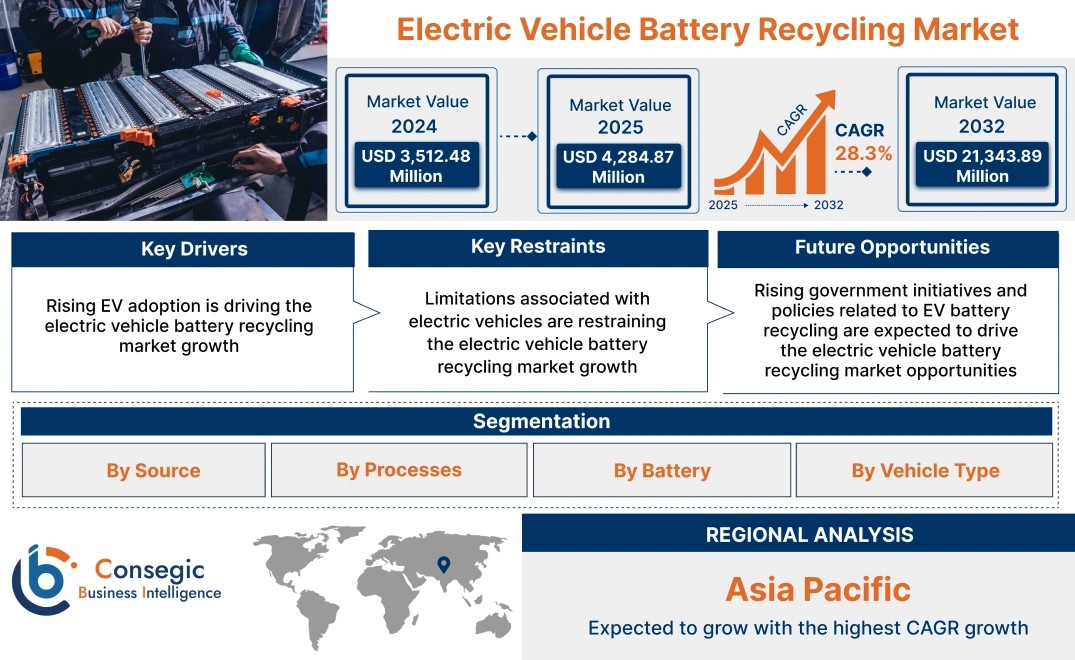
Electric Vehicle Battery Recycling Market size is estimated to reach over USD 21,343.89 Million by 2032 from a value of USD 3,512.48 Million in 2024 and is projected to grow by USD 4,284.87 Million in 2025, growing at a CAGR of 28.3% from 2025 to 2032.
The market includes processes used to collect, diagnose, dismantle, repurpose, and recycle batteries from electric cars, buses, commercial vehicles, and other electric transportation systems.
Key activities include:
The industry is evolving from a manufacturing-scrap-focused model toward a broader circular system that includes end-of-life EV batteries. The IEA expects end-of-life EV and energy-storage batteries to become the dominant source of recycling feedstock after 2035.
Several factors are supporting the expansion of the Electric Vehicle Battery Recycling Market.
Growing EV adoption: More electric cars on the road will eventually create larger volumes of used and end-of-life battery packs.
Critical mineral security: Recycling provides a secondary source of lithium, nickel, cobalt, and other materials, reducing dependence on newly mined resources. The IEA estimates that effective recycling could substantially reduce future demand for primary critical minerals.
Government policies: Governments are introducing recycling targets, producer-responsibility requirements, funding programs, and supply-chain regulations.
Battery manufacturing growth: Manufacturing scrap already represents a major recycling feedstock. As battery production expands, recyclers can access additional material before end-of-life battery volumes become dominant.
Investment in circular supply chains: Automotive companies, battery producers, recyclers, and material suppliers are developing partnerships to connect collection, processing, and battery-material manufacturing.
The Electric Vehicle Battery Recycling Market is increasingly influenced by digitalization and advanced technologies.
Artificial Intelligence (AI) and Machine Learning (ML) can support battery sorting, state-of-health assessment, fault detection, and process optimization. Data Analytics can help recyclers understand battery chemistry and determine whether a pack is more suitable for reuse or material recovery.
Automation and Robotics are also becoming important in battery dismantling because automated systems can improve consistency and reduce worker exposure to hazardous processes.
Digital Transformation is supporting traceability throughout the battery lifecycle. Cloud Technologies and IoT Integration can connect battery identification, logistics, inspection, recycling, and material recovery systems.
Sustainability is another major trend. Smart Manufacturing, Green Technologies, and Circular Economy principles are encouraging manufacturers to recover valuable materials and return them to battery production.
Battery recycling technologies generally fall into several categories. Mechanical processing separates battery components through crushing, sorting, screening, and other physical methods. Hydrometallurgical processes use chemical solutions to recover valuable metals, while pyrometallurgical techniques rely on high-temperature treatment.
Direct recycling is attracting attention because it aims to preserve and recover active battery materials rather than reducing them completely to elemental compounds. Improvements in automation, sensor technology, robotics, and process monitoring may help recyclers improve recovery efficiency.
Advanced Materials and new battery chemistries will also influence recycling economics. Lithium iron phosphate (LFP), for example, has gained substantial EV battery adoption, but its lower concentration of high-value metals can create different recycling economics compared with nickel-rich chemistries.
Predictive Maintenance can further improve recycling equipment reliability by identifying equipment degradation before unexpected failures occur.
North America: The region is strengthening domestic battery supply chains through recycling investments, collection infrastructure, and government support. The U.S. Department of Energy reported domestic capacity capable of reclaiming more than 35,000 tons of battery materials in 2023, with additional capacity planned.
Europe: Regulatory requirements are creating strong incentives for battery collection, recycling efficiency, and recycled-content integration. EU rules establish progressively higher recovery targets for lithium and other battery materials.
Asia-Pacific: Asia-Pacific remains central to battery manufacturing and recycling capacity. China has a particularly strong position in battery recycling infrastructure, accounting for more than 80% of global recycling capacity in 2023 according to the IEA.
Latin America: Growing EV adoption, developing battery supply chains, and access to mineral resources could support future recycling investments. Collection infrastructure and regulatory development will remain important.
Middle East & Africa: EV adoption is developing at different rates across countries. Opportunities are emerging around battery collection, second-life applications, logistics, and localized recycling infrastructure.
The Electric Vehicle Battery Recycling Market offers opportunities across several stages of the value chain. High-potential areas include automated dismantling, battery diagnostics, collection networks, second-life energy storage, hydrometallurgical recovery, and direct recycling.
Regional recycling facilities located close to EV manufacturing centers can reduce transportation requirements and improve supply-chain efficiency. Companies that can establish reliable battery traceability and long-term feedstock agreements may also gain advantages as competition for recyclable materials increases.
The IEA notes that global recycling capacity has expanded rapidly, although capacity and future feedstock availability differ significantly by region.
Competition is developing around technology efficiency, recovery rates, processing costs, safety, and access to feedstock. Market participants are investing in technology development, capacity expansion, strategic partnerships, and recycling facilities.
Automakers and battery manufacturers are increasingly interested in closed-loop supply chains that return recovered materials into new battery production. Recycling companies are also exploring partnerships with dismantlers, collection networks, material refiners, and energy-storage providers.
Research investments are increasingly focused on improving lithium recovery, processing LFP batteries, reducing energy consumption, and automating battery dismantling.
The Electric Vehicle Battery Recycling Market is expected to move toward a more integrated circular model through 2034. During the earlier part of the period, manufacturing scrap will remain an important feedstock, while growing EV retirement volumes will gradually increase the importance of end-of-life batteries.
AI-enabled diagnostics, automated dismantling, digital battery passports, advanced separation techniques, and improved material recovery processes could reshape industry operations. Second-life battery applications may also complement recycling by extending useful battery life before final material recovery.
A major opportunity will be building recycling capacity in regions where future battery feedstock is expected to grow faster than existing infrastructure. The IEA’s 2026 research indicates that around 1.2 million EV batteries could reach end of life in 2030 and about 14 million by 2040, highlighting the increasing importance of battery circularity.
The Electric Vehicle Battery Recycling Market is becoming a strategic component of the global EV ecosystem. Rising battery deployment, critical-mineral requirements, regulatory pressure, and sustainability objectives are encouraging investment across collection, reuse, recycling, and material recovery.
Through 2034, technological innovation will remain central to market development. Automation, AI, Robotics, Data Analytics, IoT Integration, Advanced Materials, and Green Technologies can improve efficiency while supporting more circular battery supply chains. Companies capable of combining safe battery handling, reliable feedstock access, advanced recovery technologies, and sustainable operations will be well positioned as the volume of end-of-life EV batteries increases.
The Electric Vehicle Battery Recycling Market covers the collection, processing, reuse, dismantling, and material recovery of batteries used in electric vehicles. It focuses on recovering valuable materials such as lithium, nickel, cobalt, copper, and graphite while reducing battery waste and supporting more sustainable and resilient EV supply chains.
Major growth factors include rising EV adoption, increasing battery production, demand for critical minerals, government recycling regulations, sustainability objectives, and investment in circular supply chains. Technological improvements in battery diagnostics, automated dismantling, material separation, and recovery are also supporting the industry’s long-term development.
Asia-Pacific, particularly China, has a strong position in battery recycling capacity and the broader battery supply chain. Europe and North America are also expanding recycling infrastructure through regulations, investments, and domestic battery-supply strategies. Regional leadership may evolve as end-of-life battery volumes increase and new recycling facilities become operational.
Important trends include AI-assisted battery diagnostics, automated dismantling, direct recycling, hydrometallurgical recovery, second-life battery applications, digital traceability, and improved lithium recovery. Sustainability and Circular Economy strategies are also encouraging manufacturers to integrate recovered materials into new battery production and reduce dependence on primary resources.
Opportunities are expected across automated recycling plants, battery collection networks, second-life energy storage, advanced material recovery, battery diagnostics, digital traceability, and closed-loop manufacturing. Emerging markets may also require localized recycling infrastructure as EV adoption expands, creating opportunities for technology providers, recyclers, logistics companies, and battery manufacturers.
About Us
At Consegic Business Intelligence Pvt. Ltd., we empower organizations with actionable market intelligence, strategic insights, and data-driven research solutions that support informed business decision-making. Our comprehensive market research reports provide in-depth analysis of industry trends, competitive landscapes, emerging opportunities, and future growth prospects across diverse sectors.
Contact Us
Consegic Business Intelligence Pvt. Ltd.
Website: www.consegicbusinessintelligence.com
Email: sales@consegicbusinessintelligence.com
Phone: +1-833-313-3130




