Physical Address
304 North Cardinal St.
Dorchester Center, MA 02124
Physical Address
304 North Cardinal St.
Dorchester Center, MA 02124

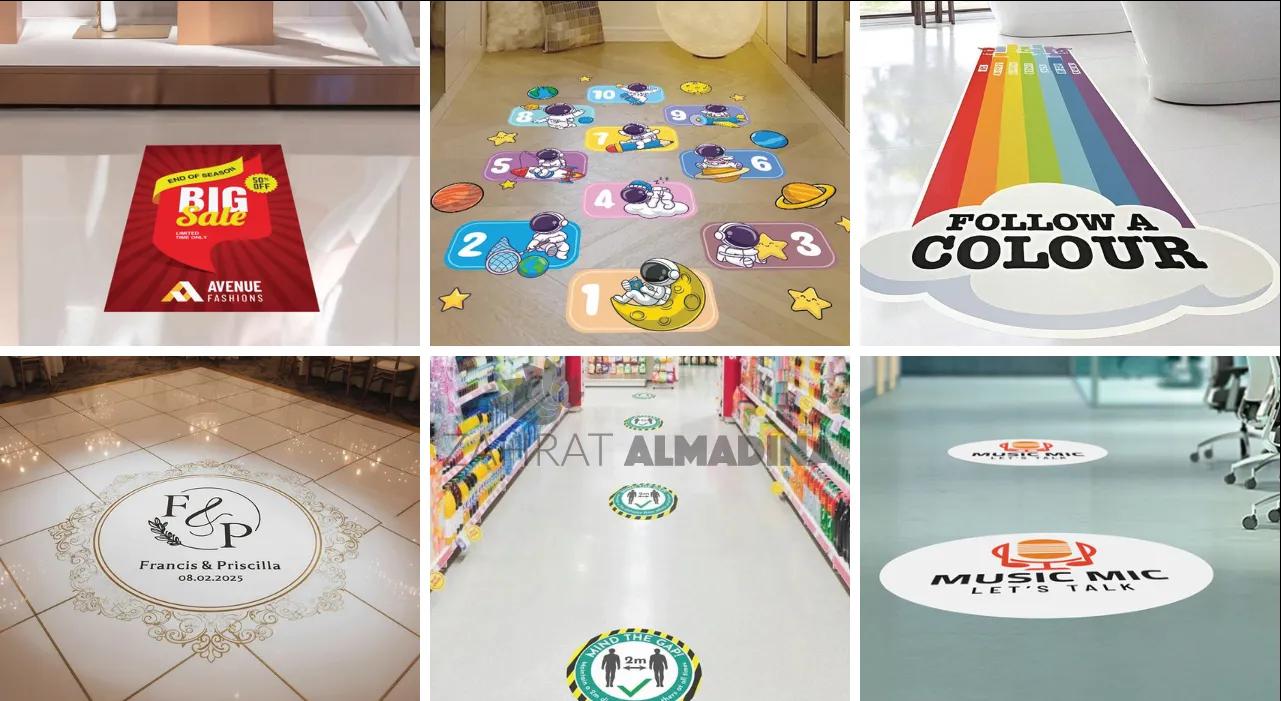
Floors are often treated as empty spaces that simply connect one part of a building to another. In schools, nurseries, libraries, activity centres, and children’s play areas, however, the floor can become part of the learning environment.
Floor stickers for kids offer a simple way to turn unused floor space into interactive areas for games, educational activities, directions, and creative play. Instead of relying entirely on wall displays, teachers and activity planners can use the floor itself as a surface for learning.
For schools and children’s spaces in Dubai, where indoor activities are particularly useful throughout much of the year, well-designed floor graphics can add variety to classrooms and play areas without requiring major structural changes.
Children naturally interact with their surroundings. A colourful graphic placed at eye level can attract attention, but a floor graphic can encourage children to move, count, follow instructions, or participate in a game.
The main advantage is that floor stickers design can combine movement and learning.
For example, a simple numbered path can help younger children practise counting while walking from one number to the next. A set of coloured shapes can become part of a sorting activity, while alphabet graphics can turn an ordinary walkway into a basic language-learning exercise.
The activity does not always need to feel like a formal lesson. Play-based learning can make educational concepts more engaging.
The possibilities depend on the age group and purpose of the space.
A numbered path is one of the simplest designs. Numbers can be arranged in a straight line, curve, or pattern that encourages children to move from one number to another.
Teachers can use the path for:
Counting practice
Number recognition
Simple addition games
Sequencing activities
Movement exercises
The same design can support different activities as children progress.
Alphabet floor graphics can introduce letters through movement.
For example, a teacher might call out a letter and ask children to find and stand on it. Pictures can also be added to help younger children connect letters with familiar objects.
A simple letter path can therefore become both a visual display and an interactive learning tool.
Large circles, triangles, squares, and other shapes can help younger children learn basic concepts.
A teacher could ask children to:
Find a particular shape
Stand on a specific colour
Jump between matching shapes
Sort objects according to colour
Follow a sequence of shapes
These activities require very little equipment and can be adapted to different age groups.
Educational spaces do not need to separate learning from movement.
Hopscotch-style graphics, stepping paths, footprints, balance patterns, and directional arrows can encourage children to move while following simple instructions.
This can be particularly useful in indoor play areas where available space needs to serve several purposes.
A floor graphic might provide a quiet learning activity at one time and become a movement game later in the day.
The key is to design the graphics around the available space rather than filling every open area.
Floor stickers can also help divide a large room into functional zones.
For example, a nursery could have separate areas for:
Reading
Building blocks
Drawing
Group activities
Quiet play
Movement
Different shapes, colours, or symbols can identify each area without requiring permanent walls or furniture.
This approach can make a large open room easier for children to understand while giving teachers a simple visual system for organising activities.
A floor graphic designed for toddlers should not be the same as one created for older children.
Younger children generally benefit from large, simple shapes, bright visual contrasts, familiar objects, and straightforward instructions.
Older children may respond better to:
Word games
Mathematical challenges
Maps
Science-related graphics
Puzzle activities
More detailed movement games
The amount of information should increase with the age and ability of the children using the space.
A children’s floor graphic needs to be visually interesting, but safety is more important than appearance.
The material should be suitable for floor application and appropriate for the expected level of foot traffic. The surface should also remain suitable for the environment where children will walk or play.
Designers should avoid placing graphics where they could create unnecessary obstacles or interfere with doors, stairs, emergency routes, or other important areas.
It is also important to follow the manufacturer’s cleaning and maintenance recommendations. Worn edges, peeling sections, or damaged graphics should be addressed rather than left in areas used by children.
More graphics do not necessarily create a better learning environment.
If every section of the floor contains numbers, letters, shapes, arrows, and illustrations, children may struggle to understand what they are supposed to focus on.
A better approach is to give each area a clear purpose.
For example, one section might contain a number game while another provides a reading-zone marker. The rest of the floor can remain visually quiet.
This creates contrast and makes the educational graphics more meaningful.
In Dubai, indoor learning and play spaces can benefit from flexible designs that make good use of available areas.
Nurseries can use floor graphics for alphabet and number activities. Schools can introduce educational games into corridors or activity rooms. Children’s libraries can use footprints or themed paths to guide visitors toward reading areas.
Indoor entertainment centres can also use floor graphics to create queues, activity zones, or interactive games.
The important factor is to match the design with the purpose of the space rather than treating floor stickers as simple decoration.
Before ordering floor graphics, consider the following:
Measure the available floor area accurately.
Decide what children should learn or do with the graphic.
Select designs suitable for the intended age group.
Check whether the material is appropriate for floor use.
Consider expected foot traffic.
Test the design and placement before covering a large area.
Keep important walkways and access points clear.
Establish a simple cleaning and inspection routine.
Businesses and educational organisations researching local printing options can also compare materials, application methods, design support, and expected durability before making a decision.
For example, Zahrat Al Madina Printing can be one of the local options considered when researching printed graphics and related applications in Dubai.
An empty floor does not have to remain an unused part of a children’s environment. With thoughtful planning, floor stickers can turn ordinary surfaces into number paths, alphabet games, activity zones, movement challenges, and visual learning aids.
The most effective designs are not necessarily the most colourful or complicated. They are the ones that fit the age group, support a clear purpose, remain easy to understand, and work safely within the available space.
For schools, nurseries, libraries, and children’s activity centres, floor stickers can provide a flexible way to combine learning and movement while making better use of existing indoor space.




