
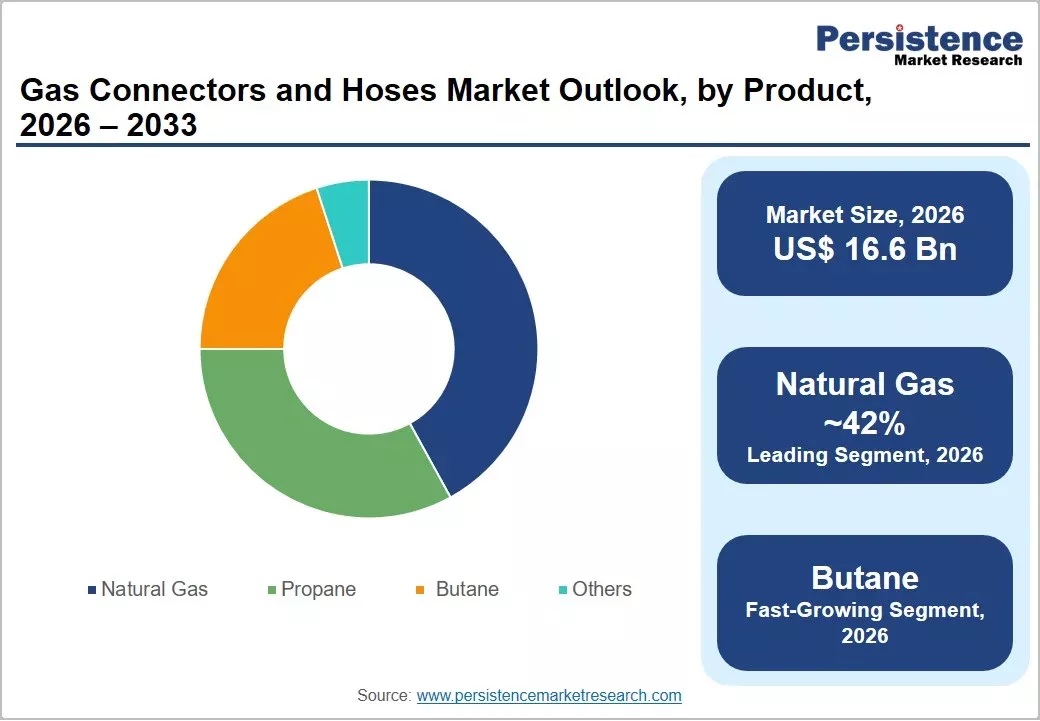

The global gas connectors and hoses market is expected to be valued at US$ 16.6 billion in 2026 and projected to reach US$ 27.5 billion by 2033, growing at a CAGR of 7.5% between 2026 and 2033. Market expansion is primarily driven by increasing investments in residential and commercial gas infrastructure, stringent safety requirements, and growing adoption of natural gas and liquefied petroleum gas (LPG). Rising demand for certified, leak-resistant connection systems is encouraging manufacturers to develop durable products that improve gas distribution efficiency and operational safety.
Flexible gas connectors represent an important product segment because of their widespread application in household appliances, commercial kitchens, heating equipment, and industrial installations. Asia Pacific is positioned as a major demand center, supported by expanding LPG distribution networks, urbanization, and residential construction across China, India, and Southeast Asia. Increasing awareness of gas leakage prevention, alongside regulatory requirements for approved connectors and hoses, is also encouraging replacement of aging equipment with corrosion-resistant alternatives.
𝐅𝐑𝐄𝐄 𝐒𝐚𝐦𝐩𝐥𝐞 & 𝐄𝐱𝐩𝐥𝐨𝐫𝐞 𝐭𝐡𝐞 𝐋𝐚𝐭𝐞𝐬𝐭 𝐌𝐚𝐫𝐤𝐞𝐭 𝐈𝐧𝐬𝐢𝐠𝐡𝐭𝐬:https://www.persistencemarketresearch.com/samples/37475
Key Highlights from the Report
- The global gas connectors and hoses market is projected to reach US$ 27.5 billion by 2033.
• The market is expected to register a CAGR of 7.5% during 2026–2033.
• Residential and commercial gas infrastructure expansion supports market demand.
• Flexible gas connectors remain important for household appliances and commercial installations.
• Asia Pacific offers significant opportunities through expanding LPG and natural gas distribution.
• Stricter safety standards encourage demand for certified, corrosion-resistant gas connection systems.
Market Segmentation: Product Types, Materials and Applications
The gas connectors and hoses market can be segmented by product type into flexible gas connectors, stainless steel corrugated hoses, rubber gas hoses, thermoplastic hoses, and specialized industrial gas transfer assemblies. Flexible connectors are widely used where equipment positioning, vibration absorption, and installation flexibility are important. Stainless steel connectors offer corrosion resistance and mechanical durability, making them suitable for demanding residential and commercial applications.
Based on material, the market includes stainless steel, rubber, reinforced polymers, and composite materials. Stainless steel products are commonly selected for durability and resistance to environmental deterioration, while rubber and polymer-based hoses provide flexibility for applications involving LPG cylinders, portable equipment, and specialized gas handling systems. Material selection depends on gas compatibility, operating pressure, temperature, installation conditions, and applicable certification requirements.
By end-user, demand originates from residential buildings, commercial establishments, industrial facilities, and energy infrastructure. Residential applications include cooking appliances, water heaters, and heating systems. Commercial demand comes from restaurants, hotels, institutional kitchens, and other facilities requiring dependable gas connections. Industrial applications involve manufacturing equipment, process gas distribution, and specialized machinery.
Regional Insights: Infrastructure Expansion and Safety Modernization
Asia Pacific presents substantial opportunities for gas connector and hose manufacturers because of expanding urban populations, residential construction, and LPG distribution infrastructure. India and China represent important markets where household energy access, industrial development, and appliance ownership support demand for gas handling components. Southeast Asian countries also offer opportunities through commercial construction and expanding energy distribution networks.
North America maintains established demand through residential appliance installations, commercial foodservice equipment, industrial gas systems, and replacement activities. Product certification and compliance with applicable fuel gas codes strongly influence purchasing decisions. Demand for durable connectors is supported by renovation projects and maintenance requirements across existing buildings.
Europe emphasizes product quality, technical compliance, and energy infrastructure modernization. Manufacturers serving European markets must address requirements relating to pressure resistance, material compatibility, and installation safety. Latin America and the Middle East also offer opportunities as LPG consumption, commercial development, and industrial activity support investment in gas distribution equipment.
Market Drivers: Gas Infrastructure Investment and Safety Requirements
Increasing investment in gas infrastructure represents a major driver of market growth. Residential developments, commercial buildings, and industrial facilities require dependable connections between gas distribution networks and consuming equipment. As natural gas and LPG distribution expands, demand for hoses, connectors, fittings, and associated installation components increases.
Safety awareness is another important growth factor. Gas leaks can create serious fire, explosion, and health hazards, making appropriate product selection and installation essential. Regulatory frameworks, including standards recognized by plumbing and mechanical authorities, encourage the use of certified products designed for specific operating conditions.
Replacement demand also contributes to market activity. Aging hoses, damaged connectors, corrosion, and equipment upgrades create recurring requirements for suitable replacement components. Manufacturers offering verified performance, installation guidance, and reliable distribution support are positioned to benefit from these purchasing cycles.
Market Restraints: Cost Pressures and Regulatory Complexity
The gas connectors and hoses market faces challenges associated with raw material price fluctuations, product certification costs, and competition from lower-priced alternatives. Stainless steel, specialty polymers, and reinforced materials influence manufacturing expenses, while fluctuations in procurement costs can affect profitability.
Regulatory differences between countries create additional complexity. Manufacturers must ensure that products comply with relevant standards for gas type, pressure rating, installation environment, and intended application. Certification procedures and testing requirements can increase product development costs and delay market entry.
Improper installation and counterfeit or uncertified products also present significant concerns. Even high-quality connectors may fail when incorrectly selected, damaged, reused contrary to instructions, or installed without appropriate safety precautions.
Market Opportunities: Advanced Materials and Smart Gas Safety
Innovation in materials and connector design offers opportunities for manufacturers seeking to improve reliability and service life. Advanced corrosion-resistant alloys, reinforced hose structures, and improved sealing technologies can support performance under demanding operating conditions.
Commercial kitchens and industrial facilities represent attractive markets for specialized gas connection assemblies. These applications often require products designed for frequent equipment movement, elevated temperatures, or challenging installation environments.
Smart gas safety systems provide another area of potential development. Integrating compatible connectors with gas leak detection devices, automatic shutoff valves, and connected monitoring technologies can support broader safety solutions for residential and commercial customers.
Manufacturers can also expand through partnerships with appliance producers, plumbing distributors, energy utilities, and infrastructure contractors. Strong aftermarket support and installer education can help differentiate certified products from unsuitable alternatives.
Company Insights: Key Players in the Market
- Watts Water Technologies (Dormont)
• Parker Hannifin Corporation
• Continental AG (ContiTech)
• Eaton Corporation
• Titeflex (Smiths Group)
• Flex-Tek Group
• The Hosemaster Group
• Omega Flex, Inc.
• Tricoflex
• Trelleborg Group
Recent Developments in the Gas Connectors and Hoses Market
January 2026: Watts’ Dormont brand published its updated foodservice gas and water connector product price list, effective January 19, 2026. The catalog covers Blue Hose gas connector kits and SnapFast quick-disconnect products, reflecting continued commercial availability of specialized gas connection solutions.
December 2025: Continental’s ContiTech business introduced its RDS hydraulic hose series in Asia Pacific, emphasizing durability, temperature resistance, and flexible construction. Although intended for hydraulic rather than fuel-gas applications, this adjacent hose-industry development illustrates broader innovation in reinforced hose materials.
Conclusion: Future Outlook for Gas Connectors and Hoses
The global gas connectors and hoses market is positioned for continued expansion, supported by infrastructure investment, appliance installations, safety awareness, and demand for durable connection systems. With the market projected to reach US$ 27.5 billion by 2033, manufacturers have opportunities to strengthen their presence through certified products, advanced materials, and dependable aftermarket services. Long-term competitiveness will depend on meeting evolving technical standards, maintaining product quality, and delivering safe, cost-effective solutions across residential, commercial, and industrial applications.