Physical Address
304 North Cardinal St.
Dorchester Center, MA 02124
Physical Address
304 North Cardinal St.
Dorchester Center, MA 02124

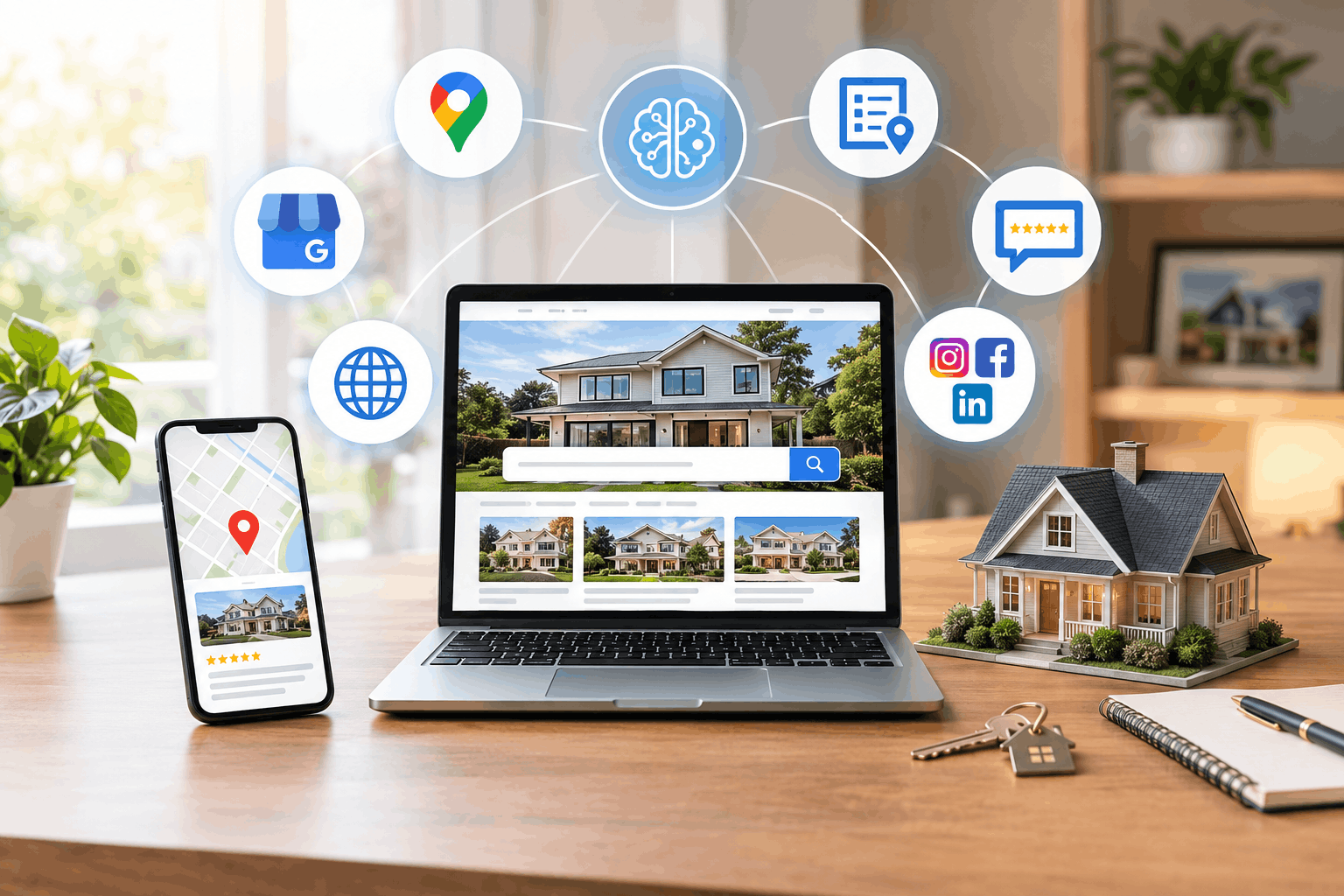
Real estate search is no longer limited to typing a few keywords into Google and choosing from a list of blue links. Buyers, sellers, investors, and renters are increasingly using maps, review platforms, conversational search, and AI-powered tools to discover local businesses and real estate professionals. That shift is changing what it means for a real estate brand to be visible online.
For agencies investing in Real Estate Digital Marketing Services, this creates an important question: should more attention go toward Google Business Profile, or should businesses focus on directories and other third-party listings?
The answer isn’t really one or the other. Your Google Business Profile can provide an important foundation, while reputable directories, industry websites, your own website, reviews, and other online references can help reinforce who you are and what you do. 247 Real Estate’s recent analysis makes a similar point, noting that AI systems can cross-reference information from multiple sources rather than depending on a single listing.
When someone asks for an AI tool for a real estate agent, brokerage, property manager, or specialist in a particular location, the system needs enough reliable information to understand the businesses it encounters.
That information can come from several places, including:
This creates what can be thought of as a digital footprint for your business.
The stronger and more consistent that footprint is, the easier it can be for search systems to connect different references to the same company.
Google itself says Business Profile information can come from business owners, publicly available web content, third-party data, users, and other sources. It also uses this information to help provide local results across Google Search and Maps.
For real estate companies, this makes consistency particularly important.
A Google Business Profile isn’t simply another online directory listing. It connects your business with Google’s local search ecosystem and gives you direct control over important information.
A real estate business can use its profile to communicate details such as:
Google recommends keeping Business Profile information complete and accurate. Its guidance also identifies relevance, distance, and prominence as major factors in local ranking.
For real estate businesses, this means your profile shouldn’t be treated as something you create once and forget.
If your agency adds property management, expands into another location, changes its phone number, updates its hours, or introduces a new service, your online business information should be reviewed accordingly.
Google also provides performance data showing how people discover and interact with a Business Profile, including searches, views, and other actions.
While Google Business Profile is important, third-party directories can provide another valuable layer of information.
Think about a potential buyer searching for a luxury real estate agency. They might encounter the company on its website, Google Maps, a local business directory, a real estate portal, an industry association website, and review platforms.
When these sources consistently identify the same business, location, services, and contact details, they create a much clearer online footprint.
247 Real Estate’s analysis highlights this idea of entity validation: AI systems can use multiple references to understand whether different mentions belong to the same business. It also points out that industry-specific directories can carry more contextual value than simply collecting large numbers of generic listings.
For a real estate company, that could mean prioritizing relevant real estate platforms, local organizations, professional associations, and reputable business directories instead of submitting the company to every directory available.
One of the easiest mistakes in local SEO is assuming that more listings automatically mean better visibility.
It doesn’t work that way.
Imagine your website lists:
ABC Realty
123 Main Street
555-123-4567
But an old directory lists:
ABC Real Estate
125 Main St.
555-987-4567
Another profile might use a different business name altogether.
Those discrepancies can make it harder for search systems to confidently connect the references.
That’s why citation management should focus on accuracy and consistency, not just quantity.
Your business name, address, phone number, website, service descriptions, and location information should be reviewed through your online presence.
This is also where Real Estate SEO Services can extend beyond traditional keyword rankings. A strong local SEO strategy should consider how your business information is represented throughout the web, not just how one page performs in Google’s organic results.
There is another important lesson from the discussion around AI visibility: don’t build your entire strategy around listings.
Your website should remain the central source describing your real estate business.
247 Real Estate cites research involving more than 14,000 AI citations that found business websites accounted for approximately 60% of citations, while directories represented around 20–30%, depending on the query type.
The exact percentages shouldn’t be treated as a universal rule for every AI system or every real estate search. However, the broader takeaway is useful: your website matters enormously.
Make sure your site clearly explains:
The goal is to make your business easy for both people and search systems to understand.
Review every available field and make sure your category, contact details, services, photos, and other information accurately represent the business.
Search your business name and location online. Make a list of every important directory or profile where the company appears.
Check for outdated addresses, phone numbers, business names, URLs, and descriptions.
Don’t chase every directory. Focus on reputable platforms that are relevant to real estate, your location, or your target audience.
The information on your website should match your Google Business Profile and important third-party listings.
Reviews can help demonstrate customer experience and provide additional context around your business. Google also recommends responding to reviews as part of managing a Business Profile.
Local SEO isn’t a one-time task. Businesses change. Locations move, services evolve, phone numbers get replaced, and teams grow.
Review your most important business listings periodically so outdated information doesn’t remain online.
The real opportunity for real estate businesses is not deciding whether Google Business Profile or directories are “more important.”
It’s understanding how the pieces fit together.
Your website explains your expertise. Your Google Business Profile strengthens your presence within Google’s local ecosystem. Relevant directories provide additional references. Reviews and mentions add context and reputation. Together, these sources create a broader picture of your business.
As AI-powered search continues to evolve, businesses should think beyond traditional rankings and start considering how clearly their digital identity is represented across the web. Google’s own documentation confirms that business information is compiled from multiple sources, reinforcing the importance of maintaining accurate information beyond a single profile.
For real estate companies, AI Search Optimization for Real Estate should therefore be approached as an extension of solid digital marketing fundamentals not as a shortcut or a replacement for SEO. Keep your information accurate, create useful website content, maintain your Google presence, choose relevant directories, and make sure your business tells the same story everywhere customers and search systems can find it.
The future of real estate discovery may look increasingly conversational, but the fundamentals remain familiar: be accurate, be relevant, be trustworthy, and make your business easy to understand.




