Physical Address
304 North Cardinal St.
Dorchester Center, MA 02124
Physical Address
304 North Cardinal St.
Dorchester Center, MA 02124

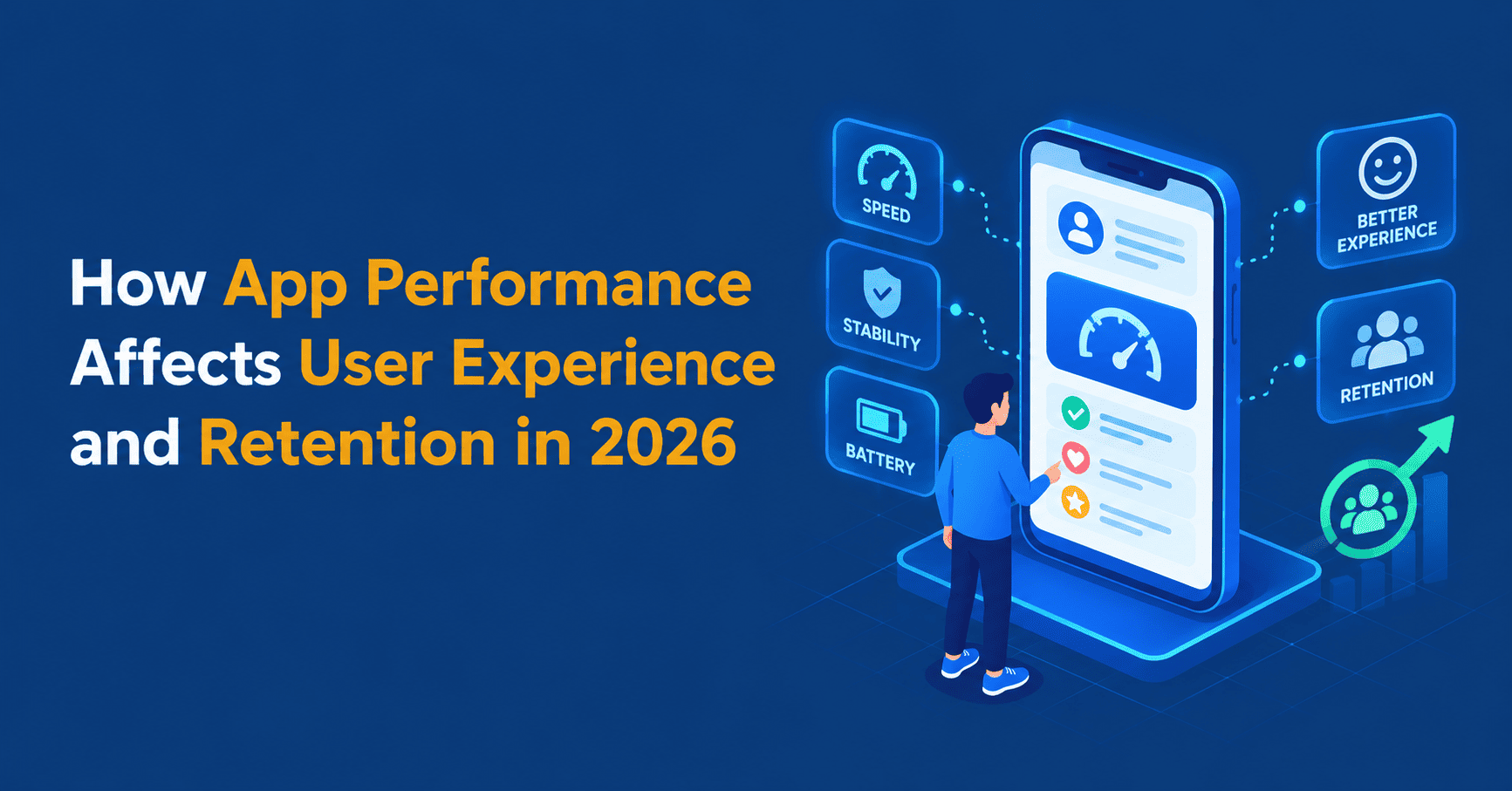
A mobile application can have useful features, an attractive interface, and a strong value proposition, but poor performance can quickly change how users perceive it. Slow loading, delayed responses, crashes, excessive battery consumption, and unexpected errors can make even a well-designed application frustrating to use.
In 2026, app performance has become more important as users expect digital experiences to feel fast, reliable, and responsive. With mobile applications becoming part of everyday activities such as shopping, banking, communication, entertainment, transportation, and work, users have less patience for applications that consistently create friction.
Performance is therefore not simply a technical concern. It directly influences user experience, engagement, and retention.
App performance refers to how efficiently an application operates on a user’s device and network. It includes several factors, such as:
A high-performing app should respond predictably and allow users to complete important actions without unnecessary waiting.
User experience is shaped by every interaction a person has with an application. Even small delays can influence whether an app feels convenient or frustrating.
For example, imagine a shopping application where users need to wait several seconds every time they open a product page. If the same problem occurs across multiple screens, users may abandon their purchase or look for another platform.
Performance creates a sense of reliability. When buttons respond quickly, screens transition smoothly, and content loads efficiently, users can focus on their intended task instead of the technology behind it.
One of the most noticeable performance problems is slow loading.
Users often expect an application to provide immediate feedback after they tap a button or open a screen. A delay without any visual indication can make users wonder whether the application has stopped working.
Developers can reduce this problem by:
The goal is not necessarily to make every operation instantaneous. Instead, the application should provide fast and meaningful feedback while work is being completed.
Speed is only one part of performance. Stability is equally important.
Frequent crashes interrupt tasks and can cause users to lose information or repeat actions. For applications involving payments, bookings, communication, or business activities, repeated crashes can be particularly disruptive.
Crash monitoring tools can help development teams identify patterns by showing which devices, operating-system versions, screens, or actions are associated with failures.
Fixing high-frequency crashes should be an ongoing part of application maintenance rather than something handled only after a major update.
Retention refers to the ability of an application to keep users coming back over time.
When an application consistently performs well, users are less likely to encounter reasons to abandon it. Conversely, repeated technical problems can gradually reduce engagement.
Performance can influence retention through several connected experiences:
Fast interactions: Users can complete tasks efficiently.
Stable sessions: Users can rely on the app without unexpected interruptions.
Lower friction: Fewer delays make common actions easier.
Better perception: Consistent performance can increase confidence in the application.
This makes performance optimization an important part of retention strategy.
Many mobile applications depend heavily on internet connectivity. However, users may access applications through different network conditions, including fast Wi-Fi, mobile broadband, and unstable connections.
An application designed only for high-speed networks may perform poorly for users with slower connections.
Developers can improve network performance by reducing unnecessary data transfers, implementing suitable caching strategies, handling failed requests gracefully, and providing useful loading states.
Offline or limited-connectivity functionality can also improve the experience when certain application features do not require a constant internet connection.
Mobile users do not all use the same hardware.
Some may have the latest flagship smartphones, while others use older or entry-level devices with less memory and processing power. Screen sizes, operating-system versions, processors, and available storage can also vary.
An application that performs well on a high-end development device may behave differently on lower-powered hardware.
Testing across representative device categories can help identify performance problems before they affect a wider audience.
The technology and architecture used to build an application can influence how developers approach performance.
For example, react native app development allows teams to create applications for multiple platforms while sharing a significant portion of the codebase. However, regardless of the development approach, performance still depends on factors such as application architecture, rendering, API efficiency, asset management, native integrations, and testing.
Choosing a development framework is therefore only one part of the performance equation. Developers need to continuously evaluate how the complete application behaves on real devices.
An application that consumes excessive battery or memory can negatively affect the overall device experience.
High background activity, inefficient location tracking, unnecessary network requests, memory leaks, and poorly optimized processes can contribute to excessive resource consumption.
Developers should monitor memory usage and background processes throughout development and after release.
Efficient resource management can make an application feel more reliable, especially during longer sessions.
Performance should be measured rather than judged only by personal testing.
Useful metrics include:
Real-user monitoring can provide additional insight because it shows how an application behaves across actual devices, operating systems, networks, and geographic locations.
These measurements help development teams identify problems that may not appear during controlled testing.
Performance improvement does not end when an application is published.
New features, third-party libraries, operating-system updates, backend changes, and increasing user activity can introduce new performance problems.
A continuous optimization process can include:
This approach helps teams avoid making optimization decisions based solely on assumptions.
Although app performance is primarily a technical characteristic, its effects can extend into business metrics.
A faster and more stable application can make it easier for users to complete purchases, bookings, registrations, searches, and other important actions. A poor experience can have the opposite effect by introducing friction at critical points.
For this reason, product managers, designers, developers, QA teams, and business stakeholders should treat performance as a shared responsibility.
App performance plays a significant role in how users experience and evaluate mobile applications in 2026. Speed, stability, responsiveness, resource efficiency, and reliable network behavior all contribute to the overall experience.
Developers can improve performance by measuring real-world behavior, optimizing application and backend architecture, testing across different devices, reducing unnecessary resource consumption, and continuously monitoring the application after release.
A visually appealing application may attract users, but consistent performance helps give them a reason to continue using it.




