Physical Address
304 North Cardinal St.
Dorchester Center, MA 02124
Physical Address
304 North Cardinal St.
Dorchester Center, MA 02124

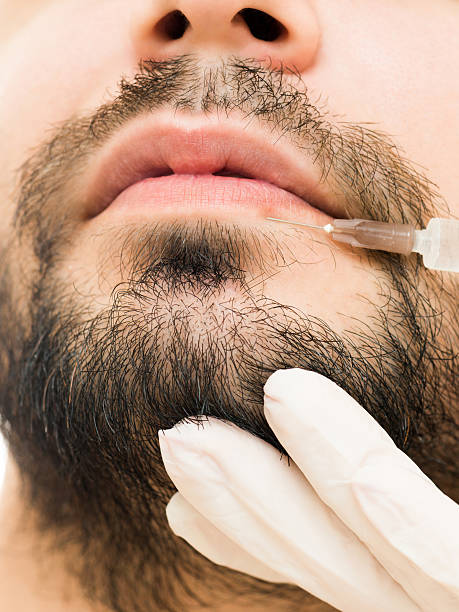
FUE is commonly used for Beard Hair Transplant in Dubai because it allows individual follicular units to be harvested and placed selectively into areas of facial hair deficiency. The technique supports detailed control over graft selection, placement, angle, spacing, and beard design, all of which influence how naturally the transplanted hair blends with existing facial hair.
FUE stands for follicular unit extraction.
Rather than removing a strip of donor skin, individual follicular units are extracted from a suitable donor region and prepared for implantation. For facial hair restoration, the value of FUE lies in this ability to work with individual grafts.
Moving hair from one location to another sounds straightforward.
The facial area makes the process more demanding because beard follicles have a visible relationship with facial contours and neighboring hair.
A scalp transplant can focus heavily on coverage. A beard transplant must also reproduce facial hair direction and create a convincing transition across the face.
The donor area is prepared before extraction.
A specialized punch is used to separate individual follicular units from the surrounding tissue. The grafts are then removed and handled carefully before implantation.
The extraction pattern matters.
Harvesting should be distributed appropriately to avoid creating an obvious reduction in donor density.
The donor area is a finite resource.
A patient may eventually require additional scalp or facial hair restoration. Conservative harvesting can help preserve future options while still providing appropriate grafts for the beard.
Not every donor follicle is identical.
Follicular units can contain different numbers of hairs and may vary in caliber, texture, and growth characteristics.
For beard restoration, these differences become particularly relevant because facial hair needs to look natural at close viewing distances.
Single-hair units can provide precise control around visible borders.
They may be particularly useful for creating a softer cheek transition or defining an area without producing an excessively heavy edge.
Units containing multiple hairs can contribute greater visual fullness where the anatomy and existing beard density allow it.
They should not simply be placed along the most visible edge because that can create an unnecessarily dense or coarse appearance.
After graft selection, recipient sites are created in the areas requiring additional facial hair.
The sites determine where and how each follicle will emerge.
This is one of the most important stages for naturalness.
Beard hair usually emerges at relatively shallow angles and can lie close to the skin.
The appropriate angle varies across different regions of the face.
Cheek hair may follow a different pattern from jawline or chin hair.
Recipient sites therefore need to follow local growth rather than using a single orientation everywhere.
Natural facial hair does not grow in a perfect grid.
Spacing is adjusted according to existing density, desired fullness, and the characteristics of the surrounding hair.
The cheek border is one of the most visible parts of a beard.
A transplant should not automatically create a perfectly straight line. The appropriate shape depends on the patient’s facial structure and grooming preference.
Fine grafts and carefully controlled placement can help create a more gradual transition where appropriate.
The jawline contributes strongly to beard definition.
A patient with weak jawline density may not need the same treatment approach as someone with a sparse cheek pattern.
The chin also requires careful blending because it connects visually with the lower lip, mustache, and jawline.
FUE allows the clinician to allocate individual grafts according to these different requirements.
A follicle can be healthy and still look unnatural if its exit direction is wrong.
Imagine placing a beard hair vertically where surrounding hairs lie diagonally across the skin. As the hair grows, the difference can become obvious.
The recipient-site direction therefore needs to be planned before the graft is inserted.
Many beard-transplant patients already have some facial hair.
That means the clinician is often working between existing follicles rather than treating completely empty skin.
Recipient-site placement needs to account for the location of native follicles to avoid unnecessary trauma and create an appropriate blend.
Facial skin varies across different regions.
Thickness, elasticity, underlying tissue, hair direction, and scar characteristics can all influence recipient-site creation.
Scarred skin can be particularly different from normal skin because previous injury may have altered tissue structure and blood supply.
A personalized assessment is therefore important before implantation.
One reason FUE is commonly considered for facial hair restoration is that individual extraction does not involve the linear donor scar associated with strip harvesting.
The donor area can still show small extraction marks during healing, and the appearance varies according to individual healing, hair characteristics, extraction technique, and donor management.
FUE should therefore not be described as a guarantee of completely invisible marks.
Clinic note: FUE is a harvesting technique, not a guarantee of naturalness by itself. The final appearance also depends on graft selection, recipient-site design, implantation direction, density, donor management, and individual healing.
The technique itself is not altered simply because the procedure takes place in Dubai, but recovery planning should account for local conditions.
Healing skin should be protected from unnecessary direct sun exposure.
This is especially relevant for patients who spend significant time outdoors or travel shortly after treatment.
High temperatures can increase perspiration.
Patients should follow their individualized instructions regarding exercise and activities that cause significant sweating.
Long periods in air-conditioned environments can leave facial skin feeling dry.
Gentle skin care and the clinic’s prescribed routine can help maintain comfort during recovery.
“FUE means there will be no marks at all.”
FUE avoids a linear strip scar, but small extraction sites can temporarily be visible and may leave subtle marks depending on individual healing.
“FUE automatically produces natural beard growth.”
The technique helps with precise follicular harvesting, but naturalness depends heavily on how the recipient sites are designed and how the grafts are implanted.
“Every graft can be placed at the same angle.”
Facial hair changes direction across different regions. A customized orientation is generally more appropriate than a uniform angle.
The main advantage is control.
Individual follicular units can be selected and placed according to the needs of different facial regions. This is valuable when the objective is not simply to add hair but to reproduce a believable beard pattern.
The technique also allows treatment to be focused.
A patient may need additional density on the cheeks but little or no intervention around the chin. FUE can support this type of selective planning.
The face should remain the starting point.
A good transplant does not ignore the patient’s natural beard. It studies it.
Hair direction, follicle spacing, facial shape, donor characteristics, skin quality, and grooming habits all contribute to the final design.
That is why two patients receiving the same number of grafts can have very different-looking outcomes.
Tajmeels Clinic can assess your donor follicles, facial hair pattern, skin characteristics, and restoration goals before determining whether FUE is appropriate for your beard.
Learn more about Beard Hair Transplant in Dubai and discuss a personalized treatment strategy designed around natural facial proportions and long-term beard growth.




