

Introduction
Enterprise IT environments rarely remain static.
Organizations continuously introduce new applications, databases, cloud services, APIs, digital platforms, and automated workloads.
Each new system may introduce additional cryptographic requirements.
Businesses may need keys for encryption, authentication, digital signatures, certificates, secure communications, and database protection.
As infrastructure grows, cryptographic key management can become increasingly complex.
A process that works for a small environment may not work effectively when an organization manages thousands of keys across multiple infrastructure platforms.
This makes scalability an important consideration in enterprise Key management.
A scalable approach to key management in cryptography helps organizations maintain security and governance as their IT environment expands.
Why Key Management Must Scale
An enterprise may operate across:
-
Public cloud platforms
-
Private cloud
-
On-premises infrastructure
-
SaaS applications
-
Enterprise databases
-
APIs
-
Mobile applications
-
Backup environments
Every additional environment can create new keys and cryptographic dependencies.
Without a scalable framework, security teams may struggle to maintain visibility and control.
Start With a Cryptographic Inventory
Organizations should begin by creating an inventory of existing cryptographic assets.
The inventory should include:
-
Key identifier
-
Key owner
-
Key purpose
-
Associated application
-
Protected information
-
Lifecycle status
-
Rotation schedule
This provides a baseline for future growth.
Understand Key Management in Cryptography
Key management in cryptography covers the complete lifecycle of cryptographic keys.
A typical lifecycle includes:
-
Generation
-
Storage
-
Distribution
-
Access
-
Usage
-
Rotation
-
Backup
-
Recovery
-
Retirement
-
Destruction
A scalable framework should address every stage.
Establish Clear Ownership
Every critical key should have an owner.
Ownership helps organizations determine who is responsible for:
-
Access
-
Rotation
-
Recovery
-
Monitoring
-
Retirement
As the number of keys grows, unclear ownership can become a significant governance problem.
Standardize Key Policies
Organizations should establish common policies for cryptographic keys.
Policies may define:
-
Approved cryptographic algorithms
-
Key sizes
-
Storage requirements
-
Access controls
-
Rotation intervals
-
Backup procedures
-
Recovery requirements
-
Retirement processes
Standardization makes it easier to manage large environments.
Use Centralized Key Management
Centralized Key management can help organizations manage cryptographic assets consistently.
Instead of allowing every application team to establish separate processes, security teams can define enterprise-wide policies.
Centralization can improve:
-
Visibility
-
Governance
-
Access control
-
Lifecycle management
-
Monitoring
This becomes particularly valuable as organizations add new systems.
Design for Cloud Growth
Cloud adoption can significantly increase the number of applications and services an organization operates.
Security teams should consider how Key management will support future cloud expansion.
They should evaluate:
-
Multi-cloud environments
-
Hybrid infrastructure
-
Cloud-native applications
-
Database services
-
Cloud storage
-
Backup platforms
Key management architecture should support both current and planned infrastructure.
Apply Least Privilege
A scalable framework must maintain access control as the number of users and applications increases.
Organizations should apply least privilege.
Applications should access only the cryptographic keys or operations they require.
Security teams should review permissions regularly.
Automate Routine Activities
Manual key management becomes increasingly difficult as the enterprise grows.
Organizations should automate appropriate processes such as:
-
Rotation
-
Expiration notifications
-
Inventory updates
-
Access workflows
-
Lifecycle events
Automation can improve consistency and reduce repetitive administrative work.
However, organizations should maintain appropriate human oversight for sensitive operations.
Build for Key Rotation
A scalable framework should make key rotation manageable.
Security teams should know:
-
Which keys require rotation
-
Which applications depend on each key
-
When rotation should occur
-
How applications handle new keys
-
How old keys are retired
Organizations should test rotation workflows before applying them widely.
Plan for Key Recovery
Scalability also requires reliable recovery.
As the number of keys increases, organizations need structured processes for recovering critical keys.
Recovery should include:
-
Strong authorization
-
Secure backups
-
Documented procedures
-
Monitoring
-
Regular testing
Integrate With Application Development
Key management should become part of application architecture.
Development teams should understand how applications access cryptographic services.
Organizations should discourage insecure practices such as storing keys directly in source code.
Standard application integration patterns can make Key management easier to scale.
Support Legacy Applications
Growing enterprises often maintain older applications.
Some legacy systems may not integrate easily with modern Key management infrastructure.
Organizations should identify these systems early and develop appropriate integration or migration strategies.
Monitoring at Scale
Security teams need visibility into cryptographic activity.
As environments grow, manual monitoring becomes difficult.
Organizations should monitor:
-
Key access
-
Key creation
-
Key rotation
-
Failed access attempts
-
Administrative changes
-
Key retirement
Automated monitoring and alerting can help security teams identify unusual activity.
Managing Key Sprawl
Key sprawl represents a common scalability problem.
Organizations should regularly identify:
-
Duplicate keys
-
Unused keys
-
Unknown keys
-
Keys without owners
-
Keys with excessive permissions
Removing unnecessary cryptographic assets can simplify the environment.
Governance and Reporting
A scalable framework should support governance reporting.
Security teams should be able to answer questions such as:
-
How many keys exist?
-
Who owns them?
-
Which applications use them?
-
Which keys require rotation?
-
Which keys have excessive permissions?
-
Which keys are obsolete?
Clear reporting supports security decisions.
Common Scalability Challenges
Rapid Infrastructure Growth
New systems can introduce keys faster than security teams can document them.
Fragmented Processes
Different teams may follow different Key management practices.
Manual Administration
Manual workflows do not scale effectively.
Poor Visibility
Security teams may lose track of key dependencies.
Legacy Technology
Older systems can complicate centralized management.
Best Practices
Organizations should:
-
Maintain a centralized key inventory.
-
Assign clear ownership.
-
Standardize lifecycle policies.
-
Apply least privilege.
-
Separate keys from protected data.
-
Automate appropriate processes.
-
Establish rotation policies.
-
Protect backups.
-
Test recovery.
-
Monitor key activity.
-
Review permissions regularly.
-
Retire obsolete keys.
-
Design for future cloud and application growth.
Building a Long-Term Framework
A scalable Key management framework should evolve with the organization.
Businesses should periodically review:
-
Infrastructure changes
-
New applications
-
Cloud adoption
-
Security requirements
-
Regulatory obligations
-
Key volumes
-
Operational processes
Continuous improvement prevents Key management from becoming outdated.
Conclusion
Enterprise infrastructure grows continuously, and cryptographic key requirements grow with it.
Organizations therefore need a Key management framework that can scale without sacrificing security or operational control.
Key management in cryptography provides the lifecycle foundation for managing keys from generation through destruction.
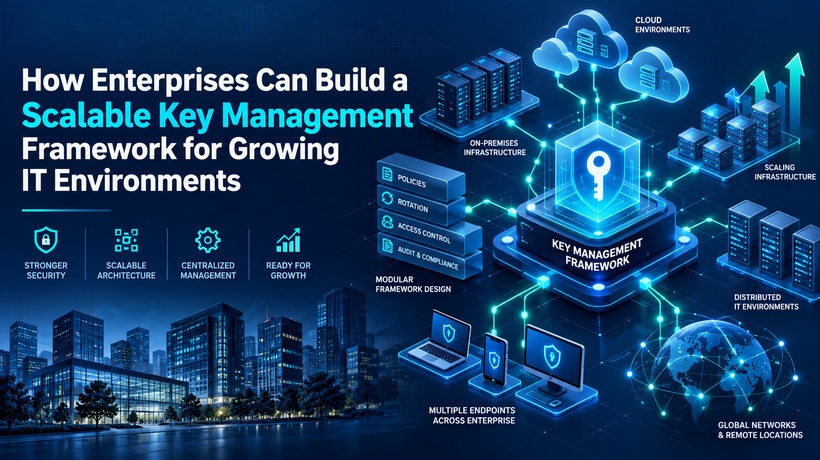
Effective Key management improves visibility, ownership, access control, rotation, recovery, monitoring, and governance.
By combining centralized management, automation, standardized policies, least privilege, accurate inventories, and scalable architecture, enterprises can maintain stronger control over cryptographic keys as their IT environments become larger and more complex.



