Physical Address
304 North Cardinal St.
Dorchester Center, MA 02124
Physical Address
304 North Cardinal St.
Dorchester Center, MA 02124

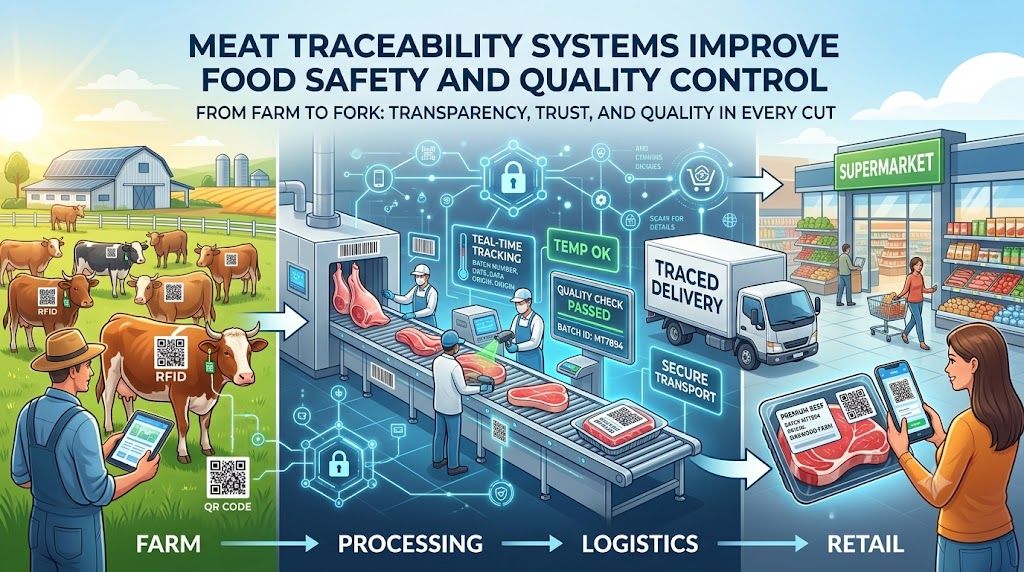
Food safety is one of the most important responsibilities in the meat processing industry. From livestock farms and slaughterhouses to processing facilities, cold storage warehouses, distributors, and retailers, every stage of the meat supply chain must maintain reliable product information and appropriate quality controls. A problem at any stage can affect product safety, disrupt operations, and damage a company’s reputation.
Meat traceability systems help businesses connect product records across these stages, making it easier to identify where meat originated, how it was processed, and where it was distributed. By maintaining accurate batch information and production records, meat processors can investigate quality issues more efficiently and respond to potential contamination concerns.
Traditional tracking methods often involve paper documents, spreadsheets, and separate inventory systems. These approaches can make it difficult to retrieve complete product histories when time matters most. Digital meat traceability systems provide a more organized way to manage product information, support recall investigations, and strengthen quality management processes.
For meat processors seeking better operational visibility, implementing an effective traceability system can be an important step toward more consistent food safety management.
Meat traceability systems are processes and technologies used to identify and track meat products throughout the supply chain. They connect information about livestock or raw meat sourcing, processing activities, packaging, storage, transportation, and distribution.
A traceability system may combine digital software, product labels, batch numbers, barcodes, supplier records, production logs, and shipment documentation. More advanced implementations may also integrate with enterprise resource planning systems, warehouse management platforms, temperature monitoring equipment, and quality management applications.
The main objective is to create a reliable record of a product’s history. For example, when a processor receives raw beef from a supplier, the receiving record can be connected to a specific lot. As the beef is processed into different cuts, the system can preserve the relationship between the incoming lot and the resulting products.
If a quality concern later affects the original material, the processor can use these relationships to investigate which finished products may be involved and where they were shipped.
Meat traceability is not the same as food safety testing. Testing and inspection help assess product conditions, while traceability helps establish product identity, history, and movement. Both can contribute to an effective food safety program.
Meat products can be exposed to biological, chemical, and physical hazards at different points in the supply chain. Improper handling, inadequate temperature control, cross-contamination, and failures in sanitation procedures can increase food safety risks.
The complexity of meat processing creates additional challenges. A facility may receive materials from multiple suppliers, process different batches on the same production line, and distribute finished products to several customers. If records are incomplete, investigating a potential issue can require extensive manual work.
Traceability helps businesses connect information across these activities. When a supplier identifies a potential problem with a raw material batch, a processor can investigate the associated production records and identify products that may require further assessment.
Accurate records also help quality teams review recurring issues, evaluate supplier performance, and identify gaps in operational procedures.
However, traceability cannot prevent every food safety incident. Its effectiveness depends on accurate data, appropriate preventive controls, employee training, and a clear process for responding to problems.
Food safety management begins with understanding where livestock and raw meat originate. Depending on the operation and applicable requirements, businesses may need records identifying suppliers, animals or animal groups, receiving transactions, and relevant source documentation.
A digital meat traceability system can centralize this information and associate it with incoming products. This gives processors a more reliable starting point for tracking materials through their facilities.
When multiple suppliers provide meat to the same processing plant, clear identification helps employees distinguish between incoming lots. It also supports investigations when a supplier reports an issue that could affect particular deliveries.
The level of tracking should match the product, business process, and regulatory requirements. Individual animal identification, group identification, and shipment-level tracking serve different purposes and should not be treated as interchangeable in every situation.
Meat processing involves several activities, including cutting, deboning, grinding, mixing, packaging, and other forms of transformation. Each activity may create new products or change the relationship between incoming materials and finished goods.
An effective meat traceability system records these relationships. When an incoming batch is divided into multiple products, the system should preserve the connection between the original batch and each resulting lot. When materials from different lots are combined, the relevant input relationships should also be recorded.
This process is commonly known as product genealogy.
Maintaining product genealogy allows quality teams to investigate the potential scope of a problem without relying only on production dates or general product descriptions. It can also help identify whether an issue is limited to one production batch or may involve multiple finished products.
Temperature control is particularly important for many meat products during storage and transportation. Businesses need suitable handling procedures to maintain product conditions within applicable requirements.
Traceability software may integrate with temperature sensors, data loggers, or cold storage monitoring systems to connect environmental records with specific shipments, storage locations, or product batches.
For example, if a refrigerated shipment experiences a temperature excursion, the business can review the associated shipment records and identify which products were involved. The responsible team can then assess the available evidence and determine the appropriate action.
Temperature monitoring and traceability are separate capabilities, even when they operate together. A company should verify that its software supports the required sensor integrations and provides the records needed for its food safety procedures.
Meat processors depend on suppliers to provide accurate information about incoming products and relevant documentation. Missing records or inconsistent supplier details can make it harder to establish product history.
Traceability systems can connect supplier profiles, receiving transactions, and supporting documents. This helps employees review incoming information and identify missing or inconsistent records.
Centralized supplier documentation can also support internal audits and supplier performance reviews. When recurring problems occur, businesses can investigate whether the issue relates to documentation, receiving procedures, or other operational factors.
Supplier verification should remain part of a broader purchasing and quality management process. Digital records help organize evidence but do not independently guarantee supplier reliability.
Food safety and product quality are closely connected, but they are not identical. Food safety focuses on protecting consumers from hazards, while quality control also covers characteristics such as product specifications, packaging integrity, consistency, and customer requirements.
Meat traceability systems support quality control by linking products to their production history and associated inspection records.
For example, a processor may receive a customer complaint about incorrect packaging or a product that does not meet the expected specification. If the product label contains a batch identifier, quality personnel can retrieve the relevant production records, examine the packaging information, and investigate whether other products from the same run may be affected.
Traceability can also help businesses identify recurring patterns across suppliers, facilities, production lines, or product categories. These patterns may support corrective and preventive action, provided the underlying records are complete and consistent.
By connecting quality findings with product history, companies can move beyond isolated investigations and develop a better understanding of operational performance.
Product recalls can be complicated when a meat processor does not have reliable information about incoming materials, production batches, and customer shipments. Teams may need to search multiple systems, contact suppliers, and manually reconcile shipping records before they can understand the scope of a potential issue.
Digital meat traceability systems can simplify this process by connecting the relevant information in one searchable environment.
When a potential safety concern is reported, authorized employees can investigate the affected material, identify related production batches, and review available distribution records. These records help the business determine which products and customers require further attention.
For example, a supplier may notify a beef processor that a specific incoming lot requires investigation. The processor can use its traceability records to determine which production runs used that lot, which finished products were created, and which shipments included those products.
This information supports a more targeted investigation and helps the responsible team coordinate its response.
Traceability software does not replace official recall procedures or determine whether a recall is legally required. Businesses must follow the applicable regulations, notify the relevant authorities when required, and make decisions based on the available evidence.
Batch and lot tracking allows processors to identify groups of products using unique identifiers. It connects receiving records, processing information, packaging details, and shipment data.
A useful system should preserve lot relationships when products are divided, combined, repacked, or transferred between facilities. This is especially important for meat businesses that handle multiple suppliers and product categories.
Digital recordkeeping helps businesses organize information about suppliers, production activities, inspections, product movements, and shipments.
Centralized records can reduce the time spent searching through paper files and separate spreadsheets. They can also make it easier to retrieve information during audits or internal investigations.
The system should support appropriate access controls, record corrections, and audit histories so that businesses can manage information responsibly.
Barcodes and QR codes can connect physical meat products, containers, or pallets with digital records. Employees can scan an identifier to retrieve relevant information, depending on their permissions and the system’s configuration.
These technologies can help reduce manual searching and improve identification accuracy when labels are readable and scanning procedures are followed consistently.
Recall-related reporting tools help teams retrieve records associated with potentially affected products. Useful capabilities may include searching by lot number, reviewing product relationships, identifying shipment destinations, and exporting supporting records.
Businesses should test these functions using realistic scenarios before implementation. The ability to find information quickly is particularly important when responding to urgent product safety concerns.
Meat processors often use ERP, inventory, production, warehouse, and quality management systems. Integrating these platforms can reduce duplicate data entry and help keep product information consistent across departments.
Before purchasing a traceability solution, businesses should confirm which systems it can connect to and how information is synchronized. Integration quality can directly affect the completeness and reliability of traceability records.
One major benefit is improved visibility into product movement. Businesses can connect information from suppliers, processing facilities, storage locations, and customer shipments, giving teams a clearer understanding of product history.
Traceability can also improve investigation efficiency. When records are structured and searchable, quality personnel may spend less time collecting information from different departments and more time evaluating the issue.
Another benefit is stronger accountability. Connecting incoming materials to suppliers and finished products to shipments makes it easier to investigate inconsistencies and communicate with supply chain partners.
Digital traceability may also support more efficient audits and documentation reviews. Rather than manually assembling records from several sources, employees can retrieve relevant information from the system, provided the necessary records have been captured.
Finally, traceability can support customer confidence by helping businesses substantiate information about product origin and handling. Any claims shared with customers should be supported by reliable evidence and should reflect what the system can actually verify.
Meat businesses operate under different regulatory frameworks depending on their location, products, and activities. Requirements may cover animal identification, slaughter and inspection records, product labeling, establishment documentation, distribution records, and other food safety obligations.
In the United States, businesses should review applicable requirements from the United States Department of Agriculture Food Safety and Inspection Service, alongside any other relevant federal, state, or local rules.
International operations may need to account for additional import, export, animal health, and product documentation requirements. A business should not assume that a traceability system configured for one market automatically meets the requirements of another.
Before implementation, companies should map applicable obligations to the records they need to maintain. They should then confirm that the selected system supports the relevant data fields, retention policies, retrieval procedures, and access controls.
Software can help organize compliance information, but regulatory compliance depends on the company’s processes, record accuracy, and adherence to applicable requirements.
One common challenge is inconsistent data collection. If different facilities use different batch formats or employees fail to record required production events, the traceability history may contain gaps.
Businesses can address this by establishing standard operating procedures, defining mandatory data fields, and training employees on when and how to capture information.
Integration with existing applications can also be difficult. Legacy systems may store information in formats that are not immediately compatible with a new platform. A structured integration plan should address data mapping, testing, error handling, and ongoing maintenance.
Supplier participation is another important factor. Traceability depends on information received from external partners as well as data generated internally. Businesses should agree on practical identification and information-sharing procedures with their suppliers.
Cost and usability should also be considered. The most appropriate solution is not necessarily the one with the greatest number of features. It is the one that reliably supports the business’s actual traceability needs and can be used consistently across relevant operations.
Selecting suitable meat traceability software begins with an assessment of existing processes and business risks.
Processors should identify which stages require tracking, how materials are transformed during production, and what information must be available during a recall investigation. Businesses handling multiple meat categories or operating several facilities may require more detailed product genealogy and cross-facility visibility.
The next step is to evaluate the platform’s capabilities. Batch tracking, supplier management, digital documentation, shipment records, reporting, and relevant integrations should be assessed against specific operational requirements.
Ease of use is equally important. Employees should be able to record information, scan identifiers, and retrieve product histories without unnecessary complexity. Training requirements and supplier onboarding should be included in the implementation plan.
Before committing to a full rollout, conduct a pilot using a realistic example, such as tracing an incoming lot through processing, packaging, and distribution. Measure whether the system can retrieve the required records and identify the relevant product relationships accurately.
A carefully selected and properly implemented system can help establish a more reliable foundation for food safety and quality management.
Meat traceability systems help processors and distributors connect product information throughout the supply chain. By maintaining accurate supplier records, tracking batches through processing, and linking finished products with shipments, businesses can improve visibility and support more effective food safety investigations.
These systems also help quality teams investigate complaints, organize documentation, and identify the potential scope of product issues. Their effectiveness, however, depends on consistent data collection, suitable technology, employee training, and well-defined procedures.
For meat businesses seeking to strengthen food safety and quality control, digital traceability provides a practical way to improve product accountability and make important information easier to retrieve. When combined with appropriate food safety controls and compliance procedures, it can support a more transparent and resilient meat supply chain.




