
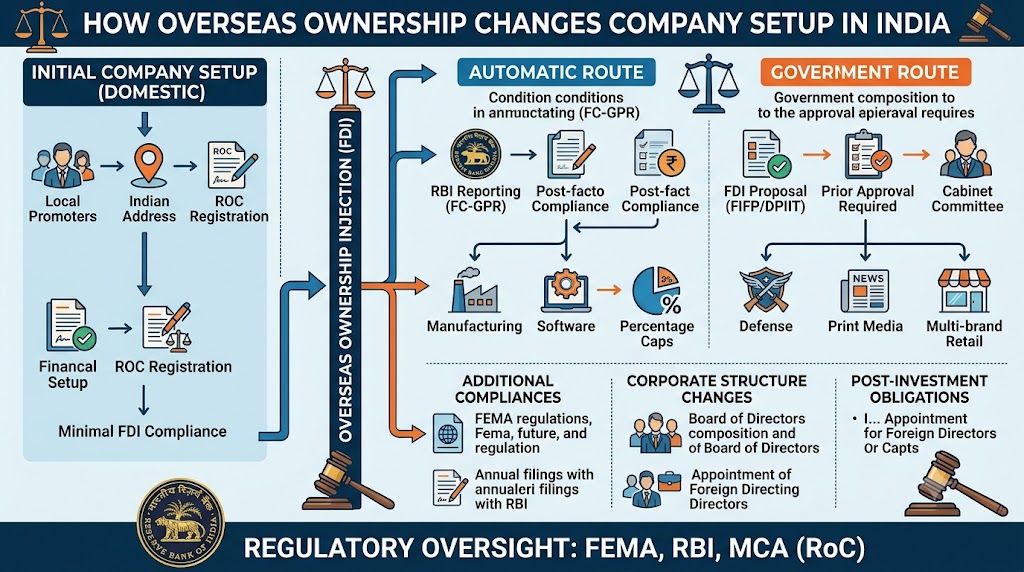

India has become an important destination for international businesses seeking new markets, skilled talent and long term growth opportunities. Foreign entrepreneurs can establish an Indian business in many sectors, but overseas ownership introduces additional legal and regulatory considerations.
The process involves more than registering a company with the Ministry of Corporate Affairs. Founders must also consider foreign investment rules, director requirements, capital transfers, tax obligations and ongoing reporting. These requirements can influence how the business is structured, funded and managed from the outset.
Understanding the differences between a domestically owned company and a foreign owned entity helps founders avoid unnecessary delays. It also allows them to build a compliant structure which supports future investment and expansion.
Choosing the Right Business Structure
The first decision is selecting a legal structure suited to the proposed business. Foreign investors may consider an Indian private limited company, a limited liability partnership or an eligible branch or liaison office of an overseas entity.
Each option serves a different purpose. A private limited company creates a separate Indian legal entity and can accommodate foreign shareholders, subject to the applicable investment rules. It is often suitable for businesses planning to hire employees, enter commercial contracts or raise additional capital.
A branch office operates as an extension of the foreign company and can undertake only activities permitted under the relevant regulatory framework. A liaison office generally has more limited functions and cannot ordinarily conduct commercial trading activities in India.
The right structure depends on the business model, the intended ownership arrangement and the level of operational independence required. Founders should also consider future fundraising, profit repatriation and exit plans before making a decision.
How Foreign Investment Rules Affect Ownership
Overseas ownership is governed by India’s foreign direct investment framework. Although foreign investment is permitted in many sectors, the applicable conditions vary according to the industry and proposed activity.
Under the automatic route, investment can generally proceed without prior government approval, provided all relevant conditions are met. Under the government approval route, permission must be obtained before the investment proceeds.
Certain sectors have limits on foreign ownership or impose additional requirements. Some investments may also require closer scrutiny because of the investor’s country of origin or beneficial ownership.
These rules can affect both the initial shareholding structure and future transactions. For example, a founder planning to sell shares to an overseas investor should assess whether the proposed transfer complies with applicable sectoral limits, pricing requirements and reporting obligations.
It is also important to distinguish between incorporating an Indian company and obtaining permission to carry on a regulated activity. Registration alone does not authorise a business to operate in every sector.
Director and Shareholder Requirements
Foreign ownership can influence the documentation and verification needed for directors and shareholders. However, overseas nationality does not automatically prevent an individual from becoming a director or shareholder of an Indian company.
An Indian private company generally requires at least two directors and two members. At least one director must satisfy the statutory requirement concerning residence in India. A foreign founder may serve as a director, subject to the applicable identification, appointment and compliance requirements.
The company must also establish its shareholding structure clearly. Incorporation documents should accurately identify the subscribers, their share allocations and the proposed management arrangements.
Foreign individuals may need to provide passports, proof of address and other identity documents. Depending on the country where documents originate, notarisation, apostille or consular legalisation may be necessary.
Planning these requirements early helps prevent registration delays. Professional guidance can also clarify how overseas documents should be prepared and whether additional verification is required.
Capital Transfers and Banking Compliance
A foreign owned company needs suitable arrangements for receiving investment and managing funds. Banks typically conduct checks on the company’s ownership, beneficial owners, directors and source of capital.
The movement of funds from overseas into India must comply with the applicable foreign exchange framework. Depending on the transaction, the company may need to maintain evidence of remittance, issue shares within the prescribed period and submit the required reports through the relevant regulatory channels.
For example, when a foreign investor subscribes to shares in an Indian company, the company must consider the applicable pricing rules, share allotment requirements and reporting deadlines. Failure to complete these steps can create compliance difficulties even if the investment itself is permitted.
Founders should coordinate with their bank and professional advisers before transferring funds. A clear record of each transaction makes it easier to demonstrate compliance and respond to future due diligence requests.
Taxation and Cross Border Transactions
Overseas ownership can make tax planning more complex because the Indian company may transact with its foreign parent, overseas investors or associated enterprises.
An Indian entity may have obligations involving corporate income tax, goods and services tax, tax deducted at source and statutory financial reporting. The specific requirements depend on its activities, turnover and transactions.
Cross border payments also require careful consideration. Payments for intellectual property, consultancy, management services or royalties may have withholding tax implications. Double taxation agreements can provide relief in eligible cases, but the applicable conditions and documentation must be examined.
Transfer pricing rules may apply to international transactions between associated enterprises. Businesses should maintain appropriate records to support the commercial basis and pricing of such transactions.
Early tax planning helps founders understand the overall cost of operating in India and reduces the risk of unexpected liabilities.
How Overseas Ownership Affects Company Incorporation
The incorporation process follows the applicable Indian company law framework, but foreign participation can introduce additional documentation and coordination requirements.
The company must select an available name, prepare its constitutional documents, identify its directors and shareholders, and provide a valid registered office address. Digital signatures and director identification procedures must also be completed where required.
Foreign founders may face additional steps involving identity verification and authentication of documents executed abroad. The exact requirements depend on the individuals involved, the country of origin and the registration process applicable to the company.
Working with company incorporation lawyers can help founders assess the proposed structure, prepare the necessary documents and identify foreign investment conditions before filing an application.
A properly planned private limited company setup can also make later changes in ownership, fundraising and corporate governance easier to manage. However, incorporation should be treated as the beginning of the compliance process rather than its conclusion.
Ongoing Compliance After Incorporation
Once the company is registered, foreign ownership does not remove its obligations under Indian corporate law. The business must maintain statutory records, file applicable annual returns and financial statements, and comply with board meeting and shareholder decision requirements.
Additional reporting may apply to foreign investment and changes in shareholding. Companies operating in regulated industries may also require sector specific licences or approvals.
Where the Indian company employs staff, it must comply with relevant employment, payroll and workplace regulations. Depending on the nature of its activities, further registrations may be necessary before commercial operations begin.
The company should establish a compliance calendar and assign responsibility for each filing and reporting obligation. This becomes particularly important when directors and shareholders are based in different countries and decisions must be coordinated across time zones.
Conclusion
Overseas ownership can open valuable opportunities for businesses entering India, but it also changes the legal and administrative considerations involved in company formation.
The choice of business structure, foreign investment eligibility, director requirements, capital transfers and tax treatment should all be assessed before operations begin. These decisions influence not only the incorporation process but also the company’s ability to attract investment and expand in the future.
By reviewing the applicable regulations, preparing accurate documentation and establishing reliable compliance procedures, foreign founders can create a sound legal foundation for their Indian business. The specific requirements should always be verified against current laws and the circumstances of the proposed investment.