Physical Address
304 North Cardinal St.
Dorchester Center, MA 02124
Physical Address
304 North Cardinal St.
Dorchester Center, MA 02124

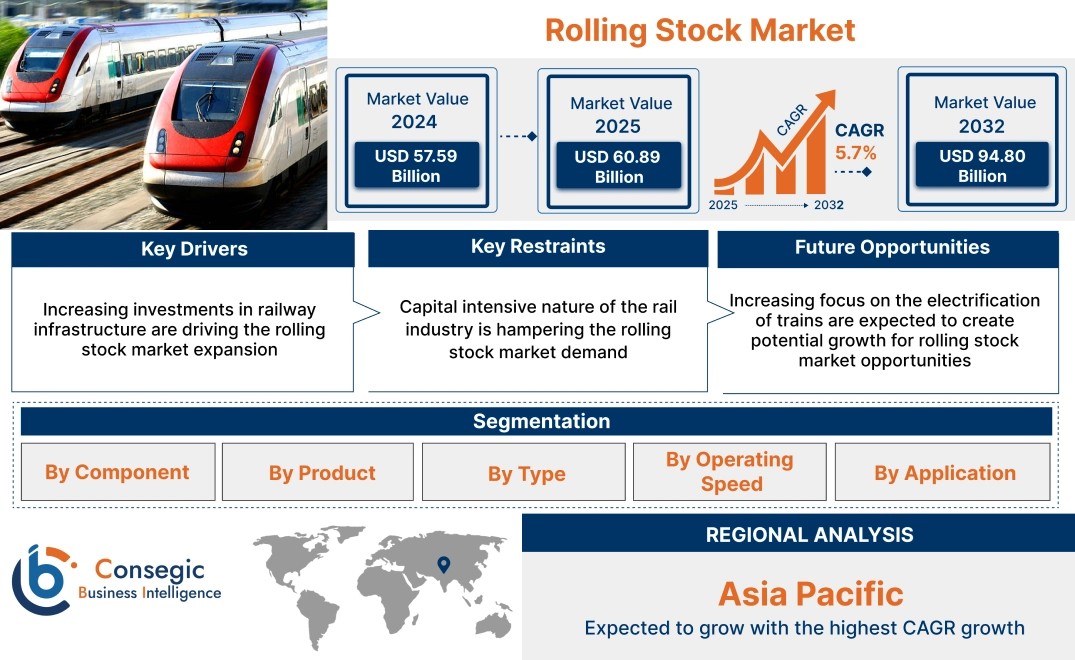
Rail transportation is becoming increasingly important as governments and operators seek efficient, sustainable, and high-capacity mobility solutions. Urbanization, expansion of metro networks, railway modernization, high-speed rail projects, and freight transportation are creating sustained demand for new trains and upgraded fleets. Against this backdrop, the Rolling Stock Market is evolving from a conventional vehicle manufacturing industry into a technology-driven transportation ecosystem.
Rolling stock includes locomotives, passenger coaches, metro vehicles, high-speed trains, trams, and freight wagons. Current developments are focused on energy efficiency, passenger comfort, safety, automation, and connected fleet management. For example, India has expanded its modern train production, while Europe continues to invest heavily in rail infrastructure and connected mobility.
The Rolling Stock Market covers the production, modernization, maintenance, and deployment of railway vehicles used for passenger and freight transportation. Demand comes from conventional railways as well as metro, light rail, high-speed rail, and urban transit systems.
Key applications include:
The market is closely linked to railway infrastructure investment. One industry estimate values the global market at about USD 70.6 billion in 2025 and projects it to reach approximately USD 123.0 billion by 2033, representing a 7.4% CAGR from 2026 to 2033. Asia-Pacific accounted for about 44.3% of global revenue in 2025 according to the same estimate.
Several structural factors are supporting the expansion of the Rolling Stock Market.
Rail infrastructure modernization is one of the strongest drivers. Aging fleets require replacement or refurbishment, while new metro and high-speed corridors require purpose-built trains.
Urbanization is also increasing demand for metro and light-rail vehicles. Growing cities need transportation systems capable of moving large numbers of passengers while limiting road congestion and emissions.
Government investment is another important factor. In Europe, the European Commission selected 94 transport projects receiving nearly €2.8 billion in grants in 2025, with rail receiving 77% of the funding.
Demand is also being strengthened by:
Digital transformation is changing how trains are designed, operated, and maintained. Artificial Intelligence (AI) and Machine Learning (ML) are increasingly being explored for condition monitoring, fault detection, scheduling, and predictive maintenance.
IoT Integration allows sensors installed across trains to collect information about motors, brakes, wheels, doors, HVAC systems, and other components. Data Analytics can then identify unusual operating patterns before they develop into major failures.
Automation is also expanding. Driver-assistance technologies, automated metro systems, digital signaling, and remote diagnostics are contributing to smarter railway operations.
Sustainability is another major trend. Manufacturers are focusing on lightweight structures, energy-efficient propulsion, regenerative braking, recyclable materials, and battery-electric or hybrid technologies. These developments support Green Technologies and the broader Circular Economy.
The technology landscape of the Rolling Stock Market is moving toward connected and intelligent vehicles. Modern train platforms increasingly combine advanced propulsion, digital control systems, onboard connectivity, and real-time monitoring.
Advanced Materials can reduce vehicle weight while maintaining structural strength. Lightweight alloys, composites, and improved interior materials can contribute to lower energy consumption and longer component life.
Smart Manufacturing and Industry 4.0 are also changing production facilities. Robotics, automation, digital quality inspection, and connected manufacturing systems can improve consistency and production efficiency.
Cloud Technologies enable centralized analysis of fleet information, while digital twins can help operators simulate equipment behavior and evaluate maintenance requirements. Research into AI-enabled railway maintenance is also expanding, with recent studies examining machine learning for predictive and condition-based maintenance.
North America is supported by freight rail activity, commuter transportation, and fleet modernization. Investment opportunities are emerging in locomotives, passenger rail vehicles, digital monitoring, and maintenance technologies.
Europe remains a major rail technology market because of extensive passenger networks, cross-border transportation, high-speed rail, and sustainability objectives. ERTMS deployment and railway modernization are creating additional demand for digitally equipped trains and compatible onboard systems.
Asia-Pacific represents a major growth center due to rapid urbanization, metro expansion, high-speed railway development, and large-scale infrastructure investment. India is expanding domestic rolling-stock manufacturing, including Vande Bharat trainsets. In April 2026, Indian Railways reported nearly 3.98 crore Vande Bharat passengers during FY 2025–26, about 34% higher than the previous year.
Latin American opportunities are concentrated around urban transit modernization, metro development, and replacement of aging fleets. Public transportation investment can support demand for metro cars, locomotives, and maintenance services.
Investment in new urban rail systems, intercity connections, and railway infrastructure is supporting long-term opportunities. New transit projects can create demand for passenger coaches, locomotives, signaling-compatible vehicles, and fleet maintenance solutions.
Investment potential extends beyond manufacturing complete trains. High-growth opportunities can emerge across:
Emerging economies may offer particularly attractive opportunities as cities develop new transportation networks and replace aging railway fleets.
Competition in the Rolling Stock Market is increasingly based on technology, lifecycle costs, energy efficiency, reliability, and customization rather than vehicle production alone.
Manufacturers and technology providers are investing in research and development, strategic partnerships, manufacturing capacity, digital platforms, and advanced propulsion systems. Partnerships between train manufacturers, railway operators, software companies, and infrastructure providers can accelerate technology deployment.
India provides a current example of expanding domestic manufacturing capability. In May 2026, Modern Coach Factory, Raebareli rolled out its first Vande Bharat trainset for testing, adding another manufacturing facility to the program.
The Rolling Stock Market is expected to move toward more connected, efficient, automated, and environmentally sustainable railway vehicles through 2034. Electrification, high-speed transportation, urban rail expansion, and freight modernization will remain important demand areas.
Future trains are likely to integrate greater AI capabilities, IoT Integration, automated diagnostics, advanced sensor networks, cloud-based fleet management, and Predictive Maintenance. Digital Transformation will increasingly connect rolling stock with railway infrastructure, allowing operators to make decisions using real-time operational data.
Sustainability will remain equally important. Energy-efficient propulsion, recyclable materials, battery technologies, regenerative braking, and improved lifecycle management can support lower environmental impact.
The Rolling Stock Market is entering a period of technological and structural transformation. Expansion of rail infrastructure, urban mobility requirements, fleet modernization, and sustainability targets are creating opportunities across passenger, freight, metro, and high-speed transportation.
Through 2034, the strongest opportunities are likely to emerge where advanced engineering meets digital technologies. AI, automation, smart manufacturing, IoT Integration, advanced materials, and predictive maintenance can improve vehicle performance while reducing lifecycle costs. As governments and operators continue investing in modern rail networks, rolling stock will remain a critical component of the future transportation ecosystem.
The Rolling Stock Market refers to the industry involved in manufacturing, upgrading, maintaining, and supplying railway vehicles such as locomotives, passenger coaches, metro cars, high-speed trains, trams, and freight wagons. Its growth is closely connected with railway infrastructure development, fleet modernization, urbanization, electrification, and increasing demand for efficient public transportation.
Key growth drivers include railway infrastructure modernization, urbanization, expansion of metro and high-speed networks, freight transportation demand, fleet replacement programs, electrification, and government investment. Technological developments involving automation, AI, IoT, energy-efficient propulsion, and Predictive Maintenance are also increasing the value of modern rolling stock.
Asia-Pacific is a leading regional market, supported by extensive railway networks, rapid urbanization, metro expansion, high-speed rail projects, and significant manufacturing activity. China and India are particularly important contributors to regional demand, while Europe remains a major center for advanced railway technology, high-speed rail, and sustainable transportation development.
Major trends include electrification, lightweight vehicle structures, AI-enabled maintenance, IoT-based monitoring, automated operations, digital twins, smart manufacturing, advanced passenger information systems, and energy-efficient propulsion. Sustainability is also becoming increasingly important as railway operators seek lower energy consumption, reduced emissions, recyclable materials, and longer vehicle lifecycles.
By 2034, opportunities are expected across high-speed trains, metro vehicles, electric locomotives, freight wagons, fleet modernization, digital maintenance platforms, railway cybersecurity, advanced propulsion, lightweight components, and connected train systems. Companies developing technologies that improve energy efficiency, reliability, automation, and lifecycle management may benefit from long-term rail investment.
About Us
At Consegic Business Intelligence Pvt. Ltd., we empower organizations with actionable market intelligence, strategic insights, and data-driven research solutions that support informed business decision-making. Our comprehensive market research reports provide in-depth analysis of industry trends, competitive landscapes, emerging opportunities, and future growth prospects across diverse sectors.
Contact Us
Consegic Business Intelligence Pvt. Ltd.
Website: www.consegicbusinessintelligence.com
Email: sales@consegicbusinessintelligence.com
Phone: +1-833-313-3130




