Physical Address
304 North Cardinal St.
Dorchester Center, MA 02124
Physical Address
304 North Cardinal St.
Dorchester Center, MA 02124

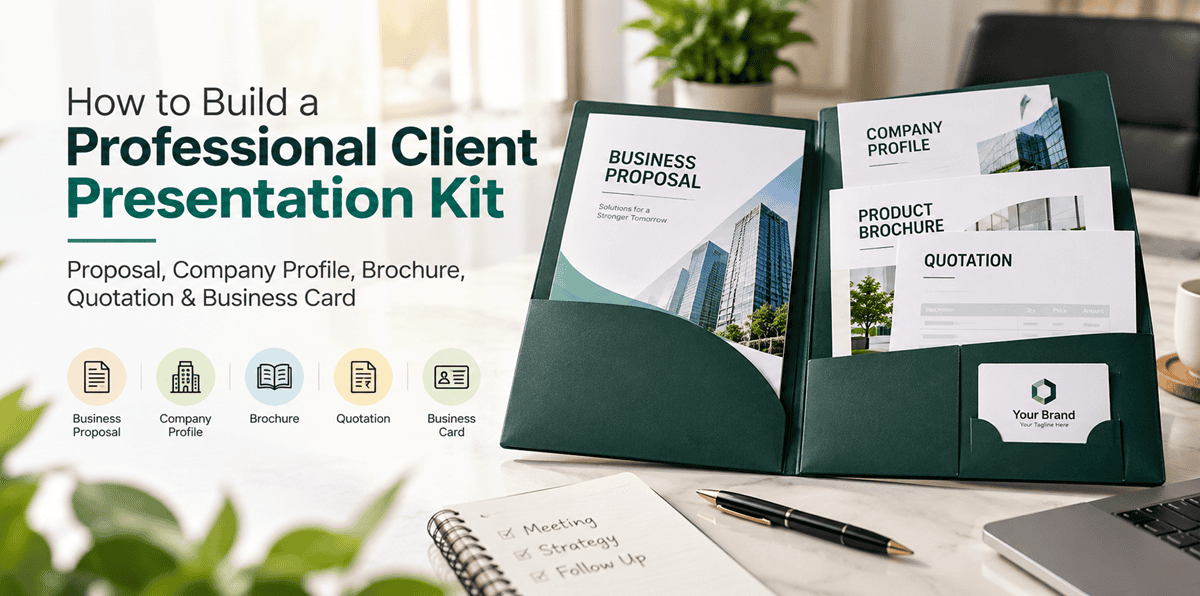
A professional client presentation kit should make business information easy to understand, review and keep after a meeting. Rather than including every available marketing material, a useful kit focuses on the documents that support the conversation.
Depending on the purpose of the meeting, this may include a business proposal, company profile, brochure, quotation, business card and relevant supporting documents. The materials should be organised logically and use consistent branding throughout.
A client presentation kit is a collection of business documents prepared for a meeting, proposal, sales discussion or company introduction.
Its purpose is simple: give the client the right information in an organised format without overwhelming them.
A presentation kit may be entirely digital, entirely printed or a combination of both. For face-to-face meetings, printed materials can be particularly useful when clients need to review specifications, pricing or other information during the discussion.
There is no single format that works for every business. The contents should depend on the purpose of the meeting.
| Material | Purpose |
|---|---|
| Business Proposal | Explains the proposed solution or scope |
| Company Profile | Introduces the business and its capabilities |
| Product or Service Brochure | Summarises key offerings |
| Quotation | Provides relevant commercial information |
| Business Card | Gives direct contact details |
| Supporting Documents | Provides additional technical or project information |
| Presentation Folder | Keeps printed materials organised |
An introductory meeting may require only a company profile and brochure, while a proposal meeting may need a detailed proposal, quotation and supporting documents.
Before preparing any documents, identify what the meeting needs to achieve.
For example, an introductory meeting may focus on explaining who you are and what your company does. A sales meeting may require product information and a proposal. A technical discussion may require specifications, drawings or supporting documentation.
Starting with the meeting objective prevents unnecessary material from being added simply to make the presentation kit look larger.
For proposal-focused meetings, the business proposal is often the central document.
It should help the client quickly understand:
Keep the proposal focused on the specific discussion. Long company histories and unrelated service information can make the main message harder to find.
A company profile provides useful background about the organisation.
Depending on the meeting, it might cover the company’s core capabilities, major products or services, industries served, locations and contact information.
The profile should answer a basic client question:
“Why is this company relevant to my requirement?”
Information that does not help answer that question may not need to be included.
A brochure can support the proposal by presenting products or services in a more visual format.
Instead of repeating the proposal, use the brochure for information such as product categories, key features, applications, photographs or short service descriptions.
This allows the proposal to remain focused while giving the client additional information to review when needed.
When several printed documents need to be shared together, organisation becomes important.
Loose proposals, brochures and quotations can easily become separated after a meeting. When multiple materials are required, a custom presentation folder can provide a practical way to organise proposals, brochures and contact materials for the meeting.
The folder should be chosen according to the documents it needs to hold. Size, pocket configuration and overall usability are generally more important than adding unnecessary decorative features.
A business card gives the recipient a quick reference for contacting the person they met.
Make sure the name, phone number, email address and website are consistent with the information shown elsewhere in the presentation kit.
If several team members attend the meeting, decide whose contact information should be included rather than adding multiple cards without a clear reason.
A quotation is most useful when the discussion has reached a stage where pricing or commercial terms are relevant.
Depending on the transaction, it may include the product or service, quantity or scope, pricing, applicable taxes, validity period, payment terms and contact information.
For an early introductory meeting, detailed pricing may not always be necessary. In that situation, it may be better to prepare a quotation after the client’s requirements are understood.
Some meetings require more detailed information.
Depending on the business, supporting material might include product specifications, technical data sheets, drawings, implementation plans, case studies or compliance information.
The key is relevance.
Do not add technical documents simply to make the presentation appear more comprehensive. Include them when they answer a likely client question or support an important part of the discussion.
Every document does not need to look identical, but the overall presentation should clearly come from the same organisation.
Use consistent logo treatment, brand colours, typography, contact information and tone across the proposal, brochure, business card and other materials.
Consistency also applies to information. A phone number, website address or company name should not appear differently across documents.
Arrange the kit according to what the client is most likely to need first.
For a proposal meeting, one possible order could be:
Proposal → Company Profile → Brochure → Quotation → Supporting Documents → Business Card
For an introductory meeting, the company profile or brochure may come first. A technical meeting may prioritise specifications or drawings.
There is no universal order. The best sequence follows the purpose of the meeting.
One common mistake is adding too much information. A larger presentation kit is not automatically a better one.
Other issues to watch for include outdated quotations, incorrect contact details, low-resolution logos, inconsistent branding, broken QR codes and documents that are difficult to navigate.
Also avoid printing a large quantity before the final artwork and information have been reviewed.
Before the meeting, confirm:
A short review can prevent simple errors from distracting from an otherwise well-prepared presentation.
A professional client presentation kit should make the meeting easier, not more complicated.
Start with the purpose of the discussion, select only the documents the client needs and arrange them in a logical order. Keep branding and contact information consistent, verify important details before the meeting and make sure printed materials are easy to handle.
The strongest presentation kit is usually not the largest one. It is the one that helps the client find the right information at the right time.




