Physical Address
304 North Cardinal St.
Dorchester Center, MA 02124
Physical Address
304 North Cardinal St.
Dorchester Center, MA 02124

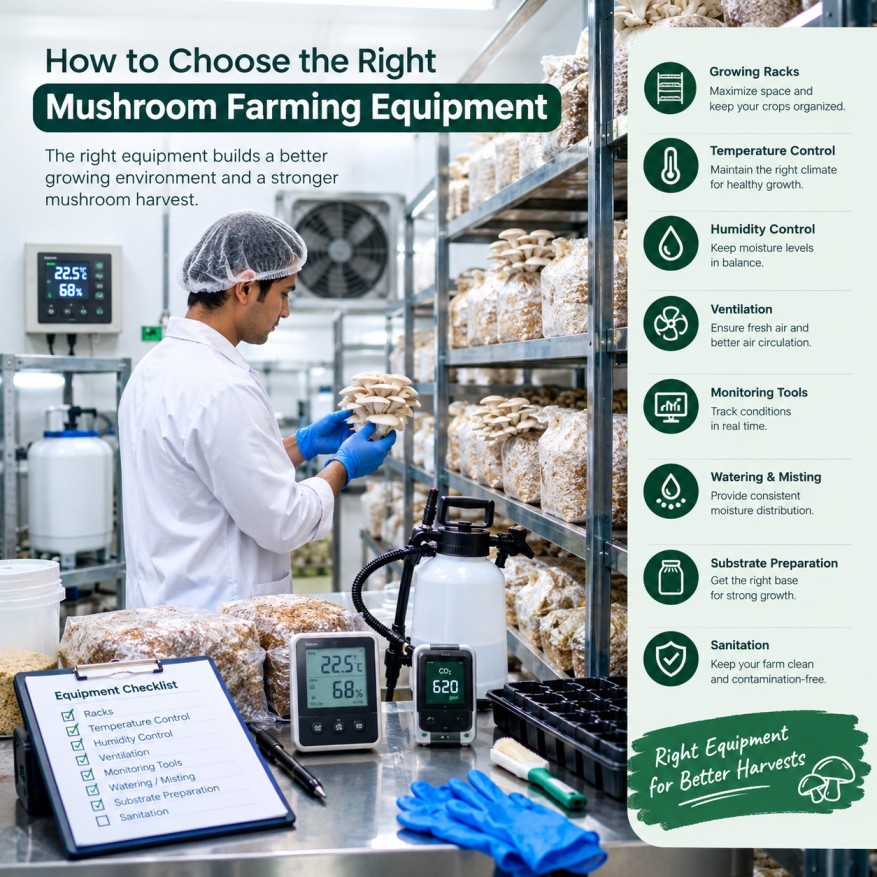
Successful mushroom cultivation depends on maintaining suitable growing conditions throughout the production cycle. Temperature, humidity, ventilation, cleanliness, and growing-space management all need regular attention.
For this reason, selecting the right mushroom farming equipment is an important part of planning a cultivation setup. However, equipment should not be selected simply because it is advanced or expensive. The right choice depends on the mushroom variety, farm size, growing method, available space, and production requirements.
The first step is to understand how the mushrooms will be cultivated.
Different varieties can have different environmental and substrate requirements. A setup designed for oyster mushrooms may not require exactly the same equipment as one designed for button or specialty mushrooms.
Before purchasing equipment, determine:
This helps prevent unnecessary purchases and allows equipment to be selected according to actual requirements.
The size of the cultivation room directly affects equipment requirements.
A small growing room may need basic temperature and humidity monitoring, ventilation, racks, watering equipment, and sanitation tools.
A larger commercial facility may require more advanced systems for climate management, air circulation, irrigation, monitoring, and environmental control.
Equipment should be capable of handling the size of the growing environment without being unnecessarily oversized.
Growing racks can help organize mushroom cultivation and make better use of indoor space.
Multi-level racks are particularly useful where growers want to use vertical space. They can hold cultivation bags, trays, or containers while keeping the growing area organized.
When selecting racks, consider:
A good rack design should allow growers to inspect and manage crops without making routine operations difficult.
Environmental conditions are important in mushroom cultivation. Different mushrooms may require different temperature and humidity ranges.
Depending on the facility, growers may use air conditioners, cooling systems, heaters, humidifiers, foggers, or other environmental-control equipment.
Monitoring devices such as thermometers and hygrometers should also be considered. Managing the environment effectively requires both control equipment and reliable monitoring.
Ventilation is another important consideration when designing a mushroom-growing room.
Fans, air-intake systems, filters, and other ventilation equipment can help maintain appropriate air movement and exchange.
The system should be designed according to the size of the room and the requirements of the cultivated mushroom. Poorly planned ventilation can make it difficult to maintain consistent environmental conditions.
Water and moisture management should also be considered when selecting equipment.
Depending on the cultivation setup, growers may use:
The equipment should provide suitable moisture distribution without creating unnecessary water accumulation.
It should also be easy to clean because hygiene is an important part of mushroom cultivation.
Monitoring equipment helps growers understand what is happening inside the cultivation room.
Basic tools can include:
Regular monitoring can help identify changes in temperature, humidity, airflow, or other conditions before they become larger operational problems.
Technology can make monitoring more convenient, but growers still need to understand what the readings mean and how they relate to the mushroom’s requirements.
Equipment requirements are not limited to the growing room. Substrate preparation can also require appropriate tools.
Depending on the cultivation method, growers may need mixing containers, weighing equipment, filling tools, cultivation bags, sealing equipment, and pasteurization or sterilization equipment.
The specific requirements depend on the mushroom variety and production process.
Mushroom cultivation requires attention to cleanliness. Equipment should therefore be easy to wash, disinfect, inspect, and maintain.
When choosing equipment, consider whether surfaces can be cleaned properly and whether components are easy to access for maintenance.
Equipment that is difficult to maintain can create unnecessary operational challenges over time.
Budget is another important consideration. A mushroom farm does not necessarily need the most expensive equipment available.
A practical approach is to prioritize equipment that directly supports essential cultivation requirements.
For example, reliable temperature and humidity monitoring may be more important than investing in unnecessary automation during the early stages.
As production expands, additional equipment and automation can be introduced according to actual operational needs.
Equipment planning should also consider potential growth.
If a small operation is expected to expand later, the initial setup can be designed with future expansion in mind. This may include choosing modular racks, scalable monitoring systems, or equipment that can support additional growing rooms.
Planning ahead can help reduce the need for completely redesigning the facility when production increases.
Some common equipment-selection mistakes include:
A well-planned system should balance functionality, maintenance, cost, and production requirements.
Modern mushroom cultivation can combine conventional farming knowledge with technology-supported equipment.
Sensors, environmental controllers, automated irrigation, climate-control systems, and monitoring tools can help growers manage cultivation conditions more systematically.
However, technology should support the cultivation process rather than replace proper farm management.
For a detailed overview of equipment used in mushroom cultivation, visit the Mushroom Farming Equipment guide by Desi Fasal.
Choosing the right mushroom farming equipment starts with understanding the mushroom variety, cultivation method, production scale, and environmental requirements.
Growing racks, temperature and humidity systems, ventilation equipment, monitoring tools, watering systems, substrate-preparation equipment, and sanitation tools can all have different roles within a cultivation setup.
Rather than selecting equipment based only on price or technology, growers should focus on creating a practical system that is easy to operate, maintain, and expand.
Start by identifying the mushroom variety, cultivation method, growing-space size, production scale, environmental requirements, and budget.
Depending on the setup, essential equipment may include growing racks, temperature and humidity monitoring, ventilation, watering or misting systems, and sanitation tools.
Automation is not always necessary. Its usefulness depends on the size of the farm, production requirements, available budget, and desired level of environmental control.
Racks help organize cultivation bags or trays and can make better use of available indoor space, particularly in multi-level growing systems.
Yes. Different mushroom varieties can have different environmental and cultivation requirements, so equipment should be selected accordingly.




