Physical Address
304 North Cardinal St.
Dorchester Center, MA 02124
Physical Address
304 North Cardinal St.
Dorchester Center, MA 02124

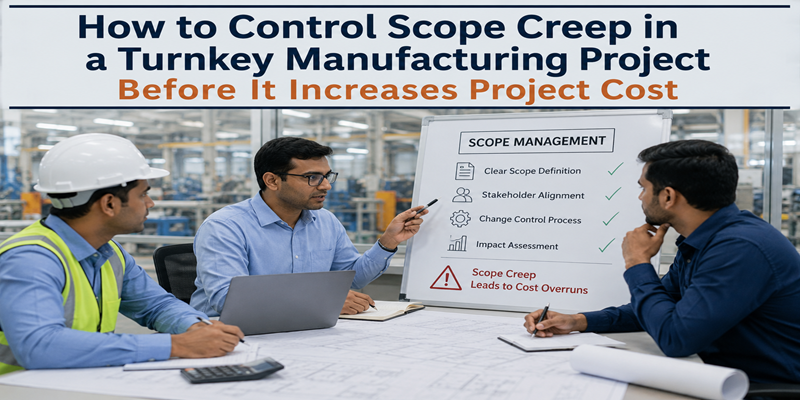
Can we just add one more machine?” is how many cost overruns begin. In a turnkey manufacturing project, that request rarely stays small. It touches layout, utilities, electrical load, procurement and commissioning, often before anyone has priced it.
This guide explains how to separate a healthy change from uncontrolled scope creep, how turnkey manufacturing project work out what a change really costs, and how to build a change-control process that holds up on a live project.
A scope change is a modification that has been evaluated, priced, approved and added to the project baseline. Scope creep is the same modification arriving without that process.
Manufacturing projects change for good reasons: capacity targets move, regulations shift, equipment becomes unavailable, or site conditions differ from assumptions. The goal is not zero change. It is zero unpriced change.
| Situation | Classification |
|---|---|
| Owner requests an extra production line, formally assessed | Scope change |
| Contractor installs extra equipment without approval | Scope creep |
| Regulation forces a design modification | Mandatory change, needs impact assessment |
| Approved revision reflected in drawings and budget | Controlled change |
Scope creep is common. PMI’s 2018 Pulse of the Profession reported that 52% of surveyed projects experienced scope creep or uncontrolled changes. That figure is dated and spans industries, so treat it as a benchmark, not a manufacturing statistic.
Turnkey projects bundle process, civil, electrical, utilities, automation and commissioning into one delivery. A change in one package spreads to the others.
Adding one production line can trigger:
The cost of a change is rarely limited to the item that changed. The later it arrives, the more orders, drawings and physical work it disturbs.
If capacity, process and expansion plans aren’t settled, detailed design starts on shaky ground. Doubling planned output from 50,000 to 100,000 units a month later affects building area, utilities, warehousing and manpower.
Equipment dimensions change, platforms get added and piping routes shift. One revision can ripple across several disciplines.
Once equipment is ordered or fabricated, changes mean cancellation charges, vendor redesign, freight, storage and delays.
Changes now mean demolition, re-routing and relocation. This is where cost becomes visible, though it was often set earlier.
A baseline is the reference point every change is measured against. Before execution starts, confirm:
Freeze early: capacity, major process and equipment philosophy, building footprint, major utility requirements, battery limits and acceptance criteria.
Keep controlled flexibility for: vendor choice within an approved specification, minor layout optimisation, construction sequencing and non-critical finishes.
Over-controlling blocks legitimate engineering improvements, so freeze what is expensive to unwind and leave the rest manageable.
Asking only “what will it cost?” misses most of the impact. Test each change against all eight:
| Dimension | Key question |
|---|---|
| Cost | What are the direct and indirect costs? |
| Schedule | Does the critical path move? |
| Engineering | Which drawings and specifications change? |
| Procurement | Are existing purchase orders affected? |
| Construction | Does completed work need modification? |
| Commissioning | Must testing or start-up be repeated? |
| Regulatory | Does any approval or compliance position change? |
| Operations | Are production, maintenance or future expansion affected? |
Don’t price a change as material plus labour. Include engineering redesign, procurement impact, rework, testing, contractor claims, extra supervision, temporary works, obsolete material and production disruption.
Illustrative example (not industry benchmark data): an additional machine costs ₹20 lakh. Associated impacts include:
The real exposure is ₹37 lakh, not ₹20 lakh. Every estimate should state its basis, such as a revised BOQ, supplier quotation, engineering hours or a revised schedule.
Greenfield: Scope uncertainty is mostly design-related, and rework mainly hits project cost.
Brownfield: Scope uncertainty combines design with existing conditions. Drawings may be outdated, utilities must integrate with live systems and shutdown windows are tight. Rework costs project money plus production loss, so brownfield change control needs to be stricter.
Accept a change when its benefit clearly outweighs its fully priced impact. Typical cases include mandatory regulatory requirements, safety improvements, site conditions that make the original design unworkable, and changes that reduce lifecycle cost. Before approving, ask whether it can wait for a later phase, and what it costs now compared with after procurement.
IMARC Engineering supports manufacturers through turnkey project management that builds scope control into the delivery system. Our team helps define the scope baseline and battery limits, coordinates engineering and procurement, manages contractors and runs change control with clear cost and schedule impact. We also monitor site execution, commissioning and handover so changes are priced before they become rework.
Speak With An Expert: https://www.imarcengineering.com/contact?service=turnkey-project-management
Scope creep rarely comes from one big decision. It builds through small, poorly documented changes that reach engineering, procurement or construction before their full impact is known. The remedy is a clear baseline, a single change channel, an eight-dimension impact check and approval before execution. Manufacturing change is inevitable, but unpriced change is avoidable. Control the change before the change controls the project.
Contact Us:
IMARC Engineering
Phone: +91-120-433-0800
Email: sales@imarcengineering.com
India: C-130, Sector 2, Noida, Uttar Pradesh 201301
LinkedIn: https://www.linkedin.com/showcase/imarc-engineering/




