
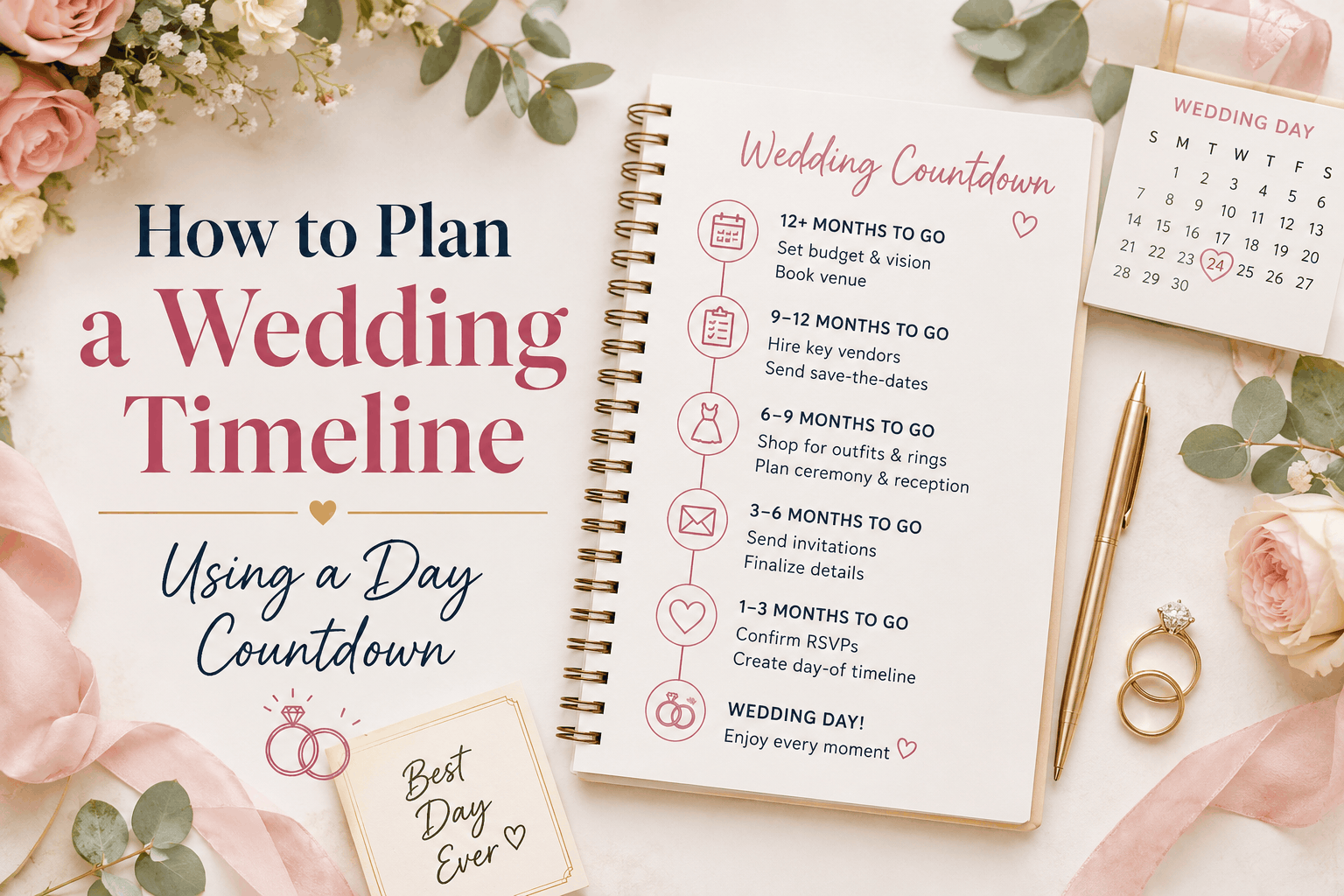

Planning a wedding means working with two things: dates and money. Every task has a deadline, and most tasks cost something. If you pay for items on a card that gives 1.5% cashback, a cash back calculator would show $60 back on $4,000 of spending. That is a nice bonus, but it is no reason to spend more, so this guide focuses on the dates first.
The best way to keep calm is to start from the wedding day and count backwards. Each step gets its own date, and nothing is left to the last minute.
Step 1: fix the date
Choose the wedding date first, because every other date depends on it. Say your wedding is on Saturday 18 September 2027. Write it at the top of a page and count backwards from there.
If your date is not fixed yet, pick two or three options and plan the same steps for each. It is much easier to change a plan on paper than to change bookings later.
Step 2: set the big milestones
Here is a simple set of checkpoints, counted back from 18 September 2027.
|
Time before |
Date |
Days left |
Main task |
|
9 months |
18 Dec 2026 |
274 |
Book the venue, set a budget |
|
6 months |
18 Mar 2027 |
184 |
Book the photographer, choose outfits |
|
3 months |
18 Jun 2027 |
92 |
Send invitations, plan the menu |
|
1 month |
18 Aug 2027 |
31 |
Final guest numbers, seating plan |
|
1 week |
11 Sep 2027 |
7 |
Confirm every supplier |
Your own plan may need more time or less. A large wedding often needs longer, and a small one can be quicker. The key idea is to give every task a date.
Step 3: break each milestone into small tasks
A milestone like “book the venue” is too big. Split it up:
- List the places you like
- Visit your top three
- Ask each for a written price
- Choose one and pay the deposit
Give each small task a date between the milestones. Now your plan is a list you can tick off.
Step 4: compare prices
Most couples ask several suppliers for a price. Say three photographers quote $1,800, $2,200 and $2,000. The total is $6,000, so the middle price is 6,000 ÷ 3 = $2,000. An average finder can do the same sum with a longer list. The average is a good guide, but do not choose only by price. Look at what is included, and read the reviews.
Step 5: build in extra time
Things go wrong at weddings. A supplier may be late. A guest may reply late. An outfit may need a change. Add a buffer of one or two weeks to your tasks, so one delay does not push everything back.
For example, if invitations should be sent 3 months before, aim to have them ready 3 weeks earlier. Then a printing mistake is a small problem, not a big one.
Step 6: watch the money dates
Money has dates too. Deposits, part-payments and final bills each have a day. Write every payment date in your plan, and add the amount. Then you can see at a glance how much you must pay each month.
Many suppliers say a final payment is due a set number of days before the wedding, such as 30 days. Check each contract, and count the days carefully.
Step 7: choose reply dates
Guests need time to answer, and you need the answers before you finalise the numbers. If you send invitations 10 weeks before the wedding, the date is 10 July 2027. Ask for replies 4 weeks before the wedding, which is 21 August 2027. That gives you about six weeks to chase and plan.
Step 8: keep a simple tracker
A single page or spreadsheet is enough. Use these columns:
- Task
- Due date
- Who is in charge
- Cost
- Done (yes or no)
Look at it once a week. A short weekly check is better than a long panic near the end.
Common mistakes
- Starting with a long list and no dates.
- Forgetting to count the days between replies and the final headcount.
- Booking too many things at once.
- Not leaving a buffer.
- Letting money decisions drift because nothing has a deadline.
Count down to the day
A countdown keeps the plan real and, for many couples, it is part of the fun. If it is 1 March 2027 and the wedding is on 18 September, a free online calculator will show you that there are 201 days left. Once you know that number, you can divide it into steps. Two hundred days is about 28 weeks, which is plenty of time if you plan well.
Final thoughts
To plan a wedding with a day countdown, fix the date, count backwards, set milestones, split them into small tasks and add a buffer. Keep money dates in the same plan, and check it every week. A clear list of dates turns a big day into a set of small, calm steps.



