Physical Address
304 North Cardinal St.
Dorchester Center, MA 02124
Physical Address
304 North Cardinal St.
Dorchester Center, MA 02124

“All three of them say manufacturer.”
That was the first thing he said. A hospital administrator in Rohini, three quotations spread across his desk, prices sitting within eight percent of each other. Every letterhead making the same claim.
Two of the three were reselling the same dome. Same source, same housing, different sticker.
He had no way of knowing that. Why would he? Purchase committees are trained to compare figures, and the figures looked fine.
A real one designs the light, builds it in a plant it owns, holds the CDSCO registration under its own name, and keeps spares and service engineers in the same building. A trader buys a finished unit, adds a margin, forwards the paperwork.
Both can sell you a light. Only one can still help you in year four.
And that gap stays invisible for a long time. It doesn’t turn up at installation. It turns up on a Saturday, three years later, when an arm starts drooping and the number on the invoice rings out to a landline nobody picks up.
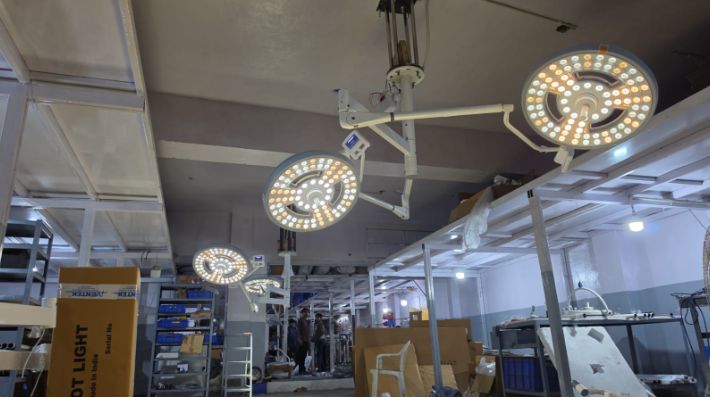
First — where’s the plant? Not the office. The plant. Anyone building here will give you an address and, usually, tell you to come and have a look. Ventek India, to take one example, builds at M-155, Sector 3, Bawana Industrial Area, and keeps its corporate office up at Shalimar Bagh. Two addresses, both real, both open to visitors.
Second, whose name sits on the CDSCO registration? This is the one that catches people. A trader will happily show you a certificate. Read the name on it slowly. Quite often it belongs to the company that made the unit, not the company invoicing you.
Third, ask for the technical drawing of the arm assembly. Manufacturers have these lying around because they drew them. Ask a reseller and you’ll get a brochure, eventually, after a follow-up.
Fourth — how many of your lights are running in Delhi right now, and where? Vagueness here is itself an answer.
Voltage.
Power across parts of NCR swings in ways that imported drivers were never built to survive. A light designed for a stable European grid will run beautifully for about eighteen months here and then start losing LED zones, one at a time, for no reason anybody can explain. It’s not usage. It’s not dust. It’s the supply.
A company manufacturing locally designs around that, because it has to. Ventek puts every unit through 48 hours of pre-dispatch testing — temperature cycling, extreme voltage fluctuation, and a physical QC inspection a supervisor signs off before anything leaves the floor. Sounds like paperwork until you hear the other number: the oldest Ventek surgical light still in daily clinical use has crossed seventeen years.
You can’t fake that one. Either the units last or they don’t.
Once you’re actually comparing specs, four figures carry most of the weight.
Light intensity in lux — but measured at one metre, not at the dome face, and the difference between those two measurements is huge, so always ask which one you’re looking at. Colour Rendering Index, where anything under 90 makes it harder than it should be to tell inflamed tissue from healthy tissue. Whether the colour temperature is adjustable or fixed. And how quickly the field recovers when somebody leans across it.
The Ventek range runs above CRI 93, goes up to 160,000 lux, and offers adjustable CCT across the series — which covers a twelve-bed nursing home in Pitampura and a four-hundred-bed multi-speciality in Dwarka without pretending one light suits both. Hospitals comparing an OT light manufacturer Delhi shortlist usually start on the OT light manufacturer in Delhi page, where the series, certifications and NCR service coverage sit together in one place.
A lot of businesses advertising themselves as OT light suppliers in Delhi are honest about being distributors. Fine. Nothing wrong with that.
The problem is the ones that aren’t. They import a dome, brand it, and vanish the moment a brake bolt fails. No drawings, no spare inventory, no engineer within a two-hour drive. Hospitals end up replacing those units far earlier than they budgeted for, and the replacement almost always costs more than choosing properly the first time would have.
The administrator in Rohini went with the manufacturer. Not the cheapest quote — and not the dearest either.
He told us later that the specification barely came into it. What decided it was that when he asked to visit the factory, one company said yes straight away, one said they’d check and get back to him, and one just stopped replying.
That’s usually how it goes, honestly.
Verify the CDSCO name. Get the plant address. Ask for an arm assembly drawing. Find out who physically turns up when something breaks, and how long they take.
Ten minutes of work. Years of difference.




