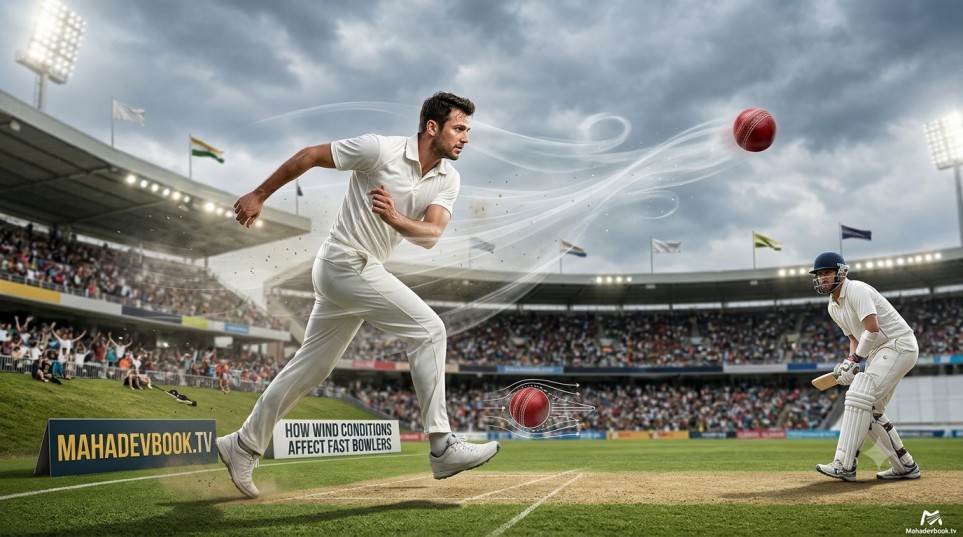

When fans watch a high-stakes cricket match—whether an international Test at Lord’s, a coastal One-Day International in Mumbai, or a night fixture in the Indian Premier League (IPL)—pitch reports usually dominate pre-match discussions. Commentators examine grass cover, cracks, and moisture levels. Yet, once the first ball is bowled, one of the most decisive variables governing the contest is entirely invisible: the wind. Understanding how wind conditions affect fast bowlers separates casual spectators from astute analysts of the game.
From altering the aerodynamic trajectory of a new leather ball to testing a bowler’s physical endurance during a long spell, wind dictates tactical decisions on the field. Captains adjust field placements, bowlers switch ends, and batters recalibrate their trigger movements based on breeze direction and velocity. For Indian cricket followers who closely track live matches, analyse player matchups, or explore statistical trends on platforms like mahadev book tv, recognizing the subtle influence of crosswinds, headwinds, and tailwinds adds a vital layer of tactical foresight. This comprehensive guide breaks down the science, mechanics, and strategic realities of bowling in windy conditions.
Direct Answer: Wind conditions affect fast bowlers primarily through aerodynamics, physical resistance, and tactical execution. Crosswinds amplify lateral drift and conventional swing by altering airflow separation around the cricket ball, headwinds increase air resistance to decelerate deliveries while enhancing late swing, and tailwinds boost ball speed and carry at the expense of reduced lateral movement and altered release points.
Key Takeaways
-
Crosswinds Enhance Lateral Drift: A steady breeze blowing across the pitch pushes the ball sideways in flight and interacts with the raised seam to exaggerate conventional swing.
-
Headwinds Slow the Ball but Increase Swing: Bowling into the wind increases aerodynamic drag, reducing radar speeds while giving air currents more time to act on the ball’s asymmetric surfaces.
-
Tailwinds Boost Pace and Carry: Bowling with the wind behind reduces air resistance, helping fast bowlers generate extra speed and steeper bounce, though late swing often diminishes.
-
Physical Mechanics and Run-Up Adjustments: Strong gusts force pacers to shorten or lengthen their run-ups, alter jump timing at the crease, and expend extra core energy to maintain balance.
-
Captaincy and End Selection: Captains strategically assign specific ends to swing bowlers versus hit-the-deck speedsters based on prevailing stadium wind tunnels.
-
Venue Architecture Matters: Open grounds like Wellington or coastal stadiums like Wankhede create vastly different wind dynamics compared to enclosed bowl-shaped arenas.
The Aerodynamics of a Cricket Ball in Windy Conditions
To understand how wind conditions affect fast bowlers, it helps to examine what happens to a cricket ball the moment it leaves the bowler’s hand. A standard regulation cricket ball weighs between 155.9 and 163 grams and features a prominent stitched primary seam dividing two leather hemispheres. Even in still air, fast bowlers manipulate this seam and the contrast between a shiny side and a rough side to generate pressure differentials.
Laminar vs. Turbulent Airflow and the Magnus Effect
In fluid dynamics, air flowing over a moving sphere creates a thin layer against the surface known as the boundary layer. When a bowler releases the ball with the seam angled toward the slips, the raised stitching trips the air on one side into a chaotic, swirling state called turbulent flow. Meanwhile, air glides smoothly over the polished, unseamed side in what physicists call laminar flow.
Turbulent air clings to the curved surface of the ball longer than laminar air, which separates from the surface earlier. Because the air detaches at different points on either side, the wake behind the ball is deflected, creating a net sideways force known as the Magnus effect (or more specifically in cricket, seam-induced asymmetric boundary layer separation).
When external wind enters this equation, the relative velocity and angle of the air hitting the ball change instantaneously:
-
Airspeed vs. Ground Speed: Aerodynamic forces depend on the speed of the ball relative to the air, not relative to the pitch. A delivery bowled at 140 km/h into a 20 km/h headwind experiences an effective airspeed of 160 km/h, magnifying aerodynamic pressure forces.
-
Angle of Attack: A crosswind alters the apparent angle at which air strikes the primary seam. Even if a bowler’s wrist position is slightly imperfect, a favorable crosswind can align the relative airflow with the seam, triggering dramatic late movement.
How Relative Air Velocity Alters Seam and Swing
Conventional swing relies heavily on maintaining laminar flow on the shiny side while encouraging turbulent flow on the rough or seam-angled side. However, if the relative airspeed becomes too high, the laminar boundary layer on the shiny side can prematurely transition into turbulence, causing the ball to stop swinging—a threshold known in physics as the drag crisis.
Conversely, moderate wind speeds keep the airflow squarely within the optimal window for swing. Furthermore, wind carries moisture and temperature variations. A cool sea breeze blowing inland across stadiums in Mumbai, Chennai, or Visakhapatnam often brings denser, more humid air, which subtly affects air density and helps preserve the condition of the leather ball’s shine.
Directional Breakdown: Crosswinds, Headwinds, and Tailwinds
Not all wind affects a fast bowler in the same way. Depending on the orientation of the pitch relative to the prevailing breeze, a bowler faces four primary wind vectors: crosswinds (left-to-right or right-to-left), headwinds, tailwinds, and swirling stadium eddies.
| Wind Direction | Effect on Ball Speed | Effect on Swing & Drift | Effect on Bounce & Carry | Impact on Bowler’s Mechanics |
| Crosswind (With Swing) | Minimal change to radar speed | Maximizes lateral drift and late swing | Slight sideways deviation off the pitch | Requires aiming wider to compensate for drift |
| Crosswind (Against Swing) | Minimal change to radar speed | Counteracts swing; can hold the ball straight | Keeps the ball closer to the stumps | Useful for holding a tight line or bowling cutters |
| Headwind (Into the Wind) | Decreases speed by 3–7 km/h | Increases conventional swing due to higher airspeed | Shorter carry; ball dips earlier | High physical exertion; requires shorter, punchier stride |
| Tailwind (With the Wind) | Increases speed by 3–7 km/h | Reduces conventional swing; aids reverse swing at high pace | Steeper bounce and strong carry to keeper | Risk of overstepping no-balls; harder to control length |
1. Crosswinds: The Swing Bowler’s Best Friend and Worst Enemy
A crosswind blows perpendicular to the 22-yard pitch, moving from the off-side to the leg-side or vice versa. For swing specialists—such as Bhuvneshwar Kumar, Trent Boult, or James Anderson—a steady crosswind is a tactical goldmine, provided they read its interaction with their natural stock delivery.
-
Bowling With the Crosswind: When a right-arm outswing bowler operates with a breeze blowing from leg-slip toward point, the wind acts as an accelerator for lateral movement. First, the physical force of the breeze pushes the ball sideways in the air (known as drift). Second, the wind reinforces the pressure differential across the seam, causing the ball to swing sharply away from the right-handed batter late in its trajectory. The danger here is losing control; if the bowler aims too wide, the combination of drift and swing carries the ball harmlessly down the wide channel.
-
Bowling Against the Crosswind: When the breeze blows from point toward fine leg, an outswing bowler must fight the air current. Often, the crosswind cancels out the natural swing, resulting in a delivery that holds its line unexpectedly. Clever bowlers use this to trap batters on the crease—the batter expects the ball to shape away, leaves a gap between bat and pad, and watches the ball hold straight to strike the off-stump.
2. Headwinds: Sacrificing Pace for Aerodynamic Control
Bowling directly into a stiff headwind is one of the most physically demanding tasks in cricket. Every stride of the run-up requires pushing against a wall of air, and once released, the ball faces heightened aerodynamic drag.
From a purely physical standpoint, a headwind slows the ball down between release and impact with the pitch. A bowler who normally clocks 142 km/h may see the speed gun drop to 135 or 136 km/h. However, that extra fraction of a second in the air—combined with the higher relative airspeed passing over the seam—gives conventional swing more time to develop. The ball often “dips” late, deceiving batters into driving early or misjudging the length for a pull shot.
3. Tailwinds: Pure Velocity, Extra Bounce, and Control Challenges
When a fast bowler turns around to bowl from the downwind end, the experience transforms entirely. The tailwind pushes the bowler forward during the approach, making the run-up feel effortless and explosive. Upon release, reduced air drag allows the ball to retain more of its initial velocity all the way to the batter.
Hit-the-deck enforcers—bowlers like Jasprit Bumrah, Kagiso Rabada, or Mitchell Starc—often thrive with a tailwind. The extra speed generates brisk carry through to the wicketkeeper and makes short-pitched deliveries significantly more threatening. However, tailwinds reduce the relative airspeed over the ball, frequently neutralizing conventional swing. Bowlers must rely more on seam movement off the surface, hard lengths, and pace variations rather than airborne arc.
Physical and Biomechanical Impact on Fast Bowlers
Beyond ball flight, wind conditions directly disrupt a fast bowler’s biomechanics. Fast bowling is a high-precision, explosive kinetic chain where milliseconds of timing separate an unplayable delivery from a waist-high full toss.
Run-Up Rhythm and No-Ball Risks
A fast bowler’s run-up is calibrated down to the centimeter. Bowlers measure their strides meticulously so their back foot lands in the exact same spot at the crease every delivery.
-
With a Tailwind: The breeze accelerates the bowler’s center of mass during the approach. If the bowler does not consciously shorten their run-up by one or two feet, their strides lengthen involuntarily, leading to front-foot no-balls—a costly error in modern white-ball cricket where every overstep triggers a Free Hit.
-
Into a Headwind: The wind acts as a brake during the final bound before delivery. Bowlers often find themselves landing six to twelve inches behind the popping crease. Being further back from the stumps reduces the effective angle of delivery and can cause the ball to pitch shorter than intended, sitting up nicely for the batter to hit.
Balance at the Point of Release
During the delivery stride, a fast bowler absorbs ground reaction forces equivalent to five to eight times their body weight. A sudden, gusting crosswind at the exact moment of the jump can tilt the bowler’s upper torso slightly off-axis.
If a bowler’s head falls away toward the off-side due to a strong gust, their bowling arm drops lower than usual. A lower arm slot changes the seam orientation, turning a planned top-of-off-stump delivery into a half-volley on the pads. Over a four-over T20 spell or an eight-over Test spell, constantly stabilizing the core against gusting winds causes accelerated muscular fatigue in the obliques, lower back, and hip flexors.
Tactical Adjustments: How Captains and Bowlers Adapt
Elite cricket teams never treat wind as a passive background detail; they incorporate it directly into their bowling plans and field placements.
Selecting Ends Based on Bowler Profiles
One of a captain’s primary tactical responsibilities is matching the right bowler to the right end of the ground. Suppose a strong wind is blowing diagonally from the Pavilion End toward the Lake End.
-
The Swing Specialist is typically handed the ball into the wind or across the wind where they can maximize lateral drift and loop.
-
The Express Speedster is assigned the downwind end to exploit the tailwind for extra zip, steeper bounce, and aggressive bouncers.
In T20 leagues like the IPL, where bowlers only bowl four overs, captains frequently rotate bowlers in short two-over bursts specifically to keep their premier swing bowler operating from the wind-assisted end during the Powerplay.
Reshaping the Field for Wind-Assisted Drift
Field placements must evolve dynamically when wind speeds pick up. When a bowler is operating with a strong crosswind pushing the ball from off to leg:
-
Off-Side Protection: Because the wind naturally carries the ball across the batter’s body or into the pads, batters frequently look to open the face of the bat and guide deliveries through backward point or third man. Captains often station a deep third man and a tight backward point.
-
Leg-Side Catching Traps: Conversely, if an inswing bowler uses a crosswind to curve the ball sharply back into a right-hander’s pads, the ball often beats the inside edge or takes a leading edge toward mid-wicket or square leg. Placing a short mid-wicket or leg gully capitalizes on batters closing the bat face too early against wind-assisted inswing.
Adjusting Lengths and Variations
In windy conditions, standard “good length” markers shift.
-
Bowling into a headwind requires pitching the ball slightly fuller than normal. Because air resistance slows the ball down and makes it dip, a traditional back-of-a-length delivery can arrive slowly enough for the batter to rock back and pull comfortably. Pitching it up invites the drive and brings bowled and LBW dismissals into play.
-
Bowling with a tailwind demands pulling the length back slightly. Full deliveries bowled downwind tend to skid onto the bat quickly without swinging, making them easy to drive down the ground. Hitting a hard length between six and eight meters from the batter’s stumps maximizes the wind-assisted bounce.
Stadium Architecture and Iconic Windy Cricket Venues
The geographic location and architectural design of a cricket stadium dramatically shape how wind behaves at pitch level. Enclosed modern arenas with towering multi-tier stands often block external winds, creating localized swirling eddies inside the bowl. In contrast, open-sided stadiums or coastal venues channel powerful, uninterrupted wind tunnels directly across the square.
Coastal Venues in India: Mumbai, Chennai, and Visakhapatnam
Indian cricket fans are well acquainted with the role of sea breezes in evening matches.
-
Wankhede Stadium (Mumbai): Located right beside the Arabian Sea, the Wankhede experiences a consistent evening sea breeze that blows across the ground from the west/southwest. During the first innings of an IPL night match, fast bowlers frequently extract sharp early swing under the lights because the sea breeze carries cooler, moisture-laden air across the pitch before dew settles later in the evening.
-
MA Chidambaram Stadium (Chennai): Situated near the Bay of Bengal, Chepauk’s evening sea breeze cools the humid air and provides fast bowlers with a narrow window of lateral movement with the new ball before spinners take center stage.
-
ACA-VDCA Stadium (Visakhapatnam): Surrounded by hills on one side and open toward the coast on the other, Vizag is notorious among Indian domestic and international pacers for swirling crosswinds that make holding a consistent line challenging.
International Benchmarks: Wellington, Port Elizabeth, and Headingley
Globally, certain grounds are famous for testing a fast bowler’s wind-management skills:
-
Basin Reserve & Sky Stadium (Wellington, New Zealand): Known as the “Windy City,” Wellington regularly features gusts exceeding 40–50 km/h. Bowlers often struggle simply to keep the bails on the stumps, and legendary spells—such as Tim Southee’s 7/33 against England in 2015—showcase the art of riding the wind rather than fighting it.
-
St George’s Park (Gqeberha / Port Elizabeth, South Africa): Exposed to strong coastal winds off Algoa Bay, this venue rewards bowlers who can control crosswind drift with both the new and old ball.
-
Headingley (Leeds, England): With open corners and elevated Yorkshire terrain, Headingley generates brisk crosswinds that combine with overhead cloud cover to create some of the most swing-friendly conditions in world cricket.
Wind Conditions Across Match Formats: Test, ODI, and T20
The strategic weight of wind shifts depending on the format of the game, the type of ball used, and the duration of the contest.
Test Cricket: Sustained Spells and Changing Weather
In a five-day Test match, wind direction and speed rarely remain static. A calm morning session can give way to a stiff afternoon sea breeze, fundamentally altering batting conditions between lunch and tea. Test pacers must demonstrate endurance and adaptability across multiple spells:
-
With the red Dukes or SG ball, pronounced seams interact aggressively with crosswinds throughout the first 30 to 40 overs.
-
Once the ball softens after 50 overs, fast bowlers use crosswinds to generate drift with cutters or slower off-breaks, even when conventional swing disappears.
One-Day Internationals (ODIs): Two New Balls and Middle-Over Drift
In modern 50-over cricket, the use of two new white Kookaburra balls (one from each end) means the ball stays harder for longer, preserving the raised seam well into the middle overs. When a brisk crosswind blows across an ODI venue, captains can keep a seam bowler on during overs 15 to 30 specifically to exploit lateral movement before the pitch flattens out.
T20 and the IPL: Micro-Adjustments Under Pressure
In the fast-paced environment of the IPL, every single delivery carries immense tactical consequence. A sudden gust of wind during the 19th over can turn a pinpoint wide yorker into a costly wide ball—giving the batting side an extra run and an extra delivery in a tight chase.
T20 fast bowlers use wind awareness to disguise variations:
-
Slower Balls into the Wind: Bowling an off-cutter or back-of-the-hand slower ball into a stiff headwind exaggerates the deceleration. The ball seems to hang in the air, causing power-hitters to swing early and slice catches into the deep.
-
Wide Yorkers with a Crosswind: When bowling from the end where the crosswind blows away from the batter’s arc, pacers can aim straighter at the fifth stump and let the breeze carry the ball safely just inside the wide tramline, out of the batter’s hitting zone.
Common Misconceptions About Wind in Cricket
Because wind is invisible on television broadcasts—visible only through fluttering boundary flags, rippling shirts, or flying dust—several myths persist among casual viewers.
-
Misconception 1: “Humid air is heavier, which makes the ball swing more.”
-
The Reality: Aerodynamicists have demonstrated that moist air is actually less dense than dry air (because water vapor molecules have a lower molecular mass than nitrogen and oxygen). However, coastal winds carrying moisture subtly affect the leather surface of the cricket ball, keeping the lacquer supple and helping maintain the contrast between the shiny and rough sides—which is what truly sustains swing.
-
-
Misconception 2: “Stronger wind always equals more swing.”
-
The Reality: Gale-force winds often ruin conventional swing. Excessive wind speed pushes the airflow past the critical Reynolds number threshold too early, stripping away smooth laminar flow on the shiny side. Gale winds produce erratic sideways push (drift) rather than controlled, late aerodynamic swing.
-
-
Misconception 3: “Spinners are the only bowlers who get drift.”
-
The Reality: While spin bowlers rely heavily on the Magnus effect via high revolutions per minute (RPM) to drift the ball in a crosswind, fast bowlers also experience pure aerodynamic drift whenever a brisk breeze blows across the pitch, independent of seam swing.
-
Using Weather and Wind Insights for Informed Cricket Analysis on Mahadev Book
For passionate Indian cricket fans, understanding technical nuances like wind direction, pitch behavior, and bowler matchups transforms how they experience live matches. Whether following an international series or analyzing every ball of the IPL season, looking beyond basic team lineups gives fans a sharper perspective on momentum shifts. When a team loses three quick wickets in the Powerplay at Wankhede or Chepauk, recognizing how an evening sea breeze aided a swing bowler explains the collapse far better than scorecard numbers alone.
Readers looking to stay connected with live match coverage, explore sports insights, or learn more about online cricket platforms can visit mahadev book tv. As an informational and interactive sports hub tailored for Indian audiences, the platform brings together match updates, sports guides, and user resources in one accessible ecosystem.
For newcomers curious about how digital sports and gaming platforms operate, mahadev book tv offers clear educational resources explaining platform structures and terminology. For example, fans who want to understand the difference between season-long fantasy leagues and real-time match engagement can read the detailed breakdown on fantasy cricket vs betting id, or explore dedicated guides covering online cricket betting book concepts and mahadev cricket betting categories.
Users exploring the platform’s interface and access options can review the step-by-step walkthrough for mahadev book registration or learn how the mahadev app organizes live sports sections for mobile convenience. Those seeking clarity on account setup, mahadev book login procedures, or funding workflows like mahadev book deposit can also consult the official support channels via the mahadev book agent help desk. During major tournaments, fans tracking mahadev book ipl betting markets or researching id for ipl betting often combine tactical match knowledge—such as wind conditions and toss decisions—with disciplined analysis.
Responsible Participation & Legal Reminder: Online sports betting and real-money gaming laws in India vary significantly by state and jurisdiction. Readers must verify and comply with all applicable local and state regulations before participating in any online gaming or betting activity. Platforms are intended strictly for adults aged 18 years and older. Always approach sports engagement responsibly, treat statistical analysis as informational rather than a guarantee of outcomes, and never wager beyond personal financial limits.
Practical Tips: How to Spot and Analyze Wind Impact During Live Matches
Whether you are a club cricketer looking to improve your bowling or a viewer watching from home, you can spot wind conditions within the first over of a match using these practical indicators:
-
Watch the Corner Flags and Umpire’s Coat: Before the first ball is bowled, look at the corner boundary flags and the square-leg umpire’s coat or hat. A steady horizontal flutter indicates a crosswind; flags blowing straight toward the bowler or batter signal a headwind or tailwind.
-
Track the Speed Gun Discrepancy: Compare the radar speeds of the same bowler operating from opposite ends. If a pacer clocks 141 km/h from the North End but drops to 134 km/h from the South End, a strong north-to-south wind is actively influencing ball carry and air resistance.
-
Observe the Wicketkeeper’s Positioning: Watch where the wicketkeeper stands. When a brisk tailwind is blowing, keepers often take two steps further back to account for steeper bounce and late carry. Into a headwind, they edge slightly closer to prevent the ball from dying before reaching their gloves.
-
Notice Run-Up Markers: If a fast bowler places an extra towel or marker cone slightly ahead of or behind their usual starting mark, they are actively compensating for wind resistance or tailwind acceleration.
-
Monitor the Toss Decision: Captains who win the toss in coastal venues often factor in when the sea breeze arrives. Bowling first under an evening breeze frequently yields early swing before dew neutralizes the advantage in the second innings.
Conclusion
Wind is one of cricket’s great invisible variables—an ever-present force that shapes ball aerodynamics, tests physical biomechanics, and forces captains into constant tactical recalibration. Whether it is a crosswind amplifying late conventional swing, a headwind turning slower cutters into deceptive traps, or a tailwind propelling express deliveries past a batter’s defense, understanding how wind conditions affect fast bowlers enriches every ball of the game.
For cricket enthusiasts in India who enjoy dissecting match dynamics, pitch reports, and tactical matchups across international fixtures and the IPL, paying attention to wind direction offers a genuine analytical edge. To continue exploring cricket insights, platform guides, and live sports coverage, visit mahadev book tv and explore its educational resources responsibly.
Frequently Asked Questions (FAQs)
Q1. How does a crosswind affect fast bowlers in cricket?
Answer: A crosswind blows across the pitch and pushes the cricket ball sideways in flight, a phenomenon known as aerodynamic drift. When the breeze aligns with the bowler’s seam angle, it reinforces pressure differences between the shiny and rough sides, significantly increasing late conventional swing and forcing batters to play wider of their bodies.
Q2. Do fast bowlers bowl faster with a tailwind or a headwind?
Answer: Fast bowlers generate higher ball speeds with a tailwind because the breeze reduces aerodynamic drag and accelerates the bowler’s run-up momentum. Depending on wind velocity, a tailwind can add 3 to 7 km/h to radar speeds while increasing bounce and carry, whereas a headwind increases air resistance and slows the delivery down.
Q3. Why does the ball swing more when bowling into a headwind?
Answer: Bowling into a headwind increases the relative airspeed flowing over the cricket ball even though its ground speed decreases. Higher relative air velocity strengthens the boundary layer separation between the ball’s shiny and rough sides, while the slightly longer flight time allows lateral swing more time to curve the ball before it pitches.
Q4. How do fast bowlers adjust their run-up in windy conditions?
Answer: Fast bowlers adjust their starting markers to prevent overstepping or losing momentum at the crease. When bowling with a tailwind, pacers typically move their starting marker back by one to two feet to avoid front-foot no-balls caused by wind-assisted stride lengthening. Into a headwind, they shorten their approach slightly to maintain explosive rhythm.
Q5. Which Indian cricket stadiums are most affected by wind conditions?
Answer: Coastal stadiums in India experience the most consistent wind impact due to evening sea breezes. Venues such as Wankhede Stadium in Mumbai, MA Chidambaram Stadium in Chennai, and the ACA-VDCA Stadium in Visakhapatnam regularly feature brisk crosswinds that aid swing bowlers during the Powerplay overs of night matches.
Q6. Does wind affect reverse swing differently than conventional swing?
Answer: Yes, reverse swing behaves differently in wind because it occurs at high ball speeds with an older, roughened ball where airflow is turbulent on both sides. While a moderate crosswind still adds lateral drift, a tailwind often benefits reverse-swing bowlers by keeping ball velocity above the high-speed threshold required for reverse movement.
Q7. How do captains change field placements when it is windy?
Answer: Captains adjust field placements to account for wind-assisted drift and altered shot trajectories. When a crosswind pushes the ball away from the batter, captains add protection at deep third man and backward point for edges. When the breeze curves the ball into the pads, they place catchers at short mid-wicket and leg gully.
Q8. Can strong winds ruin a fast bowler’s swing?
Answer: Yes, excessively strong or gusting winds can disrupt conventional swing. If wind speed pushes the relative air velocity past a critical aerodynamic threshold, smooth laminar flow on the shiny side breaks down into turbulence, eliminating the pressure differential needed for late swing and leaving only erratic sideways wind push.
Q9. How does wind impact slower balls and cutters in T20 cricket?
Answer: Wind dramatically enhances pace variations, particularly when bowling into a headwind. When a fast bowler delivers an off-cutter or back-of-the-hand slower ball into a stiff breeze, heightened air drag decelerates the ball rapidly in flight, causing batters to swing early and mistime shots into the outfield.
Q10. Where can cricket fans find match guides and platform information on Mahadevbook.tv?
Answer: Readers interested in online cricket coverage, sports guides, and platform navigation can visit mahadev book tv. The website provides informational articles, explanations of mahadev book registration, details on the mahadev app, and customer assistance resources for eligible adult users.
Q11. What is the difference between drift and swing for a fast bowler?
Answer: Drift is the lateral movement of the ball caused directly by external air currents or spin-induced Magnus forces pushing the ball sideways through the air. Swing is the aerodynamic curve generated by asymmetric airflow separation across the ball’s raised seam and contrasting shiny and rough leather surfaces.
Q12. Why do wicketkeepers stand further back when a fast bowler has a tailwind?
Answer: A tailwind reduces air resistance on the ball, allowing it to maintain higher velocity after pitching and bounce more steeply toward the stumps. Wicketkeepers take one or two steps back to give themselves extra reaction time for the brisk carry and avoid misjudging edges that travel faster behind the stumps.