Physical Address
304 North Cardinal St.
Dorchester Center, MA 02124
Physical Address
304 North Cardinal St.
Dorchester Center, MA 02124

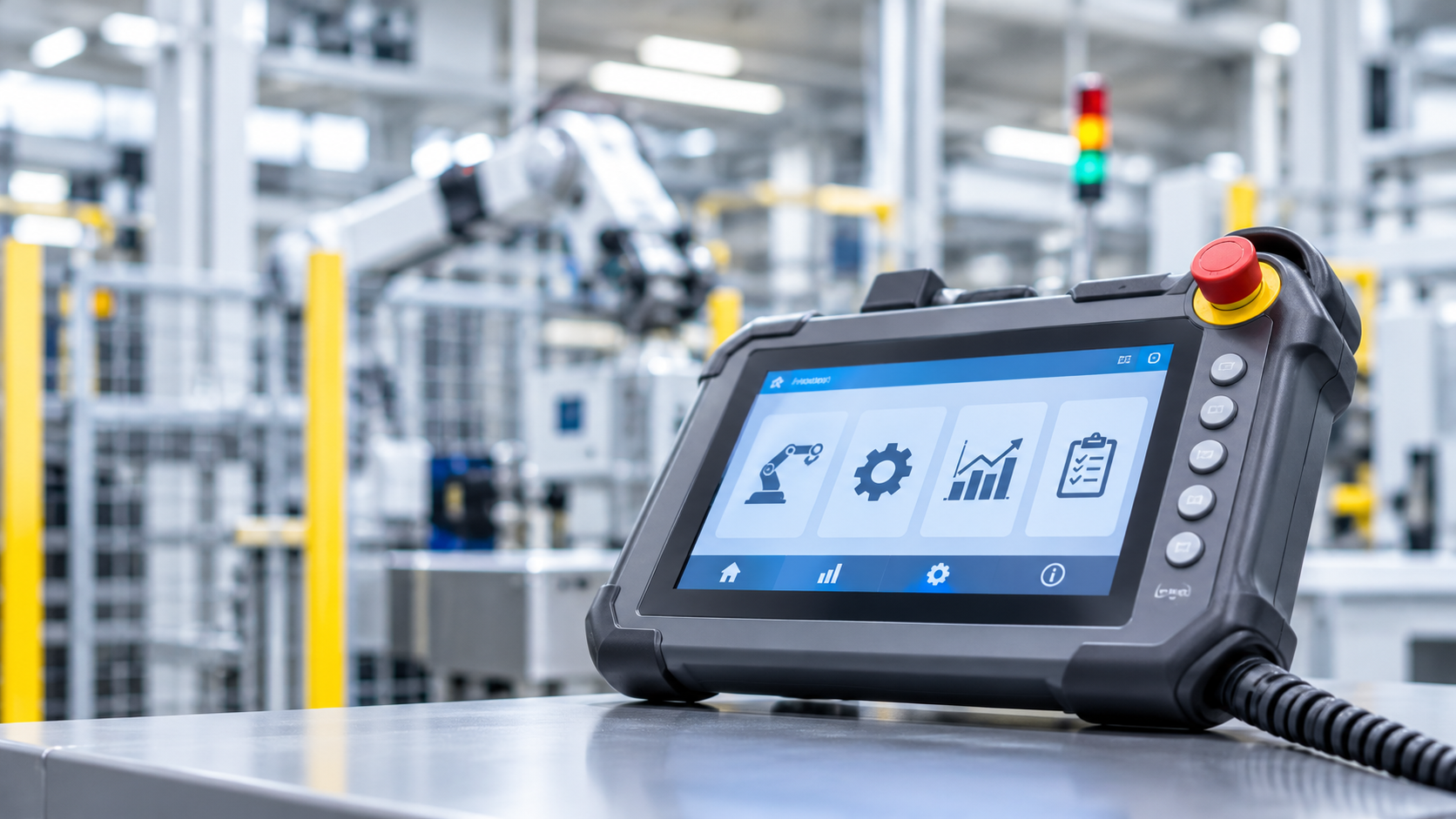
Industrial machine operation is changing. Manufacturers are moving towards connected production environments where operators need immediate access to machine information, clear visualisation and reliable control interfaces.
Traditional fixed Human-Machine Interfaces (HMIs) remain essential in many applications. However, they are not always the most practical solution when operators need to move around large machines, production lines or complex industrial equipment.
This is where Industrial Mobile Operator Panels become valuable. They allow operators and maintenance personnel to interact with machines from different working positions, making machine setup, monitoring and maintenance more flexible.
In 2026, developments in industrial connectivity, HMI design, cybersecurity and digitalisation are influencing how these devices are designed and selected.
Let’s explore what’s changing and what manufacturers should consider before investing in an industrial mobile operator panel.
A conventional HMI is usually installed at a fixed position, such as a machine cabinet or control station. Operators must return to that location whenever they need to check machine status or interact with the control system.
This arrangement works well for many machines. However, it can become inconvenient when working with:
Mobile operator panels allow authorised personnel to access machine information and operating functions closer to the point of work.
For example, during machine setup, an operator can position themselves where they have a better view of the equipment rather than relying entirely on a fixed control station.
This can improve workflow efficiency and reduce unnecessary movement around the production floor.
One of the important developments in 2026 is the increasing focus on making industrial interfaces more useful to operators.
Modern HMI systems are moving beyond basic machine status displays. Depending on the application, they can provide process information, alarm notifications, diagnostics, operating instructions and maintenance information.
Mobile operator devices can bring these functions closer to the person working with the equipment.
For example, a maintenance technician may need to check operating parameters, review an alarm or access diagnostic information while inspecting a machine.
Better interface design can help operators find relevant information quickly and reduce unnecessary navigation.
However, an effective HMI is not simply about adding more information to the screen. It should present the right information clearly, according to the operator’s task and responsibilities.
Industrial machines increasingly need to exchange information with different automation and monitoring systems.
Mobile operator panels must therefore be compatible with the communication architecture of the machine.
Depending on the application, important connectivity considerations include:
Some mobile panels use wired connections, while other solutions use wireless communication.
Wired mobile operator panels can be suitable when predictable connectivity and a defined operating area are important.
Wireless mobile operator panels can offer greater movement flexibility, but require careful consideration of network coverage, latency, authentication and communication reliability.
The right choice depends on machine layout, operating requirements and the existing automation infrastructure.
Industrial mobile operator panels are often used close to moving machinery. Their design must therefore consider operator safety as well as usability.
Some applications require physical safety-related controls, such as emergency stop devices and three-position enabling switches.
These controls can help operators perform specific machine operations under defined safety conditions.
Important considerations include:
An important distinction is that an emergency stop function must be implemented through an appropriately designed and validated safety circuit. A normal touchscreen button should not be treated as a substitute for a safety-rated emergency stop device.
Safety requirements should be considered from the beginning of the HMI development process, not added as an afterthought.
As industrial equipment becomes more connected, cybersecurity is becoming an essential consideration.
Mobile operator devices may provide access to machine information, diagnostics and operating functions. This makes access control and communication security particularly important.
Manufacturers should consider:
The objective is to make machine operation more accessible without creating unnecessary security risks.
Digitalisation should also be introduced carefully. Existing control and safety functions must remain reliable while new monitoring and communication capabilities are integrated.
Selecting an industrial mobile operator panel requires more than comparing display sizes or prices.
Before purchasing, manufacturers and OEMs should evaluate the following factors.
Display and touch technology: Consider screen size, resolution, brightness and touch response. The display should remain readable in the intended working environment.
Operating environment: Check housing protection, resistance to industrial conditions, cable arrangements and mechanical durability.
Connectivity: Confirm compatibility with the machine’s PLC, communication interfaces and existing automation architecture.
Safety controls: Determine whether the application requires emergency stop devices, enabling switches or other physical operating controls.
Software compatibility: Verify that the panel supports the required operating system, HMI application and communication protocols.
Ergonomics: Consider weight, grip, cable length, operating position and how frequently the device will be handled.
Customisation: Some OEM applications require specific display layouts, buttons, connectors, housing designs or software integration. In such cases, a customised operator device may be more suitable than a standard product.
The VH 21 from T&O Electronic Solutions (TO-ES) is an example of an industrial mobile operator device developed for process-proximate machine operation and monitoring.
Developed for an industrial automation application, the VH 21 combines a 10.1-inch capacitive multitouch display with physical operating controls.
Its listed features include:
The combination of touchscreen interaction and physical controls makes it an example of how mobile operator devices can be designed around specific machine-operation requirements.
For OEMs and machine builders, the VH 21 also demonstrates the importance of combining display technology, hardware integration and application-specific operating requirements in one device.
Explore the VH 21 Industrial Mobile Operator Device to learn more about this solution.
Not every machine has the same operating requirements. A standard HMI may be sufficient for a straightforward application, while more complex machinery may require a customised operator interface.
Custom development can address requirements such as:
Working with an experienced engineering partner can help OEMs develop an operator device that fits their machine design and production requirements.
Conclusion: Mobile HMI Is Becoming an Important Part of Smart Machine Operation
Industrial mobile operator panels are helping manufacturers make machine operation more flexible and accessible. Developments in HMI design, connectivity, cybersecurity and industrial digitalisation are creating new opportunities for improving how operators interact with machinery.
However, selecting the right device requires careful evaluation of the application, operating environment, communication requirements and safety functions.
For machine builders and OEMs planning a new machine or modernising an existing system, the right operator interface can make an important difference to usability, integration and long-term operation.
Looking for a customised industrial mobile operator panel for your next project?
T&O Electronic Solutions supports industrial and OEM projects with display solutions, embedded hardware development and application-specific engineering.
Contact TO-ES to discuss your industrial operator interface requirements.
Frequently Asked Questions
An Industrial Mobile Operator Panel is a portable or movable interface that allows operators to monitor and interact with industrial machines from different working positions.
A fixed HMI is installed at a specific location, while a mobile operator panel allows an operator to move to a suitable position when monitoring, setting up or maintaining equipment.
Wired panels can provide predictable connectivity within a defined working area. Wireless panels offer greater mobility but require reliable network coverage and appropriate security measures.
They provide physical safety-related controls for applications where operators need to interact with machinery under defined operating conditions. Their implementation must meet the relevant safety requirements.
Yes. Depending on the engineering partner and application, the display, housing, physical controls, connectivity and software can be adapted to meet specific machine requirements.
Read More: https://tecsysproductguides.blogspot.com/2026/11/industrial-mobile-operator-panels-in.html