Physical Address
304 North Cardinal St.
Dorchester Center, MA 02124
Physical Address
304 North Cardinal St.
Dorchester Center, MA 02124

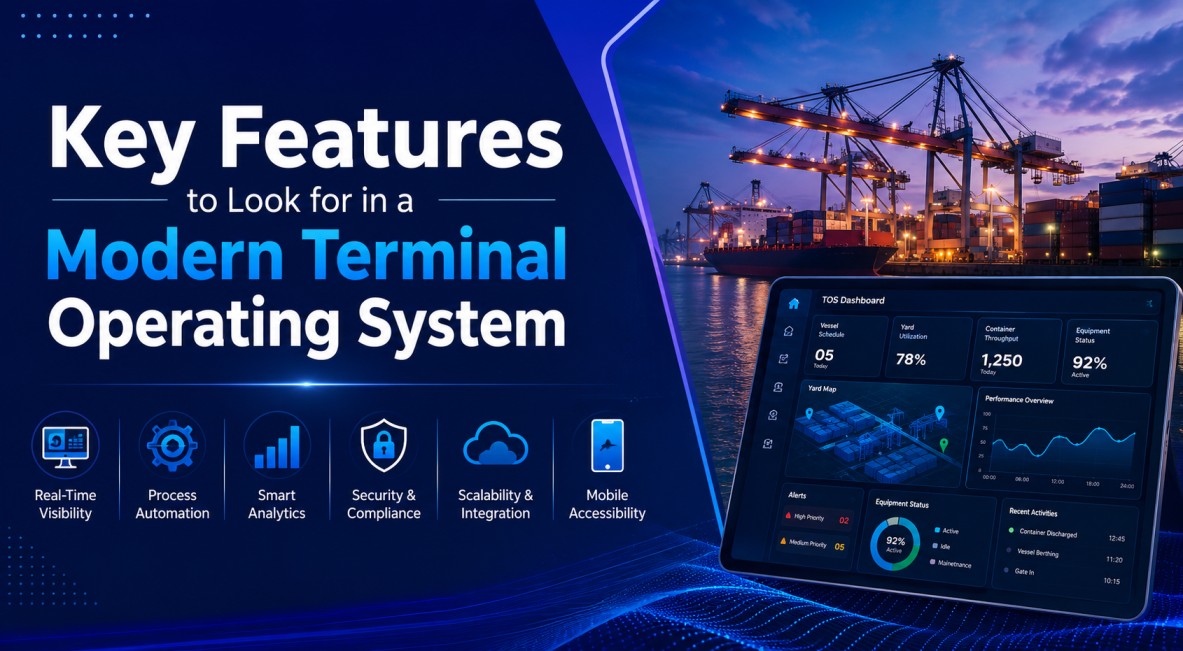
Discover the essential features every modern container terminal operating system needs — from AI-powered berth planning to automated gate processing to boost efficiency and reduce delays.
Ports and terminals today operate under constant pressure — rising cargo volumes, tighter vessel schedules, and growing customer expectations for speed and transparency. At the center of managing this complexity is one critical piece of technology: the terminal operating system.
A modern container terminal operating system is no longer just software that tracks containers — it’s the operational brain of the entire terminal, coordinating everything from berth planning to gate processing. But not all TOS platforms are built the same. Choosing the right one can mean the difference between a terminal that runs smoothly and one that constantly firefights bottlenecks. Here are the key features every port should look for.
The biggest limitation of legacy systems is fragmentation — separate tools for vessel planning, yard management, and gate operations that don’t talk to each other. A modern container terminal operating system should unify all these functions into a single platform, ensuring that a decision made at the berth automatically reflects in yard planning and gate scheduling.
Why it matters: Unified coordination eliminates the data silos that traditionally cause delays, miscommunication, and manual reconciliation between departments.
Manual berth scheduling struggles to account for real-time variables like weather, tidal patterns, and last-minute vessel arrival changes. A modern TOS should include AI-driven planning tools that evaluate vessel size, cargo profile, berth availability, and historical performance to generate optimal schedules automatically.
Why it matters: Smarter berth planning reduces vessel waiting time and improves overall terminal throughput, even during peak traffic periods.
Yard operations are one of the most complex parts of terminal management. A capable TOS should use AI to determine optimal container stacking and slot allocation based on dwell-time predictions, vessel schedules, and retrieval priority — rather than relying on static rules or manual judgment.
Why it matters: Smart stacking logic minimizes unnecessary container reshuffling, which is one of the most time-consuming and costly aspects of yard operations.
Terminal managers need instant access to operational data — crane productivity, yard density, equipment utilization, and truck turnaround times — without having to compile reports manually. Look for a TOS that offers live, centralized dashboards with real-time KPIs.
Why it matters: Real-time visibility allows teams to catch inefficiencies early and make data-backed decisions instead of reacting after problems have already occurred.
Gate operations are often the biggest bottleneck for trucking companies interacting with a terminal. A modern container terminal operating system should support automated gate workflows — including OCR-based container and license plate recognition, digital pre-arrival validation, and automated barrier control.
Why it matters: Automated gate processing significantly reduces truck wait times, improving both terminal efficiency and customer satisfaction.
Rather than only reacting to problems after they occur, a strong TOS should use historical and real-time data to forecast congestion hotspots before they impact operations, giving teams time to rebalance workloads or reroute traffic proactively.
Why it matters: Predictive capabilities prevent minor issues from escalating into major operational delays.
Terminals rarely operate in isolation — they need to connect with Port Community Systems (PCS), customs platforms, ERP systems, and shipping line databases. A modern TOS should support robust API integrations with these external systems.
Why it matters: Strong integration capability ensures data flows accurately across the broader port ecosystem, reducing manual data entry and communication gaps.
Beyond operations, a good TOS should also handle tariff application, automated invoicing, and compliance documentation — reducing administrative overhead for finance and operations teams alike.
Why it matters: Automated billing reduces revenue leakage and speeds up financial reconciliation cycles.
As cargo volumes grow or terminals expand to multiple locations, the underlying system needs to scale without requiring a complete overhaul. Cloud-native architecture supports faster deployment, better uptime, and easier multi-terminal management.
Why it matters: Scalability ensures your technology investment continues to support growth rather than becoming a limiting factor.
With increasing cybersecurity threats targeting critical infrastructure, a modern TOS must include enterprise-grade security — role-based access control, encrypted data storage, audit trails, and compliance with maritime cybersecurity standards.
Why it matters: Robust security protects sensitive operational data and reduces the risk of costly disruptions from cyber incidents.
Selecting a container terminal operating system isn’t just about comparing feature checklists — it’s about finding a partner who understands the operational complexity of ports and terminals. INTECH Creative Services builds AI-driven terminal operating systems and port automation solutions designed to unify berth planning, yard management, gate operations, and analytics into one connected platform.
Whether you’re modernizing an existing setup or implementing a TOS for the first time, INTECH Creative Services brings deep expertise in building scalable, secure, and future-ready systems tailored to your terminal’s specific operational needs.