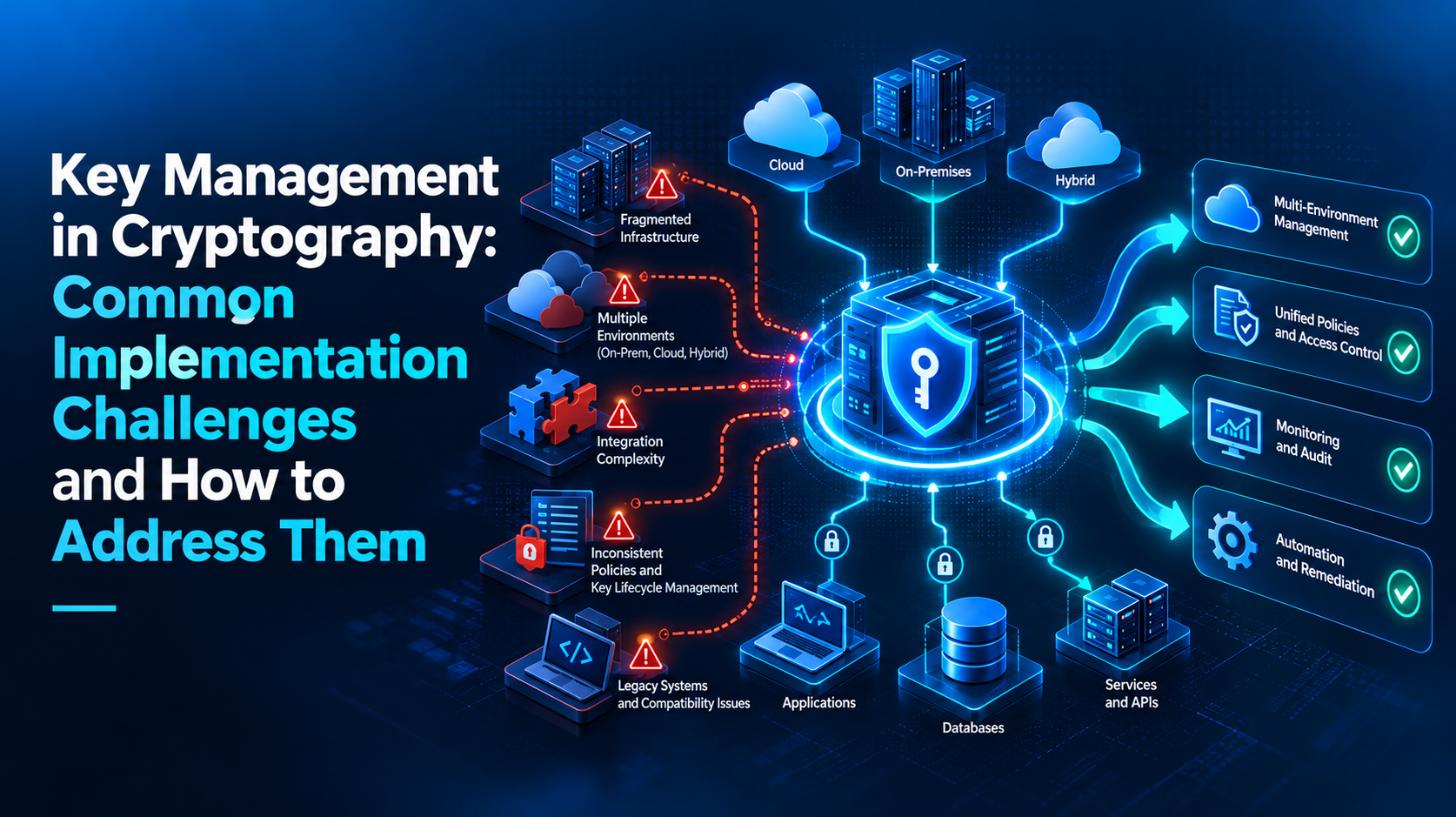

Excerpt:
Implementing enterprise cryptographic key management can become challenging as organizations expand across cloud, on-premises, database, and application environments.
Key management in cryptography requires organizations to address key sprawl, access control, lifecycle management, integration, and operational complexity.
By establishing clear policies and centralized Key management practices, businesses can address these challenges more effectively.
Introduction
Cryptographic keys protect some of the most sensitive information within an enterprise.
Organizations use keys to encrypt databases, protect cloud storage, secure applications, authenticate services, support digital certificates, and protect communications.
However, implementing an effective cryptographic key management program can become difficult as an organization grows.
Businesses may operate thousands of keys across different applications, databases, cloud platforms, and on-premises systems.
Different teams may also follow different procedures.
This can create key sprawl, inconsistent access controls, poor visibility, difficult rotation processes, and integration challenges.
Understanding these problems helps organizations build stronger Key management strategies.
A structured approach to key management in cryptography can help enterprises manage these challenges throughout the cryptographic lifecycle.
Challenge 1: Key Sprawl
Key sprawl occurs when organizations accumulate large numbers of cryptographic keys without sufficient visibility or governance.
Development teams may create keys for applications, cloud services may generate additional keys, and infrastructure teams may manage keys for databases and certificates.
Over time, organizations may lose track of which keys remain active.
How to Address It
Organizations should maintain a centralized cryptographic inventory.
The inventory should include:
-
Key owner
-
Key purpose
-
Associated system
-
Lifecycle status
-
Access permissions
-
Rotation schedule
Regular reviews can identify obsolete and unused keys.
Challenge 2: Poor Key Visibility
Security teams cannot effectively protect keys they cannot identify.
Distributed environments can make visibility difficult.
An enterprise may have keys across:
-
Cloud platforms
-
Databases
-
Applications
-
APIs
-
Backup systems
-
Digital certificates
How to Address It
Organizations should establish discovery and inventory processes.
They should map cryptographic keys to the systems and information they protect.
This gives security teams greater context when reviewing or responding to key-related incidents.
Challenge 3: Excessive Access
Cryptographic keys are sensitive security assets.
If too many users or applications can access them, the organization increases unnecessary exposure.
How to Address It
Organizations should apply least privilege.
Access should depend on:
-
User identity
-
Application identity
-
Business function
-
Data sensitivity
-
Required cryptographic operation
Security teams should review permissions regularly.
Challenge 4: Inconsistent Key Policies
Different teams may manage cryptographic keys differently.
One application may rotate keys regularly while another may use the same key for an extended period.
How to Address It
Organizations should establish enterprise-wide Key management policies.
Policies should define:
-
Key generation
-
Storage
-
Access
-
Rotation
-
Backup
-
Recovery
-
Monitoring
-
Retirement
Teams can then adapt technical implementation to their systems while following common security objectives.
Challenge 5: Manual Key Rotation
Manual rotation becomes difficult when organizations manage large numbers of keys.
Administrators may forget rotation dates or make configuration errors.
How to Address It
Organizations should automate appropriate rotation processes.
However, automation should account for application dependencies.
Before rotating a key, security teams should identify all systems that depend on it.
Organizations should test automated rotation before deploying it widely.
Challenge 6: Key Backup and Recovery
Losing a critical encryption key can make protected information inaccessible to authorized users.
Organizations therefore need secure recovery procedures.
How to Address It
Businesses should:
-
Protect key backups
-
Restrict recovery access
-
Document recovery procedures
-
Test recovery regularly
-
Monitor recovery operations
Recovery should form part of business continuity planning.
Challenge 7: Cloud and Hybrid Complexity
Cloud adoption creates additional cryptographic requirements.
An organization may operate across multiple cloud platforms while maintaining on-premises infrastructure.
Each environment may have different technical capabilities.
How to Address It
Organizations should establish common enterprise Key management policies across supported environments.
A centralized approach can help security teams maintain greater visibility while accommodating platform-specific requirements.
Challenge 8: Application Integration
Applications need access to cryptographic services.
Legacy and modern applications may use different methods for handling keys.
How to Address It
Security teams should identify application dependencies before implementing new Key management infrastructure.
They should evaluate:
-
Supported protocols
-
APIs
-
Authentication methods
-
Key access requirements
-
Rotation behavior
Testing should occur before production deployment.
Challenge 9: Protecting Keys During Development
Developers sometimes store sensitive keys in application code or configuration files.
This can expose cryptographic credentials through source repositories or deployment systems.
How to Address It
Organizations should separate application development from key storage.
Applications should use approved cryptographic services rather than embedding sensitive keys directly into source code.
Development teams should also receive guidance on secure secret handling.
Challenge 10: Certificate and Private Key Management
Digital certificates introduce additional lifecycle requirements.
Organizations need to monitor:
-
Certificate ownership
-
Expiration
-
Renewal
-
Revocation
-
Private key protection
How to Address It
Businesses should integrate certificate-related cryptographic assets into their broader Key management strategy.
Security teams should maintain visibility into certificates and associated private keys.
Challenge 11: Legacy Systems
Older applications may not support modern cryptographic technologies.
These systems can make enterprise-wide Key management implementation difficult.
How to Address It
Organizations should first identify legacy dependencies.
They may need to use integration mechanisms, phased migrations, or compensating security controls.
Businesses should create a roadmap for gradually modernizing legacy systems.
Challenge 12: Monitoring and Incident Response
Organizations need to know when cryptographic keys are accessed or modified unexpectedly.
Without monitoring, suspicious key activity may go unnoticed.
How to Address It
Security teams should monitor:
-
Key access
-
Key creation
-
Key rotation
-
Failed access attempts
-
Administrative changes
-
Key retirement
Key-related events should integrate with broader security monitoring and incident response processes.
Challenge 13: Unclear Key Ownership
A cryptographic key without a clear owner can become difficult to manage.
Teams may not know who should approve access, rotate the key, or respond to a compromise.
How to Address It
Organizations should assign clear ownership.
Key owners should understand:
-
What the key protects
-
Which applications use it
-
Who can access it
-
When it should rotate
-
When it should retire
Challenge 14: Scaling Key Management
A Key management approach that works for a small environment may not work for a large enterprise.
Organizations need to consider future growth.
How to Address It
Businesses should evaluate:
-
Number of keys
-
Number of applications
-
Number of databases
-
Cloud expansion
-
Geographic distribution
-
New business services
Scalability should form part of the initial architecture.
The Role of Centralized Key Management
Centralized Key management can help organizations address many of these challenges through common policies and visibility.
For example, security teams can establish centralized processes for:
-
Key inventory
-
Access control
-
Rotation
-
Monitoring
-
Recovery
-
Retirement
This can reduce fragmented cryptographic practices.
Thales Key Management
Thales key management can support organizations that require centralized capabilities for managing cryptographic keys across complex enterprise environments.
Organizations should evaluate such technology according to their specific infrastructure, integration, scalability, security, and governance requirements.
Technology should complement, rather than replace, sound Key management policies.
Building a Practical Implementation Strategy
Organizations can approach implementation in stages.
Step 1: Discover
Identify cryptographic keys and associated systems.
Step 2: Classify
Determine the sensitivity and business importance of protected information.
Step 3: Assign Ownership
Define responsibility for each important key.
Step 4: Establish Policies
Define requirements for access, rotation, backup, recovery, and retirement.
Step 5: Centralize Where Appropriate
Move suitable cryptographic operations into controlled Key management infrastructure.
Step 6: Automate
Automate routine lifecycle processes after testing.
Step 7: Monitor
Track cryptographic activity and policy compliance.
Step 8: Review
Regularly reassess the environment and remove obsolete keys.
Best Practices
Organizations should:
-
Maintain a complete key inventory.
-
Assign ownership.
-
Apply least privilege.
-
Separate keys from protected data.
-
Establish lifecycle policies.
-
Automate appropriate processes.
-
Monitor cryptographic activity.
-
Protect key backups.
-
Test recovery.
-
Review application dependencies.
-
Address legacy systems.
-
Retire obsolete keys.
Conclusion
Implementing enterprise Key management can become challenging as organizations expand across applications, databases, cloud platforms, and hybrid infrastructure.
Key management in cryptography provides the lifecycle framework needed to manage cryptographic keys from generation through retirement.
Organizations must address key sprawl, access control, visibility, rotation, recovery, application integration, legacy systems, and monitoring.
Effective Key management combines technology with clear policies, ownership, automation, monitoring, and regular reviews.
Thales key management can support centralized cryptographic management where its capabilities align with an organization’s technical and security requirements.
By taking a structured, phased approach to implementation, enterprises can reduce cryptographic complexity, improve operational consistency, and establish stronger control over the keys that protect sensitive business information.