
Introduction
Encryption provides an important layer of enterprise data protection.
Organizations use encryption to protect databases, applications, cloud storage, backups, communications, and other sensitive resources.
However, encryption relies on cryptographic keys.
These keys determine how organizations encrypt, decrypt, sign, or authenticate information.
If an organization fails to protect its keys, attackers may potentially undermine the security provided by encryption.
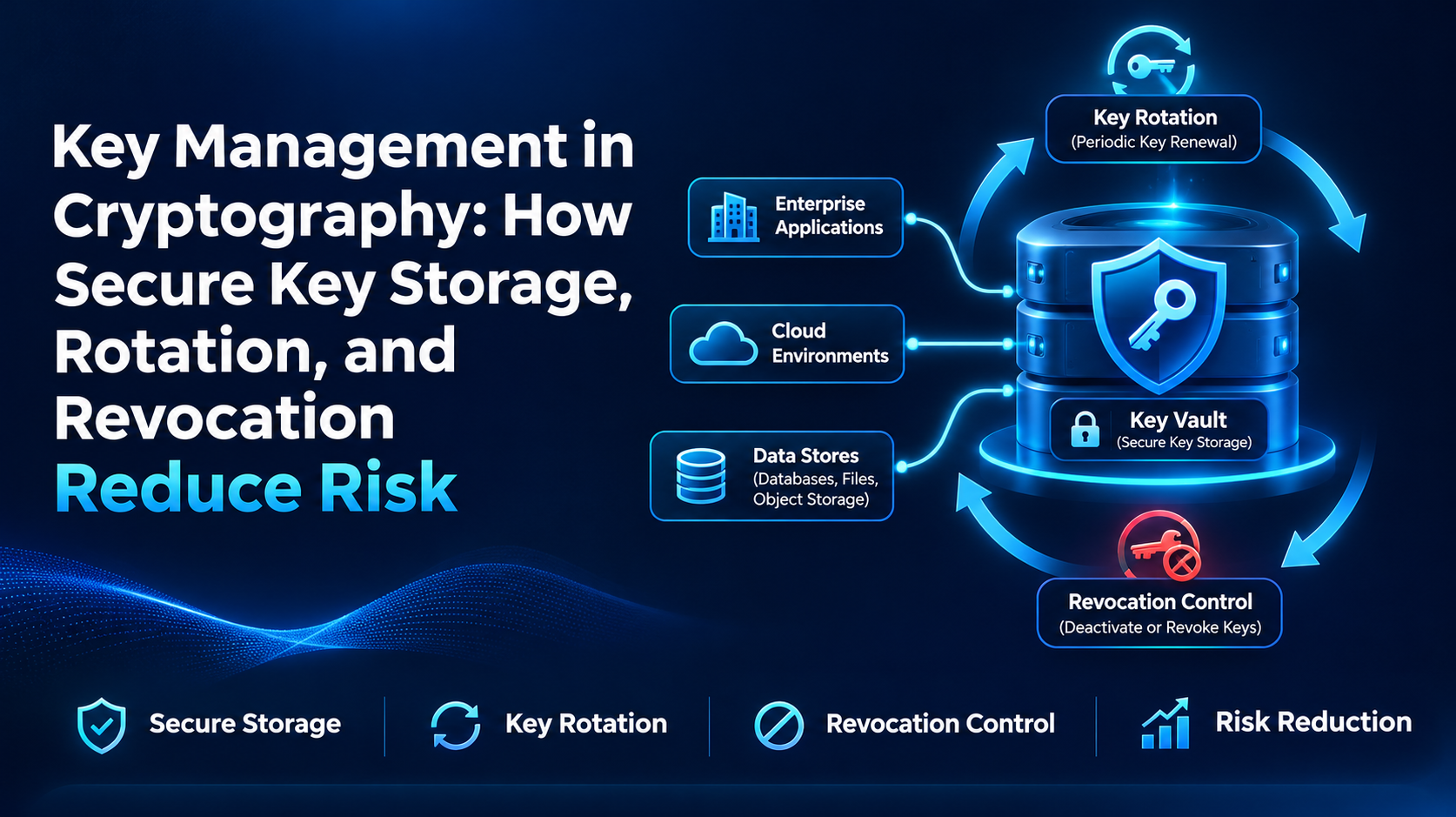
This makes secure key storage, rotation, and revocation essential components of enterprise cybersecurity.
A structured approach to key management in cryptography allows organizations to control keys throughout their lifecycle.
Effective Key management helps security teams determine where keys reside, who can access them, when they should rotate, and when they should be revoked.
Why Cryptographic Keys Require Dedicated Protection
Cryptographic keys are security-sensitive assets.
Consider an organization that encrypts a database containing customer information.
The database may remain encrypted, but authorized applications still need access to the appropriate key.
If an attacker obtains that key, the security of the protected information may be affected.
Organizations should therefore manage keys independently from the information they protect.
Understanding Key Management in Cryptography
Key management in cryptography covers the complete lifecycle of cryptographic keys.
The lifecycle includes:
-
Generation
-
Storage
-
Distribution
-
Access
-
Usage
-
Rotation
-
Backup
-
Recovery
-
Revocation
-
Retirement
-
Destruction
Each stage requires appropriate controls.
Secure Key Storage
Secure storage represents one of the most important aspects of Key management.
Organizations should avoid storing sensitive keys in:
-
Source code
-
Public repositories
-
Unprotected configuration files
-
Application packages
-
Easily accessible storage
Instead, organizations should use appropriate secure key management infrastructure.
Separating Keys From Protected Data
Organizations should maintain appropriate separation between keys and the information they protect.
For example, a database may store encrypted records while the corresponding keys remain under a separate security control.
This separation can create an additional security boundary.
Access Control for Stored Keys
Secure storage must include strong access controls.
Organizations should apply least privilege.
Only authorized users and applications should receive access to particular keys.
Administrative access should receive additional security controls.
Key Rotation
Key rotation involves replacing an existing cryptographic key with a new one according to defined policies.
Organizations may rotate keys based on:
-
Key age
-
Data sensitivity
-
Security requirements
-
Internal policies
-
Risk
-
Suspected compromise
Rotation can reduce the amount of time a specific key remains active.
Planning Key Rotation
Rotation requires careful planning.
Before replacing a key, security teams should identify:
-
Applications using it
-
Databases depending on it
-
Backup systems requiring it
-
Services that need access
-
Recovery requirements
Testing helps reduce the risk of application disruption.
Key Revocation
Revocation removes trust in a cryptographic key or credential.
Organizations may revoke a key when:
-
It may have been compromised
-
Its owner changes
-
An application is retired
-
A certificate becomes invalid
-
The key is no longer required
Organizations should establish documented revocation procedures.
Responding to a Compromised Key
If a key may have been compromised, organizations should respond quickly.
A typical process may include:
-
Identify the affected key
-
Determine which systems use it
-
Restrict or revoke access
-
Generate replacement key material
-
Update dependent applications
-
Review affected data
-
Retire the compromised key
-
Document the incident
The exact process should reflect the organization’s security architecture.
Key Backup and Recovery
Organizations should maintain secure backups of critical cryptographic keys.
However, backups require strong protection.
Businesses should restrict recovery access and monitor recovery operations.
They should also test recovery regularly.
Key Expiration
Keys and related credentials may have defined validity periods.
Organizations should monitor expiration dates.
Expired keys can create either security or availability problems depending on how applications use them.
Automated alerts can help teams manage approaching expiration dates.
Key Management Across Cloud Environments
Cloud platforms can create additional cryptographic complexity.
Organizations may operate multiple cloud environments and on-premises systems.
Security teams should maintain visibility across all supported environments.
Centralized Key management can help establish consistent lifecycle policies.
Application Security
Applications frequently use cryptographic keys for:
-
Encryption
-
Authentication
-
API security
-
Digital signatures
-
Secure communication
Developers should avoid hard-coding sensitive keys.
Applications should use approved mechanisms to access cryptographic services.
Database Security
Database encryption can protect sensitive records.
However, the associated keys require separate protection.
Organizations should track:
-
Key ownership
-
Access permissions
-
Rotation schedules
-
Backup status
-
Recovery procedures
This creates stronger control over database encryption.
Monitoring Key Activity
Security teams should monitor:
-
Key access
-
Key creation
-
Key rotation
-
Key revocation
-
Administrative changes
-
Failed access attempts
-
Key retirement
Monitoring can help identify suspicious behavior.
Common Key Management Risks
Insecure Storage
Keys may be exposed through application code or configuration.
Long-Lived Keys
Keys may remain active longer than necessary.
Poor Revocation
Organizations may not have clear procedures for compromised keys.
Excessive Access
Too many users or applications may access sensitive keys.
Incomplete Inventory
Security teams may not know where keys reside.
Best Practices
Organizations should:
-
Maintain an accurate key inventory
-
Store keys using appropriate security controls
-
Separate keys from protected data
-
Apply least privilege
-
Establish rotation policies
-
Define revocation procedures
-
Monitor expiration
-
Protect backups
-
Test recovery
-
Monitor key activity
-
Automate appropriate lifecycle tasks
-
Retire obsolete keys
Creating a Strong Key Lifecycle
A mature Key management program should follow a continuous lifecycle:
Generate → Store → Use → Monitor → Rotate → Revoke when required → Retire → Destroy
This approach helps organizations maintain control as security requirements and technology environments change.
Conclusion
Secure key storage, rotation, and revocation are essential components of enterprise cryptographic security.
Key management in cryptography provides the framework for managing keys from generation through retirement.
Effective Key management helps organizations protect stored keys, restrict access, rotate aging credentials, revoke compromised keys, monitor activity, and maintain reliable recovery procedures.
By treating cryptographic keys as critical security assets rather than simple technical components, enterprises can reduce unnecessary exposure and strengthen the overall resilience of their encryption infrastructure.