Physical Address
304 North Cardinal St.
Dorchester Center, MA 02124
Physical Address
304 North Cardinal St.
Dorchester Center, MA 02124

The Leprosy Treatment Market remains an important segment of global infectious-disease care despite the long-term decline in leprosy prevalence. Leprosy, also known as Hansen disease, is a chronic bacterial infection that primarily affects the skin and peripheral nerves. If diagnosed and treated early, it is curable and the risk of permanent disability can be substantially reduced.
Current market developments are closely linked to public-health programs, early case detection, multidrug therapy (MDT), contact screening, medicine availability, and efforts to reduce stigma. WHO reported 172,717 new cases globally in 2024, demonstrating that continued treatment access and disease-control activities remain necessary.
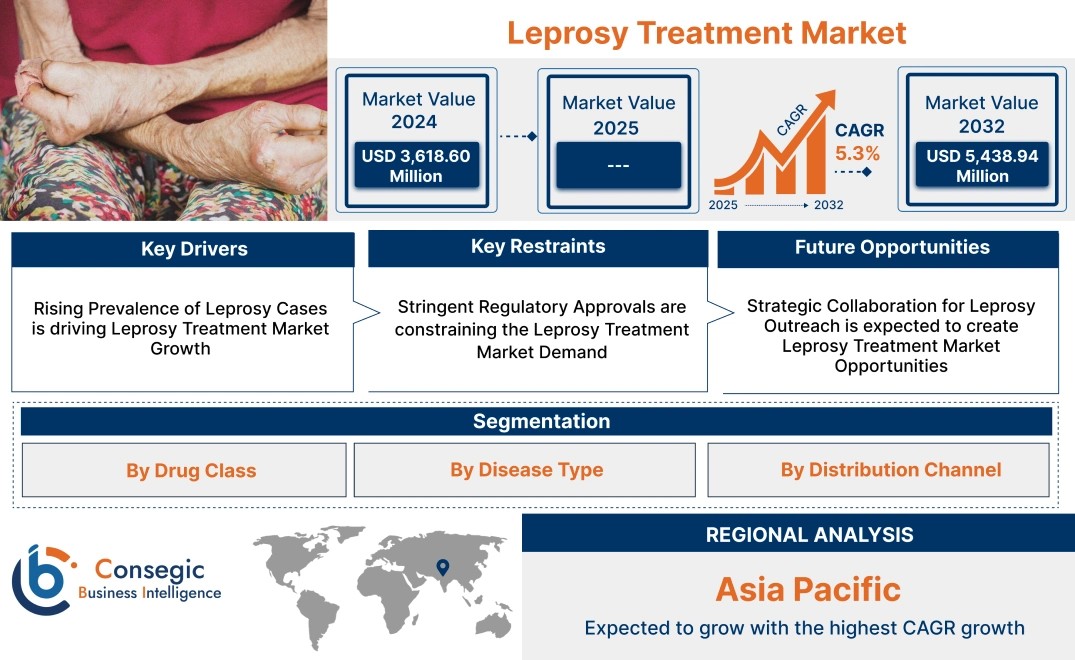
Leprosy treatment market size is estimated to reach over USD 5,438.94 Million by 2032 from a value of USD 3,618.60 Million in 2024, growing at a CAGR of 5.3% from 2025 to 2032.
The Leprosy Treatment Market includes medicines, treatment programs, diagnostic support, distribution systems, and healthcare services associated with managing Hansen disease.
The core pharmaceutical treatment is multidrug therapy. WHO currently recommends a three-drug regimen consisting of rifampicin, dapsone, and clofazimine, with treatment generally lasting six months for paucibacillary disease and 12 months for multibacillary disease.
Key applications include:
Major end users include hospitals, government healthcare programs, specialized clinics, community health centers, laboratories, pharmacies, and international health organizations.
Although leprosy has declined substantially over several decades, new cases continue to be reported across WHO regions. In 2024, South-East Asia accounted for 109,597 reported new cases, making it the largest regional contributor. Africa and the Americas also reported substantial numbers.
National elimination programs and international initiatives remain important market drivers. WHO’s Global Leprosy Strategy 2021–2030 focuses on moving toward zero disease, zero disability, and zero stigma and discrimination.
Early identification allows patients to begin treatment sooner and can reduce the risk of nerve damage and disability. Better screening, healthcare-worker training, contact tracing, and community awareness can therefore support demand for treatment services.
Reliable pharmaceutical supply chains are essential in endemic areas. WHO has facilitated free MDT distribution in endemic countries since 1995, creating a distinctive market structure in which public procurement and international medicine-donation programs have a major role.
The treatment landscape is increasingly connected with digital healthcare and data-driven public-health systems.
Artificial Intelligence (AI) and Machine Learning (ML) may support epidemiological analysis, disease surveillance, case identification research, and resource planning. These technologies can help health authorities identify patterns and allocate resources more effectively.
Digital transformation is also improving disease monitoring. Cloud technologies, electronic health records, mobile reporting tools, and data analytics can support communication between community health workers, laboratories, clinics, and public-health agencies.
Automation can improve pharmaceutical packaging, inventory management, laboratory workflows, and medicine distribution. IoT integration may further support temperature and inventory monitoring across pharmaceutical supply chains.
Sustainability is another developing consideration. Pharmaceutical manufacturers and public-health organizations can explore efficient packaging, waste reduction, optimized transportation, and green technologies. Smart manufacturing and Industry 4.0 principles may become more relevant to medicine production and distribution.
Innovation in the Leprosy Treatment Market is not limited to new medicines. Diagnostic technologies, digital surveillance, supply-chain management, and patient-monitoring systems are also important.
Research continues to examine improved diagnostic approaches because early leprosy can sometimes be difficult to identify clinically. WHO notes that laboratory-based services may be required for difficult cases, while several serological and other assays have been developed to supplement clinical diagnosis.
Pharmaceutical manufacturing is also becoming more automated. Robotics, automated quality inspection, data analytics, and predictive maintenance can improve manufacturing reliability. Advanced materials and improved packaging may contribute to medicine stability and supply-chain efficiency.
North America has comparatively low disease incidence but maintains capabilities in infectious-disease research, specialized healthcare, diagnostics, and pharmaceutical development. Opportunities are more closely associated with research, surveillance, specialized treatment, and global-health partnerships than with large domestic treatment volumes.
Europe similarly represents a lower-incidence region but has strong public-health infrastructure and research capabilities. Investment opportunities include diagnostic research, digital disease surveillance, pharmaceutical research, and partnerships supporting endemic regions.
Asia-Pacific is the most important regional market from a disease-burden perspective. WHO data show that South-East Asia recorded the largest number of new cases in 2024. Population size, endemic areas, healthcare access, case detection, and government elimination programs will continue to influence regional demand.
Latin America has established leprosy-control programs, with Brazil representing a significant contributor to regional case numbers. Expanding community-based healthcare, early diagnosis, treatment access, and public awareness can create continued demand for disease-management services.
Africa remains an important region for disease-control initiatives. WHO reported 19,171 new cases across the African Region in 2024. Opportunities include healthcare infrastructure, medicine distribution, community screening, diagnostic capacity, and public-health workforce development.
Potential opportunities include:
Investment strategies are likely to be strongest when they address unmet healthcare-access needs rather than focusing solely on pharmaceutical sales.
The competitive environment differs from conventional pharmaceutical markets because international health organizations, governments, manufacturers, research institutions, and nonprofit partners play significant roles.
Competitive activity can involve pharmaceutical partnerships, medicine donations, manufacturing agreements, research collaborations, diagnostic development, and improvements in supply-chain capacity. WHO and Novartis extended their collaboration for MDT and related leprosy initiatives through 2026–2030, illustrating the continuing importance of long-term public-private partnerships.
The Leprosy Treatment Market is expected to remain closely tied to global disease-elimination programs rather than conventional volume-driven pharmaceutical demand. Through 2034, early diagnosis, reliable medicine access, contact screening, preventive interventions, and disability prevention are likely to remain central priorities.
AI, ML, cloud technologies, data analytics, automation, and IoT integration could improve surveillance and healthcare-resource planning. Meanwhile, pharmaceutical manufacturers can apply smart manufacturing, robotics, predictive maintenance, and sustainable production practices to improve operational efficiency.
Future opportunities will likely be strongest in regions where disease burden remains significant and healthcare systems are expanding. Continued research, public-private partnerships, digital health infrastructure, and improved community-level detection can support progress toward the long-term goal of eliminating leprosy as a disease while reducing disability and stigma.
The Leprosy Treatment Market covers medicines, healthcare services, diagnostics, public-health programs, and supporting technologies used to manage Hansen disease. Its pharmaceutical foundation is multidrug therapy involving rifampicin, dapsone, and clofazimine. The market also includes treatment-access programs, disease surveillance, early diagnosis, contact screening, and disability-prevention initiatives.
Key factors include continued new-case detection, government elimination programs, demand for early diagnosis, treatment availability, community healthcare expansion, contact screening, and pharmaceutical supply-chain development. Digital health technologies, data analytics, and improved diagnostic capabilities can further strengthen disease-management programs.
Asia-Pacific, particularly the WHO South-East Asia Region, represents the largest regional area by reported disease burden. In 2024, South-East Asia recorded 109,597 new cases, substantially more than other WHO regions. This makes the region particularly important for treatment programs, medicine supply, screening, and disease-elimination initiatives.
Major trends include digital disease surveillance, improved diagnostic research, AI and ML-assisted data analysis, automated pharmaceutical manufacturing, cloud-based healthcare systems, and stronger contact-screening programs. Sustainability, supply-chain optimization, and public-private partnerships are also gaining importance as healthcare systems work toward long-term disease elimination.
Opportunities are expected in early-detection technologies, digital surveillance, medicine distribution, pharmaceutical manufacturing, community healthcare, research, and public-health infrastructure. Emerging markets with persistent disease burdens may require continued investment in treatment access, diagnostics, healthcare-worker training, and programs designed to prevent disability and transmission.
About Us
At Consegic Business Intelligence Pvt. Ltd., we empower organizations with actionable market intelligence, strategic insights, and data-driven research solutions that support informed business decision-making. Our comprehensive market research reports provide in-depth analysis of industry trends, competitive landscapes, emerging opportunities, and future growth prospects across diverse sectors.
Contact Us
Consegic Business Intelligence Pvt. Ltd.
Website: www.consegicbusinessintelligence.com
Email: [email protected]
Phone: +1-833-313-3130




