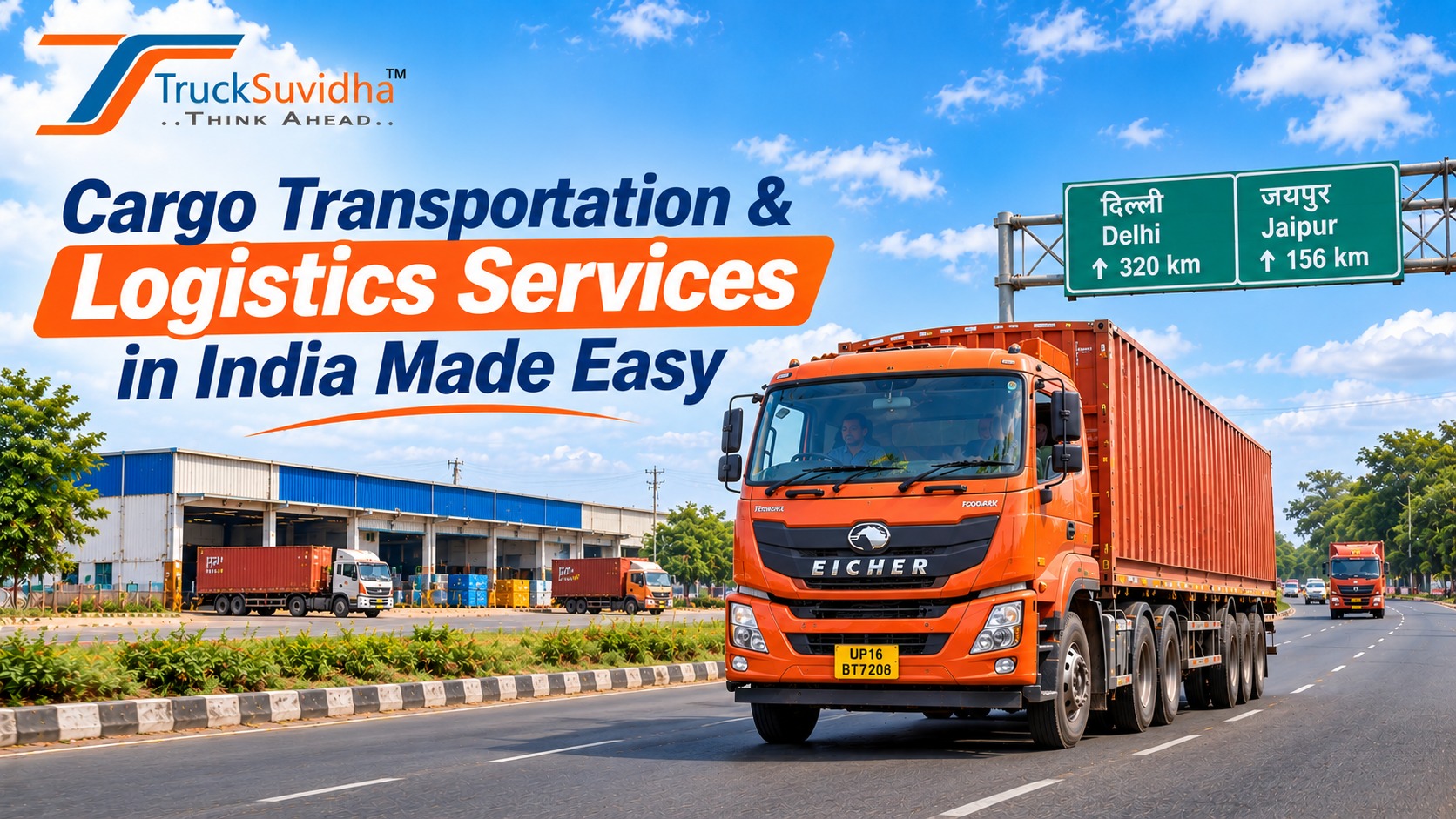

Cargo Transportation and Logistics Services in India Made Easy
Logistics services in India cover everything involved in moving goods from sender to receiver: booking a truck, planning the route, completing paperwork, tracking the cargo and confirming delivery. For most Indian businesses this means road freight. Whether you are a manufacturer sending a full truckload to another state or a trader shipping a few cartons, the transportation logistics services you choose affect your costs, delivery times and customer trust.
This guide explains how cargo transport works in India, what it costs, which rules apply and how to pick a dependable partner. Every statistic comes from a government or published source, listed at the end.
What Are Logistics Services in India?
Quick answer: Logistics services in India are the transport, storage, tracking and documentation services that move goods from one place to another. They include full truckload (FTL) and part load road freight, rail and waterway cargo, air freight, warehousing and last-mile delivery.
Most shippers choose between these formats:
- Full truckload (FTL): one consignment uses the whole vehicle. It suits bulk or time-sensitive goods.
- Part load (PTL/LTL): several shippers share one truck, and each pays for the space used.
- Multimodal transport: road combined with rail or waterways for longer routes.
- Value-added services: warehousing, GPS tracking and fleet management.
On TruckSuvidha, loads above 3 MT are listed as full loads and loads below 3 MT as part loads. Other providers may use different cut-offs.
Why Logistics Matters: What the Latest Data Says
For years, India’s logistics cost was quoted at 13–14% of GDP. In September 2025, the Department for Promotion of Industry and Internal Trade (DPIIT) released the first official assessment, prepared by NCAER. It puts logistics cost at 7.97% of GDP in 2023-24, about ₹24.01 lakh crore, and 9.09% of non-services output. The study combined primary data from over 3,500 industry stakeholders with data from MoSPI, RBI and GSTN.
Two cautions apply. Other estimates still differ because their methods differ, and DPIIT officials advised against comparing India’s figure directly with other countries. The burden is also uneven: smaller firms spend about 17% of output on logistics, against roughly 7.6% for large firms.
Cargo Transportation Costs by Mode
The same study reports average freight costs per tonne-kilometre:
| Mode | Average cost (₹ per tonne-km) |
|---|---|
| Rail | 1.96 |
| Waterways | 2.30 |
| Road (average) | 3.78 |
| Air | 72 |
Within road transport the spread is wide: about ₹1.51 for heavy 55-tonne trailers against ₹11.03 for light trucks. Vehicle size and load matter as much as distance. The report also found that rail-based multimodal movement becomes cost-competitive at around 600 km, assuming about 50 km of first- and last-mile road at each end.
Road still carries most of India’s freight. Estimates range from roughly 65% to 70% depending on the study, and road stays competitive on shorter hauls because of door-to-door flexibility.
Rules to Know Before You Ship
E-way bill. Under GST, goods moved in a vehicle generally need an e-way bill when the consignment value exceeds ₹50,000. Some states set different limits for intra-state movement. It must be generated before the vehicle starts moving, and for regular cargo it is valid for one day per 200 km. Moving goods without a valid e-way bill can lead to detention and penalties. Check the latest rules on the official GST e-way bill portal before dispatch.
FASTag. Since midnight on 15–16 February 2021, every lane at National Highway fee plazas has been a FASTag lane. Vehicles without a valid tag pay double the toll.
How Government Reforms Are Simplifying Logistics
The National Logistics Policy (NLP), launched on 17 September 2022, aims to bring logistics costs towards global benchmarks and lift India into the top 25 of the World Bank’s Logistics Performance Index (LPI) by 2030. India’s LPI rank improved from 44 in 2018 to 38 out of 139 countries in 2023.
The Unified Logistics Interface Platform (ULIP) integrates 30+ digital systems. Logistics Data Bank 2.0 lets users track shipments by container number, vehicle number or railway FNR number. PIB also credits GST and the e-way bill with removing long-standing frictions in interstate transport.
How to Choose a Transportation Logistics Services Provider
Use this checklist:
- Verification: Are vehicles and drivers checked before dispatch?
- Transparent pricing: Do you get clear quotes with no hidden extras? Cross-check with a freight calculator.
- Tracking: Is there GPS, toll-based or mobile-based visibility, not just phone calls?
- Compliance support: Does the provider help with the e-way bill and FASTag?
- Network and support: Does it cover your routes, and can you reach someone when a shipment is delayed?
Practical Ways to Cut Cargo Transportation Costs
- Match the vehicle to the load. The ₹1.51 vs ₹11.03 per tonne-km gap shows how strongly vehicle size and load affect cost. Consolidate small shipments or use part load.
- Consider rail or multimodal on long hauls. The cost advantage appears beyond roughly 600 km.
- Sort paperwork early. Generate the e-way bill before dispatch and keep FASTag funded.
- Compare quotes before you confirm a booking.
- Fleet owners: line up return loads so trucks don’t travel empty.
How TruckSuvidha Makes Cargo Transportation Simpler
TruckSuvidha, operated by Sarvodaya Infotech Pvt. Ltd., is an online platform that connects businesses, truck owners and drivers across India. Its transportation logistics services page explains how it matches shippers with transporters. At the time of writing, its Our Network page shows 39,129 customers, 80,851 transporters and 2,914 packers and movers.
As described on its website, the platform offers:
- Posting of full or part loads, plus a Load Board and Truck Board to search both sides.
- Quick quotes from its transporter network. TruckSuvidha states it verifies trucks and checks drivers, and it lists Vehicle Verification and Driver Verification services.
- Tracking options: GPS, toll-based and mobile-number-based.
- A Freight Calculator and Distance Calculator for estimates.
- An e-way bill guide and FASTag information.
- For truck owners, daily load access aimed at reducing empty return trips.
- Android and iOS apps.
Call +91-8882-08-08-08 or email [email protected].
Frequently Asked Questions
What are logistics services in India?
They are the transport, warehousing, tracking and documentation services that move goods between sender and receiver, mainly by road but also by rail, water and air.
What is the difference between FTL and part load?
FTL gives one shipper the entire truck. Part load lets several shippers share a truck and pay only for the space they use.
What is India’s logistics cost as a percentage of GDP?
The official DPIIT–NCAER estimate is 7.97% of GDP for 2023-24. The earlier 13–14% figure came from partial or external data.
Is an e-way bill required for truck shipments?
Generally yes, when the consignment value exceeds ₹50,000, subject to state-specific rules for intra-state movement.
How can I book a truck online in India?
Register on a booking platform, post your load with route and weight, compare quotes, verify the vehicle and driver, generate the e-way bill and track the shipment.
Conclusion
Logistics services in India are becoming more digital and more transparent, helped by policy reforms and better data. Businesses that know the costs, rules and options can move cargo faster and spend less. To book trucks or find loads, explore reliable transport logistics solutions at TruckSuvidha.