Physical Address
304 North Cardinal St.
Dorchester Center, MA 02124
Physical Address
304 North Cardinal St.
Dorchester Center, MA 02124

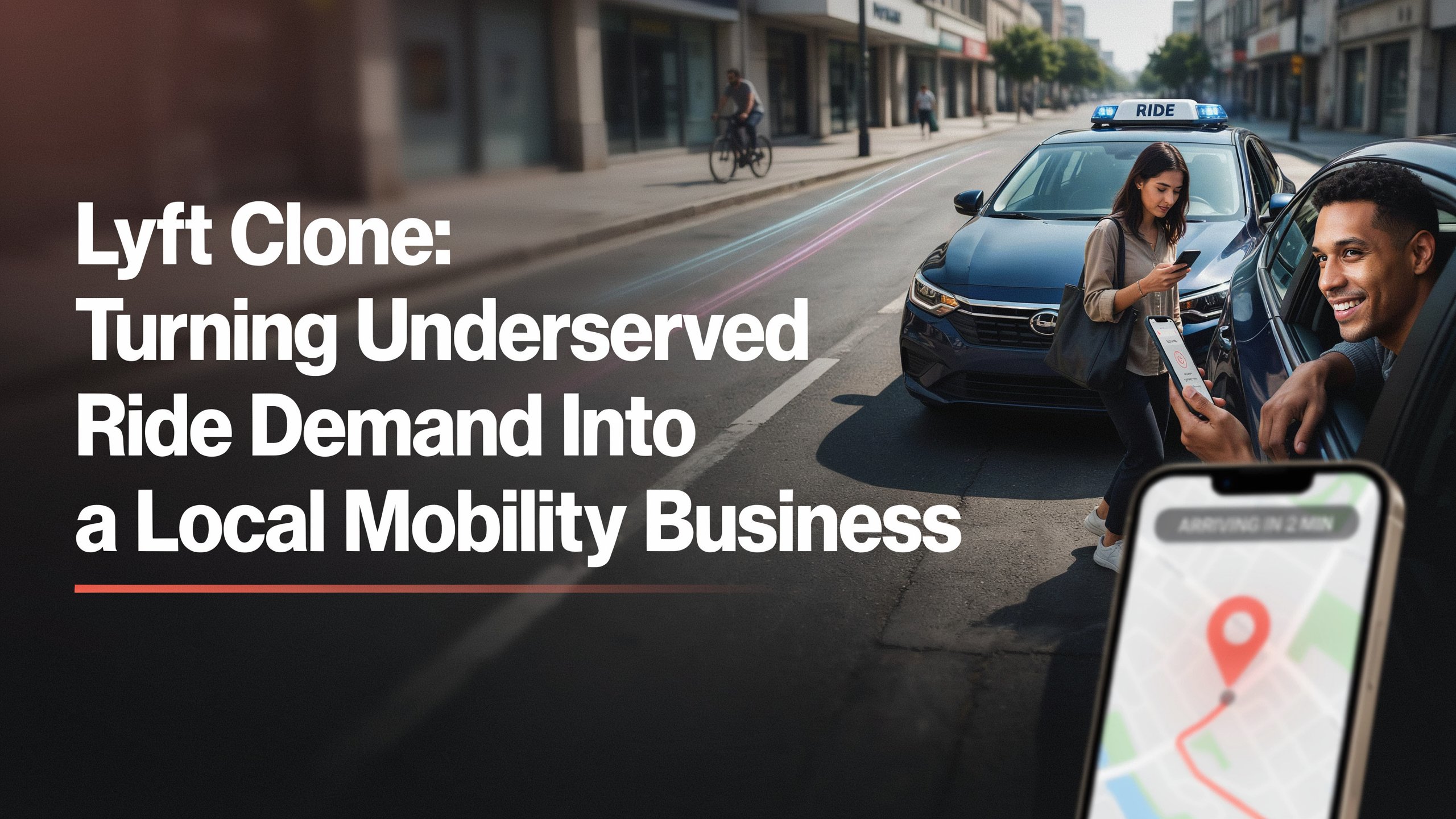
A growing city does not always need another ride-hailing app. Sometimes, it needs a better answer to a very specific transportation problem.
Consider a suburban business district where office workers struggle to find rides during peak hours. Airport passengers have difficulty securing vehicles for early-morning trips. Local businesses need dependable transportation for employees and customers, while drivers often spend time waiting in areas with unpredictable demand. The problem is not a lack of mobility—it is a mismatch between available supply and actual demand.
This is where a Lyft Clone can become more than a replica of an existing ride-hailing platform. For mobility entrepreneurs, it can serve as the technology foundation for building a localized transportation business around overlooked demand.
The conventional approach to ride-hailing is to attract as many riders and drivers as possible. A more focused model begins with a transportation gap.
For example, an entrepreneur could identify a growing commercial zone where thousands of employees travel daily but have limited transportation options outside standard commuting hours. Instead of immediately competing across an entire city, the business could initially concentrate on scheduled employee rides, office transfers, and recurring bookings.
This creates a defined use case and gives the platform a clearer reason to exist.
A Lyft Clone can support this strategy by providing rider booking, driver management, real-time tracking, digital payments, notifications, and administrative controls that can be adapted to the selected market.
On-demand rides remain important, but not every transportation requirement happens unexpectedly.
Airport transfers, employee transportation, medical appointments, events, intercity trips, and recurring commutes often involve advance planning. Customers in these situations value reliability and predictable pickup arrangements.
A localized ride-hailing platform can therefore make scheduled bookings part of its core offering rather than treating them as an additional feature.
For startups, this can also create opportunities to establish recurring demand. A customer booking transportation for the same route every weekday represents a different business opportunity from someone making an occasional spontaneous trip.
One of the biggest challenges in ride-hailing is maintaining balance between riders and drivers.
Imagine a platform operating in a developing suburban market. During weekday mornings, passenger demand is concentrated around residential areas. By afternoon, the demand pattern changes as employees return home. At night, airport and entertainment trips may become more important.
Understanding these patterns can help operators design service zones, incentives, and driver availability around actual demand rather than relying on a one-size-fits-all approach.
A Lyft Clone can provide the operational tools required to monitor bookings, driver availability, trip activity, cancellations, and revenue. The business strategy then determines how those capabilities are used.
The same platform can address businesses that need transportation without becoming a consumer-only service.
Companies may require employee transportation, client transfers, airport pickups, or scheduled rides for meetings and events. Instead of acquiring every passenger individually, a mobility startup can develop business accounts that generate multiple bookings through a single customer relationship.
Corporate mobility can also introduce predictable booking patterns, making it easier for operators to plan driver availability and service coverage.
This is particularly relevant in locations where business parks, technology hubs, hotels, industrial areas, or tourism zones are expanding.
Turn Local Ride Demand Into a Branded Service
A Lyft clone can help startups enter ride-hailing markets with a platform designed around local commuter behavior, driver availability, and underserved routes. With Spotnrides, businesses can develop a branded mobility solution that supports rider bookings, driver onboarding, real-time tracking, fare management, and digital payments.
Features That Improve Marketplace Efficiency
The strongest advantage of a localized ride-hailing business may not be the app itself. It can be the way the platform responds to its market.
A startup serving a tourist destination might prioritize hotel pickups, airport transfers, and multilingual booking experiences. A business operating around a university could focus on student transportation and recurring campus routes. An operator serving a business district could emphasize corporate accounts and scheduled employee rides.
The underlying Lyft Clone technology can support these different models while allowing the business to build its own identity, pricing structure, service areas, and customer experience.
Another emerging consideration is revenue diversification.
A mobility operator can combine trip commissions with corporate accounts, premium ride categories, scheduled booking fees, fleet partnerships, subscriptions, or other mobility services depending on its market and regulatory environment.
This allows entrepreneurs to think beyond the traditional transaction of one passenger paying for one ride.
The key is to connect each revenue stream with a genuine customer requirement. Adding unnecessary services simply to increase feature count can make operations more complicated without creating meaningful value.
Before choosing a platform, entrepreneurs should identify the transportation problem they are solving.
Who are the first customers? Where is demand concentrated? Which trips happen repeatedly? When do drivers experience low utilization? Which existing services fail to cover the target area? What regulations apply to the intended operating model?
Once these questions are answered, technology requirements become clearer.
A Lyft Clone should therefore be evaluated for customization, scalability, booking management, driver operations, payment integration, location tracking, analytics, administrative controls, and the ability to introduce new services later.
Why Startups Are Exploring Local Mobility Platforms
Instead of competing only on the number of rides, startups can focus on specific mobility gaps such as airport transfers, corporate transportation, scheduled rides, or underserved locations. A flexible Lyft clone gives businesses room to adapt their service model as local demand changes.
The opportunity behind a Lyft Clone app is not simply recreating a familiar ride-booking interface. The more interesting scenario is using established ride-hailing technology to solve a transportation problem that larger platforms may not address in the same way.
A startup that identifies an underserved service area, understands recurring travel patterns, builds dependable driver supply, and creates relevant booking options can develop a distinct mobility proposition.
The next generation of ride-hailing businesses may not emerge by copying the biggest platforms across every market. They can emerge by looking closely at one overlooked transportation problem—and building a platform specifically designed to solve it.




