
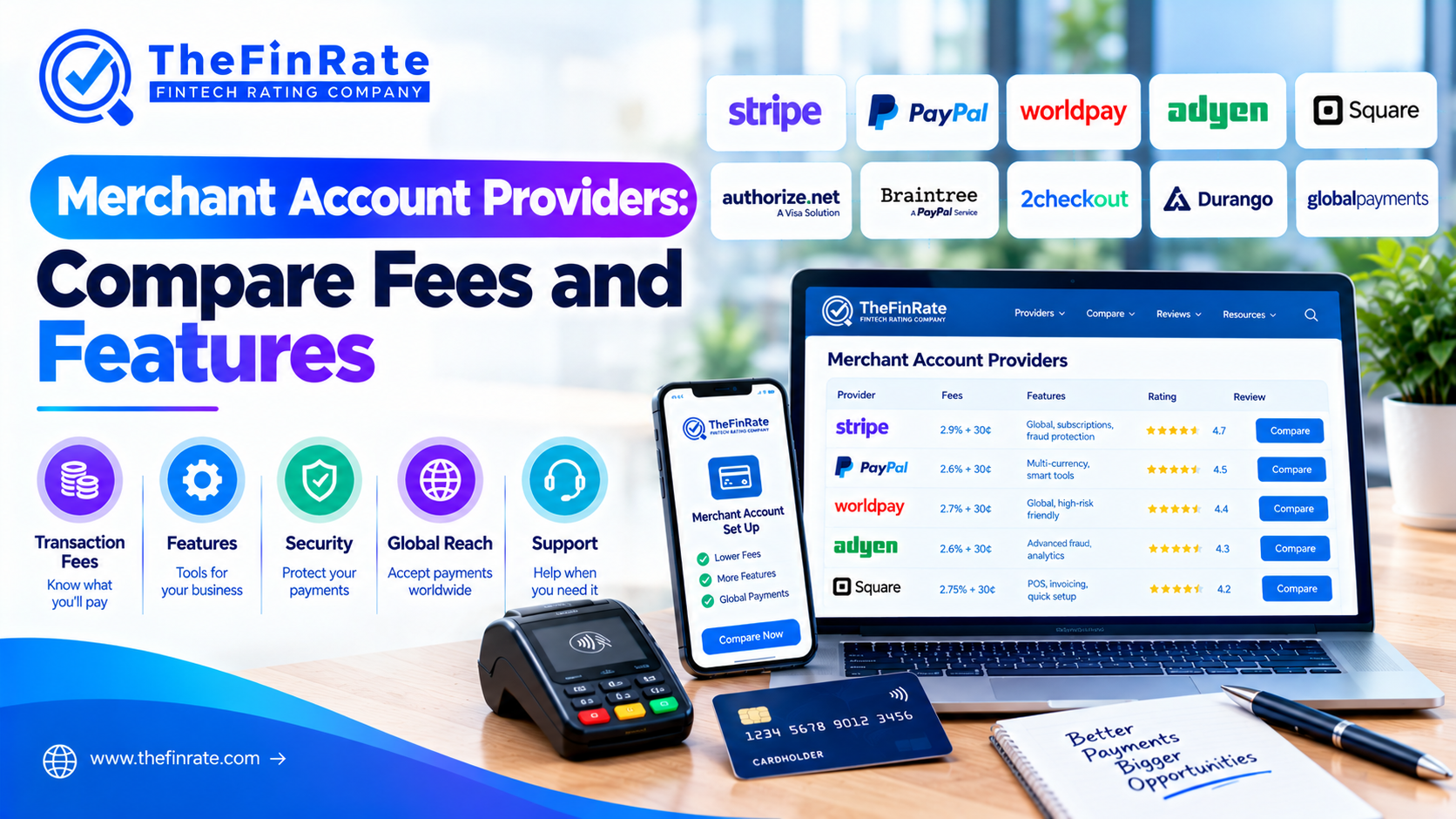

A merchant account is what lets your business accept card payments and receive the funds. Choosing a provider changes your costs, how quickly you can start selling, and how stable your account is. This guide compares merchant account providers on what matters most to small and growing businesses: pricing, contract terms, approval and risk profile. It does not rank providers, and details were last checked on 19 October 2026. Fees and terms change, so confirm them with each provider before you apply.
If you only need the definition first, read our explainer on what a merchant account provider is, then come back to compare.
Key takeaways
- A dedicated merchant account is underwritten for your business alone. An aggregated account shares one account across many businesses.
- Headline rates hide the real cost. Compare monthly fees, markups, chargeback fees and exit terms together.
- Providers price differently, so the cheapest option depends on your volume and average sale.
What a merchant account is and when you need one
A merchant account is an account that receives the funds from your card payments before they reach your business bank account. You need one to accept card payments, either directly or through a provider that holds one on your behalf. It is not the same as a business bank account. You still need that to receive payouts. For a step-by-step explanation, see our guide to how a merchant account works.
Merchant account vs payment gateway vs payment processor
- Merchant account: holds your approval and your funds, and sets reserves, contract terms and termination decisions.
- Payment gateway: captures card details at checkout and sends them for authorization.
- Payment processor: connects the transaction between the gateway, the card networks and the bank.
Many providers bundle all three. Others supply only one, so confirm which layer you are getting. Our payment gateway reviews compare the gateway layer in detail.
How to compare merchant account providers
Use these criteria for every provider on your list:
- Pricing model: flat-rate, interchange-plus, tiered or membership, and whether the rates are published.
- Monthly and one-time fees: account, minimum, statement, PCI and setup fees.
- Contract terms: length, early termination fees and what happens to your funds when you leave.
- Settlement and holds: payout timing and what can trigger a delay.
- Support: channels, hours and whether you get a dedicated contact.
- Integrations: point of sale, shopping carts, invoicing and recurring billing.
- Risk profile fit: whether your industry and chargeback history are accepted.
Our guide on how to choose a merchant account walks through these factors with a setup checklist.
Provider comparison
Providers are listed alphabetically, not ranked. Descriptions rely on provider statements and reviewer reports, not TheFinRate testing.
Helcim
- Account type: dedicated merchant account, according to reviewers, not an aggregator.
- Pricing: Helcim publishes interchange-plus pricing with volume tiers. At the lowest volume tier, its margin is interchange plus 0.40% and 8 cents for in-person payments, and interchange plus 0.50% and 25 cents for keyed and online payments. The margin falls as monthly volume grows.
- Fees and contract: Helcim states no monthly account fees, no monthly minimums, and no cancellation fee, with no contract.
- Coverage: reviewers report it serves businesses in the United States and Canada.
- Suited for: small and growing businesses that want published pricing and flexible terms.
- Limitations: reviewers note limited hardware options for larger or more complex point-of-sale setups, and limited bundled business software.
Stax
- Account type: dedicated merchant account with a software platform that includes invoicing, recurring billing and reporting.
- Pricing: membership pricing, meaning a flat monthly fee plus interchange with no percentage markup, according to Stax and reviewers. Reviewers report monthly fees starting around $99, though plan pricing is no longer fully advertised, so request a written quote.
- Contract: reviewers report month-to-month billing without early termination fees.
- Coverage: one reviewer reports it is US-only and accepts payments in US dollars only.
- Suited for: businesses with higher, steady volume that benefit from a flat fee. Reviewers suggest roughly $20,000 or more in monthly card sales as the point where it starts to make sense.
- Limitations: the monthly fee can outweigh savings for low-volume businesses.
Payment Depot by Stax
- Account type: Stax describes Payment Depot as part of its offering with interchange-plus pricing. It is listed separately because its pricing model differs from Stax membership pricing.
- Details: confirm current plans, fees and contract terms directly. I did not verify them, so no figures are given.
Square and Stripe (aggregator model)
- Account type: sources describe both as PSP aggregators, where many businesses process under the provider’s shared account.
- Trade-offs: setup is fast and underwriting is lighter, but funds go to the provider first and are released on its schedule, and accounts can be restricted or closed under the provider’s rules. Check each provider’s current pricing and prohibited-business list.
- Suited for: new or low-volume businesses that want to start quickly.
High-risk specialists
If your industry or chargeback history puts you in a higher-risk category, mainstream providers may decline you. Specialists such as Durango Merchant Services and PaymentCloud underwrite these businesses, though they generally quote prices after application. See our guide to high-risk merchant account providers for how they compare.
Dedicated account vs aggregator: trade-offs
Dedicated merchant account
- Underwritten for your business alone, with your own account.
- Funds are paid to your business bank account under standard card network rules.
- More detailed application and approval can take longer.
- Often more stable once approved, because the provider already knows your business.
Aggregated account
- Fast setup with lighter underwriting.
- Funds are held by the provider and paid out on its terms.
- Flat pricing is simple, but can cost more at higher volume.
- More exposed to sudden holds or closures if your activity changes.
How underwriting works and what documents are commonly requested
Underwriting is the provider’s review of your business risk before it approves an account. It looks at your industry, financial stability, processing history and chargeback record. Requirements vary by provider, but the documents commonly requested include:
- A business bank account and recent business bank statements, often three months or more
- Processing statements from a previous provider, if you have processing history
- Business registration or license details and your EIN
- Government-issued ID for the owners
- A voided check or bank letter
- Tax returns or financial statements, particularly at higher volumes
Make sure your business name matches across your registration, bank account, website and application. Mismatches commonly trigger extra review.
Questions to ask before signing
- Is this a dedicated account or an aggregated account?
- Which pricing model applies, and what is the full monthly cost at my volume?
- What are the monthly, annual, PCI, statement and chargeback fees?
- Is there a contract, an early termination fee or auto-renewal?
- What reserves, holds or payout delays could apply?
- How long does settlement take, and what can change it?
- What happens to my data and saved payment methods if I switch?
Once you shortlist providers, compare costs on your own statement. Our article on merchant account fees lists guides on fees, reserves and switching providers.
FAQs
What is the difference between a merchant account and a business bank account?
A business bank account holds your money. A merchant account receives card payment funds and passes them to that bank account, and it is where approval and risk terms are set.
Do I need a merchant account to accept card payments?
You need access to one. You can have your own dedicated account, or process through a provider’s aggregated account.
What are typical merchant account fees?
They vary by provider and pricing model. Common fees include a processing markup or percentage, per-transaction fees, monthly or minimum fees, statement and PCI fees, and chargeback fees. Always compare total monthly cost for your volume.
How long does approval take?
It depends on the provider, your documents and your risk profile. Treat any stated timeline as an estimate, not a promise.
Can I switch merchant account providers?
Yes, but check your current contract for termination fees and notice periods first. Our guide on switching your merchant account provider covers the steps.
Is a dedicated account better than an aggregator?
Neither is better for every business. Dedicated accounts tend to suit steady, growing businesses. Aggregators suit businesses that want to start quickly with less paperwork.
Verdict
The right provider depends on your volume, your sales channels and your risk profile. Start by deciding whether you need a dedicated account or an aggregated one, then compare total cost and exit terms for two or three providers on your own statements.



