Physical Address
304 North Cardinal St.
Dorchester Center, MA 02124
Physical Address
304 North Cardinal St.
Dorchester Center, MA 02124

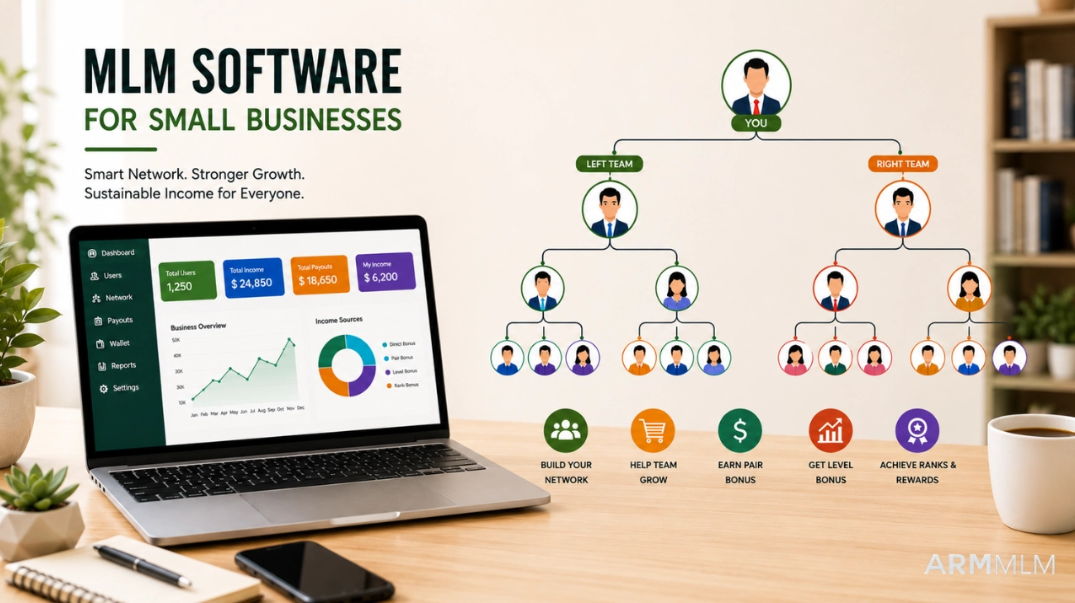
Managing a multi-level marketing business becomes increasingly complex as the distributor network grows. Tracking members, maintaining genealogy structures, calculating commissions, processing payouts, and monitoring business performance can quickly become difficult when these processes are handled manually.
This is where MLM software comes into play.
MLM software provides a centralized platform for managing distributor networks, compensation plans, commissions, payments, reporting, and other day-to-day operations. For businesses planning to scale, the right software can reduce repetitive administrative work while improving visibility across the organization.
MLM software is a business management platform designed to automate and manage the operations of a multi-level marketing or direct-selling company.
Instead of maintaining separate spreadsheets and systems for distributors, commissions, genealogy, wallets, and reports, businesses can manage these activities through a connected platform.
Depending on the software and business requirements, an MLM platform may include:
The features required will depend on the company’s compensation structure, products, markets, and operational model.
At its core, MLM software connects distributor activity with predefined business and compensation rules.
When a distributor registers, the system creates their account and places them within the appropriate network structure. As sales or qualifying transactions take place, the software processes the relevant data and calculates commissions according to the configured compensation plan.
A simplified workflow is:
Registration → Network Placement → Sales/Transactions → Commission Calculation → eWallet → Payout → Reporting
Automation becomes increasingly valuable as the network grows. Instead of manually calculating every commission or updating every distributor record, the system can process these activities according to predefined rules.
A reliable MLM platform should support the operational requirements of the business rather than simply offering a long list of features.
Genealogy management allows businesses and distributors to view their network structure.
Depending on the compensation plan, the system may need to display binary trees, unilevel structures, matrix positions, or other organizational relationships.
A clear genealogy interface helps distributors understand their teams while giving administrators better visibility into the overall network.
Commission calculation is one of the most important functions of MLM software.
The platform can apply predefined compensation rules to eligible transactions and calculate commissions automatically.
This reduces dependence on spreadsheets and manual calculations while making commission processing more consistent.
An integrated eWallet gives distributors a centralized place to view earnings, credits, transactions, and available balances.
Wallet functionality can also connect with withdrawal and payout workflows, depending on the business model and payment infrastructure.
Payout automation can simplify the process of distributing eligible commissions to distributors.
Businesses should evaluate which payment methods and gateways are supported and whether they meet the requirements of their target markets.
Managing a growing network requires more than storing names and contact details.
An MLM management platform can connect distributor profiles with their network position, activity, transactions, commissions, and other relevant information.
This creates a centralized view of the distributor lifecycle.
A replicated website gives distributors a personalized version of the company’s website while maintaining their distributor identity.
This can make it easier for a large network to establish an online presence without requiring each distributor to develop and maintain a separate website.
Reporting provides businesses with visibility into network and financial activity.
Common reports can cover:
The right reports depend on what management needs to monitor and how the business operates.
Distributors increasingly expect to manage their business from their smartphones.
An MLM mobile app can provide access to dashboards, genealogy, earnings, transactions, notifications, and other account functions while distributors are away from their computers.
MLM companies do not all operate using the same compensation structure. Therefore, software should be selected according to the specific plan the business intends to implement.
A Binary MLM plan generally organizes distributors into two legs. Software for this structure needs to handle placement, team volume, carry-forward rules, and the applicable commission conditions.
A Unilevel plan allows distributors to directly sponsor multiple members, creating multiple levels within the organization.
The software needs to calculate commissions according to the company’s defined levels and eligibility rules.
A Matrix MLM plan typically operates using predefined width and depth.
A suitable Matrix MLM plan solution should be able to manage placement rules and calculate commissions based on the configured matrix structure.
Some businesses combine elements from multiple compensation structures.
For these models, flexibility becomes particularly important because the software needs to accommodate customized rules rather than relying only on a single standard compensation model.
The larger an MLM network becomes, the more operational data the business has to process.
Every day may involve new registrations, product orders, commission calculations, wallet transactions, withdrawals, genealogy updates, and reporting.
Trying to manage these processes manually can increase administrative workload and create opportunities for calculation or data-entry errors.
MLM automation can help businesses standardize repetitive processes and give administrators more time to focus on distributor support, business operations, compliance, and growth.
Choosing an MLM platform should start with the company’s actual business requirements.
Before making a decision, businesses should consider:
Compensation plan: Does the software support the exact commission structure and rules?
Scalability: Can the platform handle an increasing number of distributors and transactions?
Payment infrastructure: Does it support the payment gateways and payout methods required by the business?
Mobile access: Can distributors conveniently manage their accounts from mobile devices?
Reporting: Does the system provide the reports management actually needs?
Security: How does the platform protect user, transaction, and business data?
Customization: Can the system accommodate unique business rules?
Integrations: Can it connect with payment systems, eCommerce platforms, or other business applications?
Support: Is technical assistance available when the business needs it?
These questions help businesses evaluate software based on practical requirements rather than choosing a platform simply because it has the largest feature list.
AI is becoming an additional layer within modern business software, including MLM platforms.
Instead of using AI only as a chatbot, businesses can explore applications such as automated assistance, knowledge retrieval, business insights, data analysis, and operational recommendations.
For MLM businesses, these capabilities can potentially help administrators understand large amounts of network information more efficiently.
However, AI should complement the core MLM infrastructure. Accurate genealogy, commission rules, transaction processing, security, and reporting remain fundamental requirements.
ARM MLM provides an MLM software platform for businesses managing different compensation structures and network operations.
The platform includes capabilities for MLM plan management, genealogy, distributor management, commission processing, eWallets, payouts, replicated websites, mobile applications, payment integrations, reporting, and KYC/AML workflows.
ARM MLM also incorporates AI-focused capabilities for automation, knowledge management, insights, and business operations.
Businesses looking to explore MLM software solutions can learn more at ARM MLM.
MLM software is used to manage distributor networks, compensation plans, commissions, genealogy, payments, wallets, reporting, and other operational processes within an MLM business.
Yes. MLM software can calculate commissions automatically based on the compensation rules configured for the business.
Genealogy management refers to organizing and displaying relationships between distributors within an MLM network. It allows users to understand their team structure and network positions.
Depending on the platform, MLM software can support Binary, Unilevel, Matrix, Monoline, Board, Gift, and Hybrid compensation structures.
Mobile access can make it easier for distributors to monitor their network, earnings, transactions, and business activity without relying on a desktop computer.
The cost depends on factors such as the compensation plan, customization, integrations, mobile applications, hosting, security requirements, and the number of users or transactions supported. Businesses should compare pricing against the functionality they actually require.
MLM software has evolved from a simple commission calculator into a broader business management platform.
For a growing MLM company, the right system can connect distributor management, genealogy, commissions, payments, reporting, mobile access, and automation within one operational environment.
The best choice depends on the company’s compensation model, target market, payment requirements, scalability needs, and long-term business goals.
Rather than choosing software based only on the number of features, businesses should evaluate whether the platform can reliably support their current operations and adapt as the network grows.




