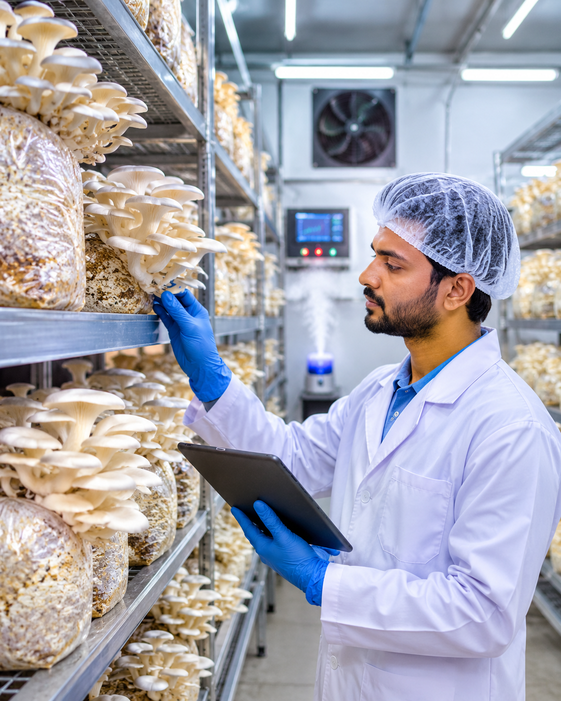

Modern technology is changing how agricultural businesses manage cultivation, production and resource utilisation. A mushroom farming business can benefit from controlled environment cultivation, where temperature, humidity, ventilation and other growing conditions are monitored and adjusted according to the mushroom variety.
Unlike conventional outdoor farming, mushroom cultivation can take place inside dedicated growing facilities. By combining suitable infrastructure with modern monitoring systems, growers can improve environmental consistency, manage production more efficiently and create better conditions for commercial cultivation.
For entrepreneurs exploring mushroom farming in India, understanding these technologies can help when planning a modern and scalable operation.
What Is Controlled Environment Mushroom Cultivation?
Controlled environment cultivation involves growing mushrooms in dedicated rooms where important environmental factors are managed according to the crop’s requirements.
Mushrooms do not need sunlight for photosynthesis, but they require suitable temperature, humidity, fresh air and hygiene throughout different growth stages. These requirements vary by species and cultivation stage.
A controlled facility helps growers manage these conditions more consistently than an unmanaged growing space. It can also make production planning easier when environmental conditions outside the facility change.
How Modern Technology Supports a Mushroom Farming Business
Technology can help commercial growers monitor cultivation conditions, identify problems and manage daily operations.
1. Automated Temperature Control
Temperature plays an important role in mushroom development. Different varieties require different temperature ranges during incubation and fruiting.
Cooling systems, heating equipment and digital thermostats can help maintain suitable conditions inside growing rooms. Automated controls can reduce the need for frequent manual adjustments, although regular inspection remains important.
2. Humidity Management Systems
Humidity affects mushroom development and the moisture conditions inside growing rooms. Low humidity can cause growing surfaces and developing mushrooms to dry out, while excessive moisture can create other cultivation problems.
Humidifiers, misting systems and digital humidity sensors help growers monitor and manage moisture levels. Settings should be adjusted according to the mushroom variety and production stage.
3. Ventilation and Fresh-Air Management
Mushrooms require appropriate fresh-air exchange during cultivation. Insufficient ventilation can allow carbon dioxide levels to rise, potentially affecting mushroom shape and development.
Exhaust fans, air circulation systems and ventilation controls can help maintain suitable airflow. A well-designed system should balance fresh-air supply with temperature and humidity requirements.
4. Digital Sensors and Remote Monitoring
Digital monitoring systems allow growers to track environmental conditions inside cultivation rooms.
Common monitoring tools include:
- Temperature sensors for tracking room conditions.
- Humidity sensors for monitoring moisture levels.
- Carbon dioxide sensors for checking air quality.
- Digital controllers for managing connected equipment.
- Remote monitoring systems for checking readings through connected devices.
These tools can help growers identify changes earlier and respond before environmental problems affect larger production batches.
Benefits of Controlled Environment Cultivation
Modern environmental management can offer several advantages to a commercial mushroom farming business.
- Better environmental consistency: Monitoring systems help maintain suitable growing conditions.
- Improved production planning: Organised growing rooms make it easier to schedule different cultivation stages.
- Early problem identification: Sensors can help detect environmental changes that require attention.
- Efficient resource management: Automated controls can help manage water, electricity and equipment usage when properly configured.
- Commercial scalability: A well-planned facility can support additional growing rooms as production requirements increase.
However, technology alone does not guarantee higher yields or profitability. Results depend on cultivation knowledge, equipment maintenance, hygiene and operating practices.
Planning the Investment in Modern Mushroom Farming Technology
The cost of a technology-enabled mushroom farming business depends on the facility size, selected mushroom variety, automation level and equipment requirements.
Before investing, consider expenses such as:
- Growing-room construction and insulation.
- Cooling and heating equipment.
- Humidifiers and ventilation systems.
- Digital sensors and environmental controllers.
- Substrate preparation equipment.
- Electricity, maintenance and labour.
- Backup power and essential spare parts.
Beginners can start with essential monitoring equipment and gradually introduce automation as production expands. Compare equipment costs with expected operational benefits before making major investments.
Is Modern Mushroom Farming Suitable for Commercial Production in India?
Yes. Controlled environment cultivation can support commercial mushroom production in India, particularly where outdoor temperatures and seasonal changes make environmental management challenging.
The most suitable technology depends on the mushroom variety and local conditions. For example, button mushroom production generally requires cooler growing conditions, while oyster and milky mushrooms have different environmental requirements.
Entrepreneurs should consult reliable agricultural institutions, including the ICAR-Directorate of Mushroom Research, for technical guidance before designing a commercial facility.
Conclusion
Modern technology and controlled environment cultivation can help a mushroom farming business manage growing conditions more systematically. Temperature controllers, humidity sensors, ventilation equipment and digital monitoring systems provide useful tools for organising commercial production. However, successful implementation requires suitable equipment, technical knowledge and regular maintenance. Starting with essential systems and expanding gradually can help growers develop an efficient and scalable cultivation facility.
Frequently Asked Questions (FAQs)
1. What is controlled environment mushroom farming?
It is a cultivation method in which temperature, humidity, ventilation and other growing conditions are managed inside dedicated growing rooms.
2. Which technology is used in modern mushroom farming?
Common technologies include digital temperature controllers, humidity sensors, cooling systems, humidifiers, ventilation equipment and remote monitoring devices.
3. How does automation help a mushroom farming business?
Automation can help monitor environmental conditions and control connected equipment, reducing some repetitive manual tasks and improving consistency.
4. Is controlled environment cultivation suitable for India?
Yes. It can be useful in India because different regions experience varying temperatures and seasonal conditions. The facility must be designed for the selected mushroom variety.
5. Does modern technology guarantee higher mushroom production?
No. Technology can help manage growing conditions, but production also depends on quality spawn, substrate preparation, hygiene, cultivation practices and equipment maintenance.{“success”:false,”data”:”Image/file size must be 2MB or less. Please choose a smaller file.”}