Physical Address
304 North Cardinal St.
Dorchester Center, MA 02124
Physical Address
304 North Cardinal St.
Dorchester Center, MA 02124

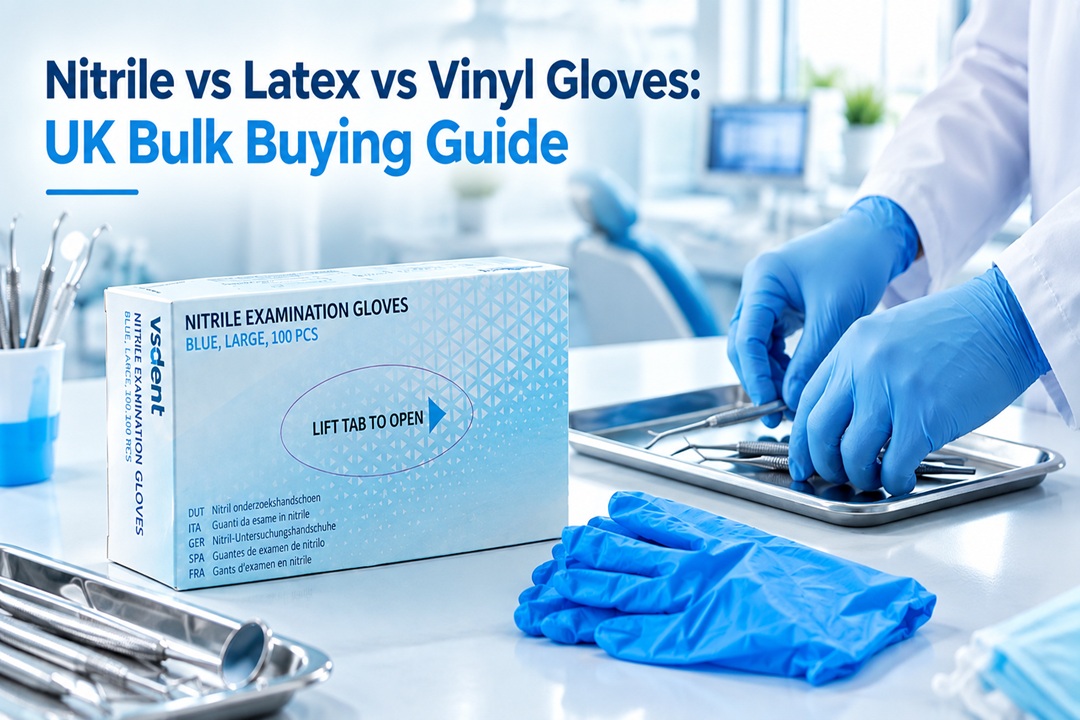
Disposable gloves are one of the few consumables a practice or workplace never stops ordering. Get the material wrong and staff complain about fit, allergies or tearing. Get the pack format wrong and you either run short mid-week or tie up storage space with cases you don’t need. This guide walks through the three main glove materials, explains where each one earns its place, and shows how to work out whether a nitrile gloves case of 10 boxes is the right order size for your team.
What are nitrile gloves?
Nitrile gloves are single-use gloves made from synthetic nitrile rubber rather than natural latex. They are latex-free, which makes them the default choice wherever latex allergy is a concern, and they hold up well against punctures and everyday oils and cleaning agents. Most clinical versions are powder-free, ambidextrous and supplied in boxes of 100.
Because they are synthetic, quality is consistent from box to box. They stretch less than latex, but modern formulations are thin and flexible enough that tactile feel is rarely an issue for examination and general handling.
How the three materials compare?
Choosing between nitrile, latex and vinyl comes down to four questions: who is wearing the glove, what is it touching, how long is it worn, and what does it cost per pair.
Nitrile: the all-rounder for clinical and workplace use
Nitrile handles the widest range of tasks. It resists punctures better than latex or vinyl, copes with most surgery disinfectants, and removes latex allergy from the equation for staff and patients. It is the material most UK dental practices, clinics and care settings have standardised on.
Latex: best feel, but an allergy risk
Natural rubber latex still gives the closest fit and best tactile sensitivity, which is why some clinicians prefer it for fine work. The drawback is well documented: latex proteins can trigger reactions from mild irritation to serious allergic responses, and repeated exposure raises the risk. Many organisations now avoid latex entirely rather than manage it.
Vinyl: low cost, low protection
Vinyl (PVC) gloves are the cheapest option and are fine for short, low-risk tasks such as food handling or light cleaning. They fit loosely, tear more easily and offer weaker barrier protection than nitrile, so they are not a sensible choice for examination work or anything involving bodily fluids.
Comparison at a glance
|
Feature |
Nitrile |
Latex |
Vinyl |
|
Material |
Synthetic nitrile rubber |
Natural rubber |
PVC |
|
Latex-free |
Yes |
No |
Yes |
|
Puncture resistance |
High |
Medium |
Low |
|
Tactile sensitivity |
Good |
Excellent |
Fair |
|
Chemical resistance |
Good |
Fair |
Poor |
|
Typical use |
Examination, clinical, workplace |
Fine clinical work where allergy is ruled out |
Short low-risk tasks |
|
Cost per glove |
Mid |
Mid to high |
Low |
For most practices the comparison ends the same way: nitrile vs latex gloves is decided by allergy policy, and nitrile vs vinyl gloves is decided by the level of protection the task actually needs.
Why blue nitrile gloves are the clinical standard
Colour is not just cosmetic. Blue nitrile gloves are easy to spot against skin, instruments and working surfaces, so a torn or missing glove is obvious at a glance. That visibility is why blue became the default across healthcare and dental settings.
Powder-free nitrile gloves are now expected in clinical environments. Powder made gloves easier to put on, but it can carry allergens into the air and contaminate surfaces, so the industry moved away from it.
Buying in bulk: box or case?
A single box of 100 suits a home user or a very small operation. Anywhere with several staff changing gloves between every patient or task gets through boxes quickly, and that is where the case format makes sense.
How many gloves does a practice actually use?
A rough way to estimate demand:
Two clinicians and a nurse each changing gloves 15 times a day would use 90 gloves daily, or roughly 1,900 gloves a month across 21 working days. That is nineteen boxes, so a case of 10 boxes covers about a fortnight for that team. Once you have that number, ordering by the case in the sizes your staff actually wear is far simpler than topping up single boxes.
The case for buying by the case
Ordering nitrile gloves in bulk cuts the per-glove cost, reduces deliveries to receive and check, and keeps a buffer on the shelf for busy weeks. The trade-off is storage: ten boxes take up real cupboard space, so confirm you have somewhere cool and dry before committing to several cases.
Buying considerations for UK purchasers
A few checks are worth making before any nitrile gloves UK order, whether one box or ten cases of disposable nitrile gloves:
Expert tips and common mistakes
Store gloves properly. Heat, sunlight and ozone from some electrical equipment degrade nitrile over time. Keep cases in their outer packaging, away from radiators and windows.
Never reuse or wash disposable gloves. Washing thins the material and opens micro-tears you cannot see.
Change gloves between tasks, not just patients. Touching a keyboard or phone with gloved hands and returning to the patient defeats the purpose.
Match the glove to the hazard. Examination gloves are not chemical-resistant gloves. For prolonged contact with solvents, use gloves rated under EN 374.
Don’t over-order one size. The most common bulk-buying mistake is a case of medium gloves half the team cannot wear. Check sizes before prices.
Practical example: a small dental practice
Picture a two-surgery practice with two dentists, two nurses and a hygienist. The practice manager tracks usage for a month and finds they go through around 35 boxes. She sets up a monthly order of three to four cases in mixed sizes from VSDent, holds one spare case as a buffer, and moves masks and sterilisation pouches onto the same delivery. Fewer orders, fewer invoices, no last-minute pharmacy runs.
If your team is unsure how many cases to hold or which sizes to stock, it is worth contacting a supplier’s team with your staff numbers and asking for a recommendation rather than guessing.
Frequently asked questions
Are nitrile gloves latex-free?
Yes. Nitrile is a synthetic rubber made without natural latex, so it suits people with latex allergy. Confirm the box states latex-free, and note that a small number of people react to manufacturing accelerators rather than latex itself.
What are nitrile gloves used for?
Nitrile examination gloves are used for patient examinations, dental treatment, laboratory work, cleaning and general workplace protection, wherever a reliable barrier is needed and latex must be avoided.
How much is a box of nitrile gloves?
Prices vary with thickness, brand and quantity. Buying by the case usually lowers the per-glove price, and UK trade suppliers typically quote excluding VAT. Compare cost per glove, not the headline box price.
When should you not use nitrile gloves?
Do not rely on standard nitrile examination gloves for prolonged contact with aggressive chemicals, for surgical procedures that require sterile gloves, or for tasks needing cut or heat protection.
Conclusion
Choosing gloves for a practice or workplace comes down to matching the material to the risk and the pack size to real demand. Nitrile is the sensible default for clinical and general use because it is latex-free, puncture-resistant and consistent from box to box. Latex still offers the best tactile feel, but it carries an allergy risk that many organisations no longer accept, and vinyl belongs only on short, low-risk tasks where barrier protection matters less. Whatever the setting, blue, powder-free, CE marked examination gloves in the sizes your team actually wears are the standard to look for.
Once monthly usage climbs past a handful of boxes, ordering by the case saves money, cuts admin and removes those awkward gaps on the shelf. Work out your team’s numbers, confirm the sizes you need, and buy at the scale that supports them. For UK practices looking to standardise their PPE ordering, VSDent supplies CE certified nitrile gloves by the box and by the case, alongside the masks, pouches and consumables that go on the same order.




