Physical Address
304 North Cardinal St.
Dorchester Center, MA 02124
Physical Address
304 North Cardinal St.
Dorchester Center, MA 02124

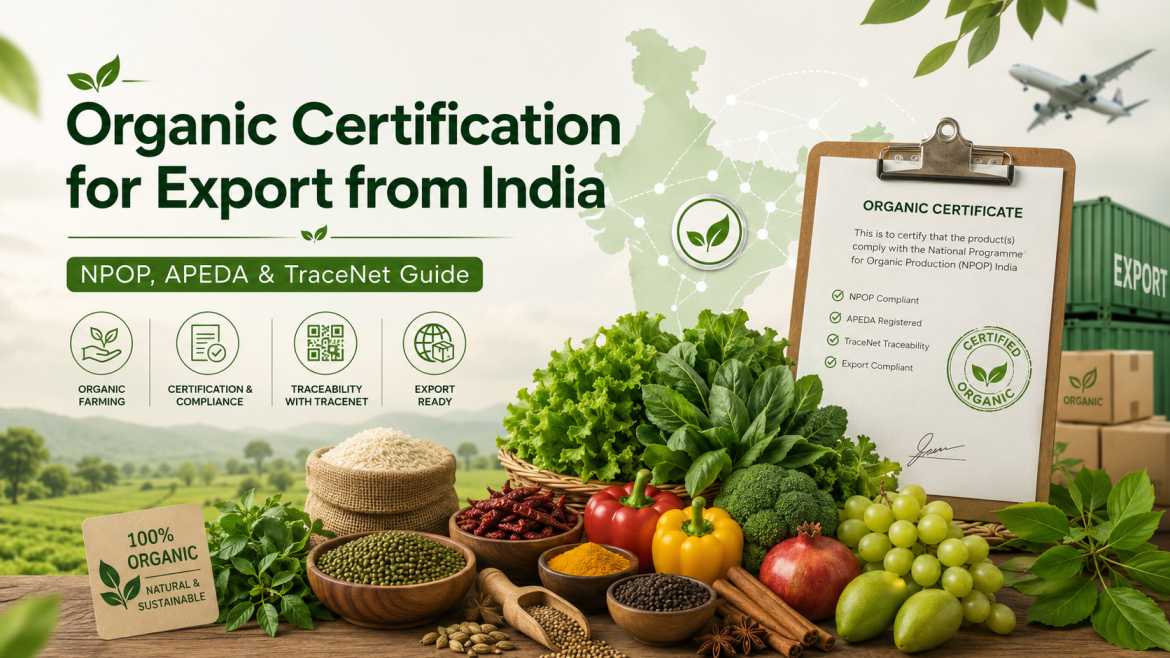
Learn the essential documents and records required for organic exports from India, including NPOP certification, APEDA, TraceNet, Scope Certificates, Transaction Certificates and export paperwork.
India has significant opportunities to supply organic agricultural products to international markets. From spices and rice to pulses, fruits and vegetables, overseas buyers are increasingly interested in products that combine quality with certification and traceable sourcing.
However, successful organic exports depend on more than finding a buyer and arranging a shipment.
Exporters must be able to demonstrate where the product came from, whether it falls within the appropriate certification scope, how it moved through the supply chain and whether the required export documents are available.
For Indian producers, processors, traders and exporters, understanding the documentation behind NPOP, APEDA and TraceNet is therefore an important part of becoming export-ready.
{“success”:false,”data”:”The uploaded file exceeds the upload_max_filesize directive in php.ini.”}
Originally published at D&S International: Organic Certification for Export from India: NPOP, APEDA & TraceNet Guide
In conventional trade, documentation is already essential for customs, logistics and payment.
In organic trade, another layer is added: the exporter must also be able to support the organic status and traceability of the product.
International buyers may want to verify:
Who produced the goods
Whether the producer or operator is appropriately certified
Which products are covered under certification
Where processing took place
How the goods were stored
Whether batches can be traced
Which certificates support the transaction
Whether the shipment meets destination-market requirements
Good documentation helps answer these questions.
It also makes the exporter easier for overseas buyers, importers and distributors to evaluate.
NPOP stands for the National Programme for Organic Production.
It provides the framework for organic production, processing, handling, certification and related activities within India’s applicable organic export system.
An exporter working with NPOP-certified products should maintain certification records relevant to the business and product.
Depending on the operation, these records may cover:
Certified operator details
Products included in certification
Production activities
Processing activities
Approved locations
Certification validity
Applicable conditions
One important rule is simple:
Never assume that certification for one product automatically covers every other product traded by the business.
The actual certification scope should always be checked.
The Scope Certificate is one of the important documents exporters may encounter in an organic supply chain.
It generally helps establish the operator’s approved certification scope.
Depending on the operation, it may identify:
Certified products
Activities
Processing operations
Facilities
Production areas
Operator details
Before quoting an organic product to an overseas buyer, exporters should confirm that the relevant product and activity fall within the approved scope.
For example, if an exporter handles cumin, turmeric and coriander, the business should not simply assume that certification covering one spice automatically covers all three.
This verification should happen before a commercial commitment is made.
Exporters sourcing from farmers, processors or other suppliers should maintain appropriate supplier records.
A buyer may want to understand not only who exported the product but also where the material originated.
Supplier documentation can include information such as:
Supplier identity
Certification details
Product supplied
Quantity
Lot or batch number
Purchase date
Certification validity
Relevant transaction information
This becomes particularly important when several suppliers contribute to one export programme.
Exporters dealing in multiple agricultural products should establish a supplier-verification process rather than relying only on verbal confirmation that a product is organic.
Organic traceability often begins at the production level.
Depending on the certified operation, important records may include:
Farm identification
Crop information
Area under cultivation
Sowing details
Harvest records
Inputs used
Production quantity
Relevant farm-management records
These records help demonstrate how the product originated.
If the exporter works directly with farmers or producer groups, having organised production information can significantly improve traceability.
It can also help answer questions from buyers looking for information about crop origin and production practices.
Every incoming organic lot should ideally be supported by procurement documentation.
This may include:
Purchase invoice
Supplier details
Product name
Quantity received
Date
Batch or lot information
Certification reference where applicable
Purchase records help establish the first commercial link between the certified source and the exporter or processor.
Without accurate procurement records, maintaining traceability becomes much more difficult.
Batch identification is one of the most practical parts of an organic traceability system.
Each lot should ideally have a unique identity that follows it through relevant stages of handling.
For example:
Supplier Lot → Processing Batch → Warehouse Batch → Export Shipment
This allows the exporter to connect the final shipment with earlier records.
Strong batch management can also help when buyers raise quality questions.
Instead of investigating the entire year’s production, the exporter may be able to isolate the specific batch involved.
Businesses exporting commodities such as rice should also maintain strong product-specific quality and batch records. This rice export from India guide provides broader insights into preparing rice for international markets.
If an organic product is cleaned, sorted, graded, processed or packed before export, those activities should be appropriately documented.
Records can include:
Quantity received
Quantity processed
Processing date
Batch number
Cleaning information
Output quantity
Packaging details
Storage destination
This helps create a clear link between incoming raw material and finished export goods.
For organic products, processors also need to take appropriate measures to avoid unintended mixing with conventional products.
Warehousing can create serious traceability problems if goods are not properly identified.
Organic exporters should maintain systems that clearly distinguish certified organic stock from conventional material.
Useful records may include:
Warehouse location
Batch identification
Quantity stored
Date received
Date dispatched
Stock movement
Inventory balance
Physical identification is equally important.
Clear labels, designated areas and batch controls can reduce the risk of accidental mixing.
TraceNet is an important part of India’s organic certification and traceability ecosystem.
It supports the recording and tracking of relevant certification and transaction information.
For exporters, the broader objective is to maintain an auditable connection between participants in the supply chain.
For example:
Farmer → Processor → Trader → Exporter → Overseas Buyer
When each stage is supported by proper records, the exporter can better demonstrate the origin and movement of the certified product.
Traceability is increasingly valuable commercially as well.
Buyers working with premium or organic food categories may prefer suppliers capable of providing transparent sourcing information.
The Transaction Certificate is another important document associated with eligible transactions involving certified organic products.
It helps support traceability for particular product movements or transactions.
It is important not to confuse this with the Scope Certificate.
A simple distinction is:
Scope Certificate: relates to the operator’s approved certification scope.
Transaction Certificate: relates to an eligible transaction involving certified organic goods.
The exact documentation required for each shipment should be confirmed with the relevant certification body and buyer.
Organic certification documents do not replace India’s normal export requirements.
Depending on the product and business, exporters may also need registrations or compliance connected with:
Import Export Code
APEDA registration where applicable
FSSAI requirements
GST
Customs
Banking
Product-specific authorities
New exporters should understand these registrations before accepting international orders.
For a detailed overview, refer to this guide covering APEDA, FSSAI and IEC registration for food exports from India.
Maintaining valid registration records alongside certification documents makes the overall export file easier to manage.
The commercial invoice is a fundamental export document.
It typically contains information such as:
Exporter details
Buyer details
Product description
Quantity
Unit price
Total value
Currency
Trade terms
Relevant shipment information
The product description should remain consistent across key shipping documents.
Significant inconsistencies can create confusion during customs clearance or buyer-document review.
A packing list provides information about how the shipment is packed.
Depending on the shipment, this can include:
Number of packages
Type of packaging
Net weight
Gross weight
Product description
Package identification
For organic shipments, accurate packaging information also supports better batch and shipment control.
Depending on the destination and buyer, exporters may need other documents such as:
Certificate of Origin
Shipping Bill
Bill of Lading or Airway Bill
Inspection Certificate
Phytosanitary Certificate where applicable
Fumigation-related documents where required
Laboratory reports
Product-specific certificates
Not every document is required for every product or destination.
Exporters should verify requirements before dispatch.
Businesses still learning the overall process can review this guide on how to export food products from India.
Organic certification does not remove the need for product-quality controls.
International buyers may request laboratory testing for parameters such as:
Pesticide residues
Moisture
Microbiological limits
Heavy metals
Aflatoxins
Product purity
Other commodity-specific parameters
Required tests vary by product, buyer and destination market.
Exporters should agree on specifications before shipping.
Sending samples or commercial quantities without confirming buyer requirements can result in disputes even when the product has organic certification.
An exporter may technically possess every required document but still face problems if the records cannot be retrieved quickly.
A practical document-management system can organise files according to:
Supplier → Product → Batch → Certification → Buyer → Shipment
For example, one shipment folder could contain:
Purchase documents
Supplier certification
Batch records
Processing information
Laboratory report
Organic transaction documents
Commercial invoice
Packing list
Shipping documents
This makes buyer audits and internal checks much easier.
Exporters should watch for several avoidable issues:
Expired certification
Product missing from certification scope
Incorrect supplier information
Missing batch numbers
Quantity mismatches
Incomplete purchase records
Weak warehouse records
Mixing organic and conventional goods
Missing transaction documentation
Inconsistent product descriptions
Small documentation errors can become major issues when a buyer is trying to verify a shipment.
Internal checks before dispatch can help reduce these risks.
Before confirming an organic export shipment, review the following:
Valid organic certification
Correct Scope Certificate
Product covered under certification
Supplier certification verified
Relevant Transaction Certificate or transaction documentation
Supplier details
Purchase records
Batch identification
Processing records
Warehouse records
Stock movement
Sales and shipment records
Commercial invoice
Packing list
Shipping Bill
Transport document
Certificate of Origin where required
Product-specific certificates
Product specification
Laboratory reports where required
Packaging details
Buyer-approved quality parameters
Organic recognition requirements
Import regulations
Labelling requirements
Residue limits
Buyer-specific documentation
For international buyers, organised documentation is a strong indicator of supplier reliability.
An exporter who can quickly provide certification details, specifications, batch records and shipment documents demonstrates better control over the supply chain.
This can become especially valuable when dealing with:
Importers
Distributors
Wholesalers
Retail chains
Organic brands
Food processors
In competitive agricultural markets, documentation can therefore become part of the exporter’s commercial advantage.
Organic exports from India require a connected documentation system.
NPOP establishes the organic framework, APEDA administers important aspects of the programme, accredited certification bodies certify eligible operators, and TraceNet supports certification-related traceability.
But successful exports also depend on procurement records, batch tracking, processing documentation, Scope Certificates, transaction-related records and normal shipping paperwork.
Indian exporters that build these systems before approaching buyers are better positioned to provide the transparency and reliability expected in international organic trade.
If you are an Indian farmer, producer, processor or agricultural supplier looking to explore international markets, contact D&S International to discuss export opportunities, sourcing requirements and buyer-market readiness.




