Physical Address
304 North Cardinal St.
Dorchester Center, MA 02124
Physical Address
304 North Cardinal St.
Dorchester Center, MA 02124

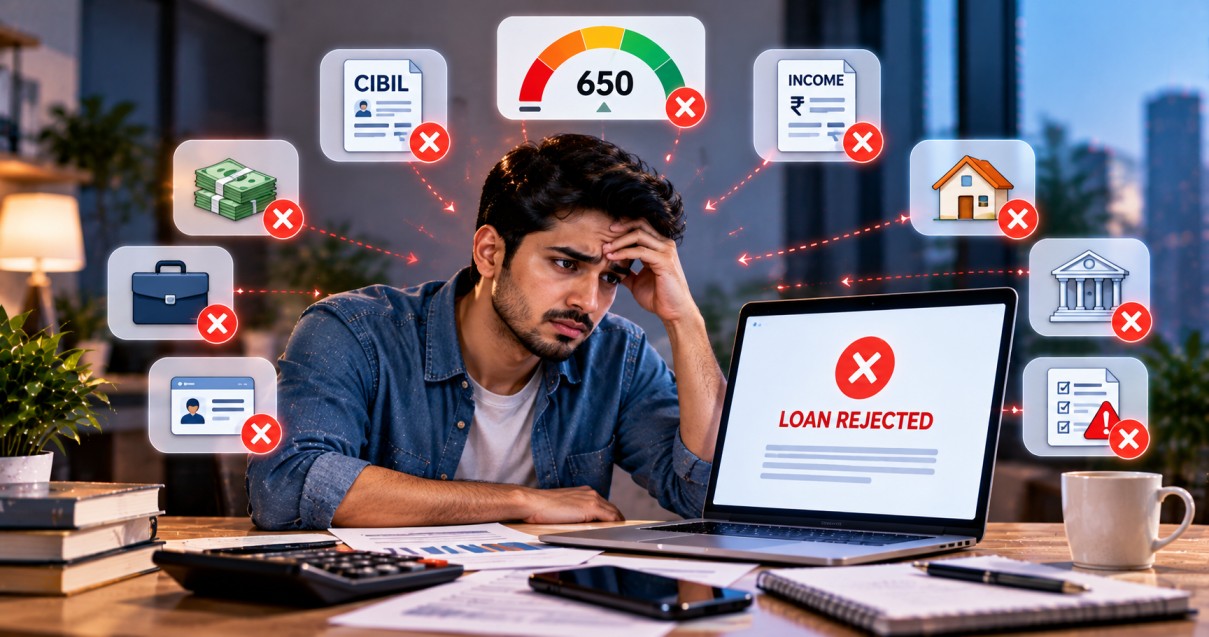
Getting a personal loan can be convenient when you need funds without providing collateral. However, a lender may reject your application even when you meet the basic income requirement.
Why is a personal loan rejected? Banks and NBFCs may consider several factors, including your CIBIL score, repayment history, income, employment stability, existing EMIs, credit utilisation, recent credit enquiries, and the information provided in your application.
There is no single reason that applies to every rejected application. CIBIL states that the decision to approve or reject a loan is made by the individual lender according to its credit policies.
A personal loan can be rejected when the lender determines that the application does not meet its credit, income, documentation, or repayment-capacity requirements.
Here are 10 common personal loan rejection reasons to check if your application has been declined.
One of the most common loan rejection reasons is an unfavourable credit profile.
Lenders may review your CIBIL Score and credit report to understand how you have handled previous credit. A low score, payment defaults, overdue accounts, or other negative information can affect the assessment. CIBIL notes that a higher score generally improves the chances of loan approval, although there is no universal score that guarantees approval.
For example, imagine Rahul has a monthly salary of ₹50,000 but has previously missed several loan payments. Even with a stable income, the lender may consider his credit history while evaluating his application.
What you can do: Check your CIBIL Report, identify outstanding or incorrectly reported accounts, and maintain timely repayments.
Having too many existing loans can reduce your repayment capacity.
When assessing a personal loan application, lenders may consider your existing EMI obligations in relation to your income. CIBIL specifically identifies the EMI-to-income ratio as a factor lenders may consider during loan evaluation.
For example:
Monthly income: ₹50,000
Existing EMIs: ₹20,000
Proposed new EMI: ₹10,000
Total EMIs: ₹30,000
In this example, 60% of the monthly income would be committed to EMIs before other household expenses are considered.
What you can do: Reduce existing debt where possible and avoid applying for a loan amount that creates an unaffordable EMI burden.
Your income may be sufficient for one loan amount but not for another.
For example, someone earning ₹30,000 per month may qualify for a smaller personal loan but may not meet the lender’s repayment-capacity requirements for a ₹5 lakh application.
Lenders assess annual income and available surplus income when evaluating whether an applicant can repay the loan.
What you can do: Apply for an amount that is appropriate for your income and existing financial obligations.
Employment stability can also influence personal loan eligibility.
Because personal loans are generally unsecured, lenders need confidence that the borrower has a reliable source of income. CIBIL identifies employment status and income as factors considered during personal-loan assessment.
For example, an applicant who recently changed jobs several times may be assessed differently from someone who has maintained stable employment.
What you can do: If possible, maintain stable employment and provide accurate employment and income information when applying.
Applying for several loans within a short period can result in multiple credit enquiries.
A credit enquiry is created when a lender accesses your CIBIL Report in connection with a credit application. CIBIL notes that enquiries have an impact on the credit profile, although individual enquiries have limited impact.
For example, applying to eight lenders within a few days may create several enquiries on your credit report.
What you can do: Compare eligibility and loan terms before applying and avoid submitting unnecessary applications to multiple lenders simultaneously.
Using a large portion of your available credit limit can affect your credit profile.
For example, suppose your credit card limit is ₹1 lakh and your outstanding balance is consistently around ₹90,000. This represents high utilisation.
CIBIL recommends keeping credit balances under control and avoiding excessive use of available credit.
What you can do: Pay down outstanding balances and avoid relying heavily on your available credit limit before applying for a personal loan.
Previous late payments, defaults, or overdue amounts can affect how lenders assess your application.
Your payment history provides information about how consistently you have met previous credit obligations. CIBIL identifies payment history as an important component of credit evaluation.
For example, if you have repeatedly missed credit card payments, a lender may consider this when assessing your personal loan application.
What you can do: Pay EMIs and credit card bills on time and clear overdue amounts.
Sometimes the problem may not be your actual financial behaviour.
Your CIBIL Report can contain incorrect information, such as:
An account that does not belong to you
Incorrect outstanding balance
Incorrect payment status
Duplicate accounts
Incorrect personal information
Unrecognised credit enquiries
CIBIL provides a dispute process for identifying and correcting inaccuracies reported by credit institutions.
For example, you may have completely repaid a loan, but the account could still appear incorrectly as outstanding in the report.
What you can do: Review your credit report regularly and raise a dispute if you identify incorrect information.
A personal loan application can also face problems when the information provided does not match the supporting documents.
For example, your application may state a monthly salary of ₹60,000 while your salary slips or bank statements show a different amount.
Differences in employment details, income, address, or other information may require additional verification or affect the lender’s assessment.
What you can do: Make sure your application is complete and that the information matches your official documents.
Even if your CIBIL score and income appear satisfactory, a lender can still reject your application.
Why?
Banks and NBFCs have their own credit policies and eligibility requirements. These may include criteria relating to income, age, employment, location, existing obligations, credit history, and other risk parameters.
CIBIL explicitly states that it does not decide whether a loan should be sanctioned. The lending institution makes that decision based on its own credit policy.
This is why having a particular CIBIL score does not guarantee personal loan approval.
Yes. A personal loan can be rejected despite a good CIBIL score.
A good credit score is only one part of the lender’s assessment.
For example, consider two applicants:
Applicant A
CIBIL Score: 760
Monthly income: ₹40,000
Existing EMIs: ₹18,000
Applicant B
CIBIL Score: 720
Monthly income: ₹60,000
Existing EMIs: ₹5,000
Applicant A has the higher CIBIL score, but the lender may consider Applicant B’s income and existing repayment obligations as part of the overall assessment.
This illustrates why personal loan eligibility cannot be determined by the CIBIL score alone.
If your personal loan application is rejected, avoid immediately submitting multiple new applications.
Instead, follow these steps:
Review the communication from the lender. It may provide information about the reason for rejection or the eligibility condition that was not met.
Look for overdue accounts, high balances, incorrect information, or unfamiliar enquiries.
Calculate your current monthly EMIs and compare them with your income.
Make sure your income, employment, address, and other details are accurate.
Make timely payments, reduce outstanding balances, and avoid unnecessary new credit applications.
If your requested amount is too high relative to your income, a lower loan amount may be more appropriate depending on the lender’s criteria.
If you want to improve loan eligibility, focus on the factors that lenders commonly assess.
Pay your dues on time: Consistent repayment helps maintain your credit history.
Reduce existing debt: Lower outstanding EMIs can improve your overall repayment capacity.
Control credit utilisation: Avoid consistently using a large portion of your available credit.
Limit unnecessary applications: Avoid applying for multiple loans within a short period.
Check your credit report: Identify and dispute inaccurate information where applicable.
Maintain stable income records: Keep salary and banking records consistent and up to date.
CIBIL recommends timely payments, controlled balances, cautious applications for new credit, and regular monitoring of your credit report.
Consider Priya, who earns ₹60,000 per month and applies for a ₹5 lakh personal loan.
She has a CIBIL score of 740, which appears healthy. However, she already has two loans with combined EMIs of ₹25,000 per month.
Her application is rejected.
At first, Priya assumes the rejection happened because her CIBIL score was not high enough. However, the lender may have considered her existing EMI obligations and repayment capacity as part of its overall assessment.
Priya could review her existing debt, check the lender’s eligibility requirements, and reassess the loan amount before making another application.
The example demonstrates an important point: a good CIBIL score does not guarantee personal loan approval.
Common reasons include a low or weak credit profile, high existing EMIs, insufficient income, unstable employment, high credit utilisation, recent credit enquiries, repayment issues, inaccurate information, incomplete documentation, or not meeting the lender’s internal eligibility criteria.
Yes. A low CIBIL score can negatively affect your chances of approval. However, there is no single CIBIL score that guarantees approval or rejection across all lenders.
A good CIBIL score is only one part of the assessment. High existing EMIs, insufficient income, employment-related factors, recent credit applications, or lender-specific eligibility criteria can also affect the decision.
There is no universal waiting period that applies to every lender. However, repeatedly applying for credit within a short period can result in multiple credit enquiries. It is generally better to understand the reason for rejection and address the relevant issue before making another application.
The rejection itself is not the same as a credit enquiry. However, when you apply for a loan, the lender may access your credit report, creating a credit enquiry. Multiple applications can therefore have an effect on your credit profile.
Maintain timely repayments, control existing debt and credit utilisation, avoid unnecessary credit applications, maintain stable income records, and check your credit report for errors before applying.
A personal loan rejection does not always mean that your CIBIL score is the problem. Banks and NBFCs evaluate several aspects of an application, including credit history, income, existing EMIs, employment stability, credit utilisation, recent enquiries, documentation, and their own lending policies.
If your application has been rejected, first identify the possible reason instead of immediately applying to several other lenders. Review your CIBIL Report, assess your existing debt, correct inaccurate information, and work on the factors that may be affecting your personal loan eligibility.
Most importantly, remember that CIBIL provides your credit information and score, while the lender makes the final lending decision according to its own credit policy.
Disclaimer: Personal loan eligibility, approval, interest rates, fees, and loan amounts vary by lender and applicant profile. The examples in this article are illustrative and do not guarantee loan approval or specific loan terms.




