Physical Address
304 North Cardinal St.
Dorchester Center, MA 02124
Physical Address
304 North Cardinal St.
Dorchester Center, MA 02124

The Power Electronics Market is becoming increasingly important as electricity moves into transportation, industrial automation, renewable energy, data centers, and connected infrastructure. Power electronics enables the conversion, control, and efficient management of electrical energy using devices such as power semiconductors, inverters, converters, rectifiers, and power modules.
The market is benefiting from accelerating electrification. The International Energy Agency (IEA) forecasts global electricity demand to grow by an average of 3.6% annually from 2026 to 2030, supported by industry, electric vehicles, air conditioning, and data centers.
At the same time, advances in silicon carbide (SiC) and gallium nitride (GaN) are improving switching efficiency, power density, and thermal performance. These developments are expanding the role of power electronics across modern energy systems.
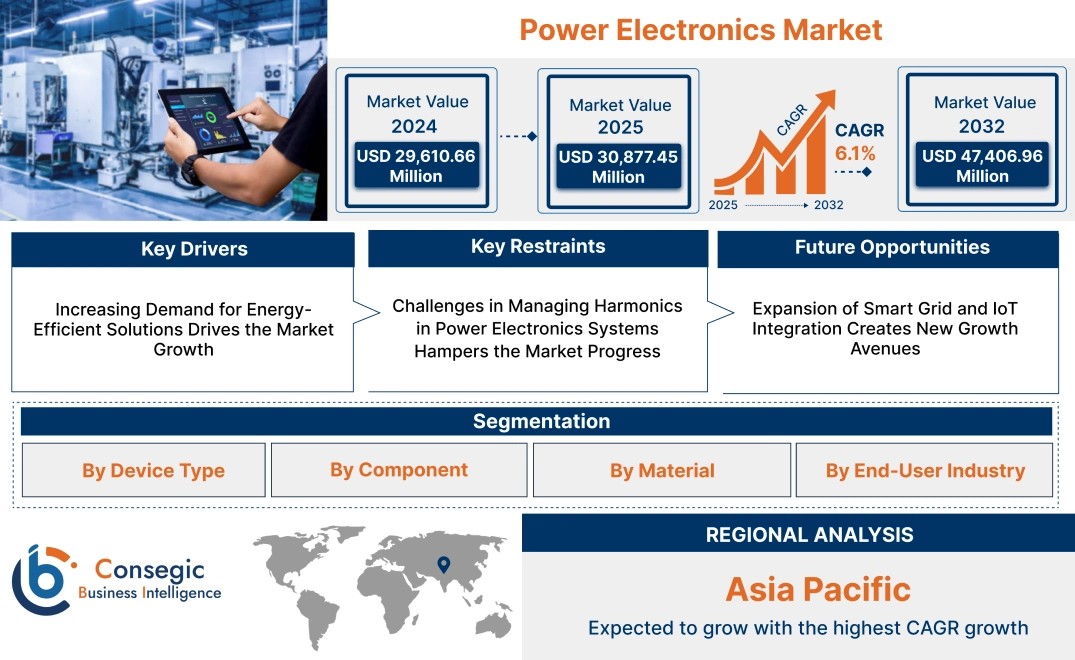
Power Electronics Market size is estimated to reach over USD 47,406.96 Million by 2032 from a value of USD 29,610.66 Million in 2024 and is projected to grow by USD 30,877.45 Million in 2025, growing at a CAGR of 6.1% from 2025 to 2032.
Power electronics refers to technologies used to control and convert electrical power between different voltage, current, and frequency levels. The market includes power discrete devices, power modules, power ICs, converters, inverters, and related systems.
Major applications include:
The market’s long-term outlook is supported by electrification and increasing requirements for energy efficiency. A 2025 industry estimate from MarketsandMarkets valued the global market at USD 51.73 billion in 2025 and projected it to reach USD 67.42 billion by 2030, representing a 5.4% CAGR.
The primary growth driver is the increasing need to convert and control electricity efficiently. Electrification of vehicles, industrial equipment, buildings, and energy infrastructure is creating new requirements for power conversion systems.
Renewable energy is another important factor. The IEA expects around 4,600 GW of renewable power capacity to be added globally between 2025 and 2030, with solar PV accounting for nearly 80% of the expansion.
Other growth factors include:
The increasing use of high-voltage EV architectures is particularly significant. New 1,000-volt electric vehicle models emerged in 2025, while faster charging technologies are encouraging higher-voltage power conversion systems.
The industry is moving toward intelligent, compact, and highly efficient power conversion systems.
Artificial Intelligence (AI) and Machine Learning (ML) are increasingly relevant to energy management, fault detection, load forecasting, and predictive control. Data Analytics can help manufacturers and operators identify abnormal operating conditions before failures occur.
Digital Transformation is also connecting power electronics with cloud platforms, IoT Integration, and intelligent monitoring systems. These capabilities support remote diagnostics, performance optimization, and Predictive Maintenance.
Industry 4.0 is further influencing manufacturing through automation, robotics, connected sensors, and Smart Manufacturing platforms.
Sustainability is another major trend. More efficient converters can reduce energy losses during electricity conversion, supporting Green Technologies and broader Circular Economy objectives.
One of the most important technological developments is the transition from conventional silicon devices toward wide-bandgap semiconductors, particularly SiC and GaN.
The U.S. Department of Energy notes that conventional silicon-based power electronics are approaching limitations in operating voltage, temperature, and switching frequency, creating opportunities for advanced semiconductor materials.
SiC is particularly relevant to electric vehicles, industrial systems, renewable-energy inverters, and high-power applications. GaN is attractive for high-frequency and compact applications such as consumer chargers, telecommunications, and data-center power systems.
Research is also focusing on:
Research from IEA 4E estimates that wider deployment of SiC and GaN converters across selected applications could deliver more than 120 TWh of annual energy savings, although the estimate is conservative and subject to application-specific conditions.
North America benefits from investment in electric mobility, renewable power, data centers, semiconductor manufacturing, and grid modernization. Government-supported research has also encouraged development and commercialization of SiC and GaN technologies.
Europe is strongly influenced by decarbonization targets, vehicle electrification, renewable energy deployment, and industrial energy-efficiency requirements. Demand is expected to remain focused on EV powertrains, charging systems, renewable-energy converters, and industrial automation.
Asia-Pacific represents a major growth environment because of large-scale electronics manufacturing, electric vehicle production, renewable-energy investment, and expanding industrial automation. China, India, Japan, and Southeast Asian economies are important contributors to regional demand.
Latin America’s opportunities are connected to renewable-energy expansion, particularly solar and wind, alongside electrification of transportation and industrial modernization. Investment in grid infrastructure can further support power conversion demand.
The region presents opportunities through renewable-energy projects, electrification programs, industrial development, and data-center infrastructure. Solar power and battery storage can create additional demand for inverters and power-conversion technologies.
Investment opportunities are increasingly concentrated in technologies that improve efficiency, power density, reliability, and digital control.
High-potential areas include:
Companies that develop scalable manufacturing capabilities and reliable supply chains for advanced power devices may benefit as electrification expands.
Competition is increasingly centered on semiconductor performance, system efficiency, manufacturing scale, reliability, and cost reduction.
Industry participants are investing in research, advanced materials, product launches, partnerships, manufacturing capacity, and technology commercialization. Collaboration between semiconductor manufacturers, automotive companies, energy firms, research institutions, and equipment manufacturers is becoming particularly important.
The competitive landscape is also shifting toward integrated solutions rather than individual components, combining power devices, control systems, sensors, software, and digital monitoring.
The Power Electronics Market is expected to evolve alongside the global transition toward electrification. EVs, renewable energy, battery storage, data centers, industrial automation, and smart grids will continue creating demand for efficient power-conversion technologies.
Through 2034, SiC and GaN are likely to gain further importance as manufacturers seek higher efficiency, switching speed, voltage capability, and power density. AI-enabled monitoring, cloud technologies, IoT integration, and predictive maintenance may also make power-conversion equipment more intelligent and connected.
The long-term opportunity will not be limited to semiconductor devices. Packaging, thermal management, digital controls, charging infrastructure, energy-storage systems, and integrated power-management platforms are likely to become increasingly important.
The Power Electronics Market covers technologies used to convert, control, and manage electrical energy. It includes power semiconductors, converters, inverters, power modules, and power ICs used across electric vehicles, renewable energy, industrial equipment, consumer electronics, data centers, telecommunications, and smart-grid infrastructure.
Key growth factors include vehicle electrification, renewable-energy deployment, battery storage, industrial automation, data-center expansion, grid modernization, and increasing demand for energy efficiency. Advances in SiC and GaN semiconductors are also improving power density, switching performance, and efficiency across several applications.
Asia-Pacific is a major regional hub because of its large electronics manufacturing base, electric vehicle production, renewable-energy deployment, and industrial expansion. North America and Europe also represent important markets due to investments in electrification, advanced semiconductor technologies, renewable power, and energy-efficient infrastructure.
Major trends include SiC and GaN adoption, higher-voltage EV architectures, intelligent power management, AI-enabled monitoring, digital transformation, smart manufacturing, advanced thermal management, and integration with renewable energy and battery-storage systems.
Opportunities through 2034 are expected across EV powertrains, ultra-fast charging, renewable-energy inverters, battery storage, smart grids, data centers, SiC and GaN semiconductors, advanced packaging, thermal management, and intelligent power-management systems.
The Power Electronics Market is becoming a foundational technology for the increasingly electrified global economy. Rising electricity consumption, renewable-energy deployment, electric mobility, industrial automation, and digital infrastructure are expanding the need for efficient power conversion.
As SiC, GaN, AI, automation, advanced materials, and smart monitoring mature, power electronics will become smaller, faster, more efficient, and increasingly connected. Through 2034, innovation across semiconductor devices, power modules, converters, thermal systems, and digital controls should create significant opportunities across energy, transportation, industry, and digital infrastructure.
About Us
At Consegic Business Intelligence Pvt. Ltd., we empower organizations with actionable market intelligence, strategic insights, and data-driven research solutions that support informed business decision-making. Our comprehensive market research reports provide in-depth analysis of industry trends, competitive landscapes, emerging opportunities, and future growth prospects across diverse sectors.
Contact Us
Consegic Business Intelligence Pvt. Ltd.
Website: www.consegicbusinessintelligence.com
Email: sales@consegicbusinessintelligence.com
Phone: +1-833-313-3130