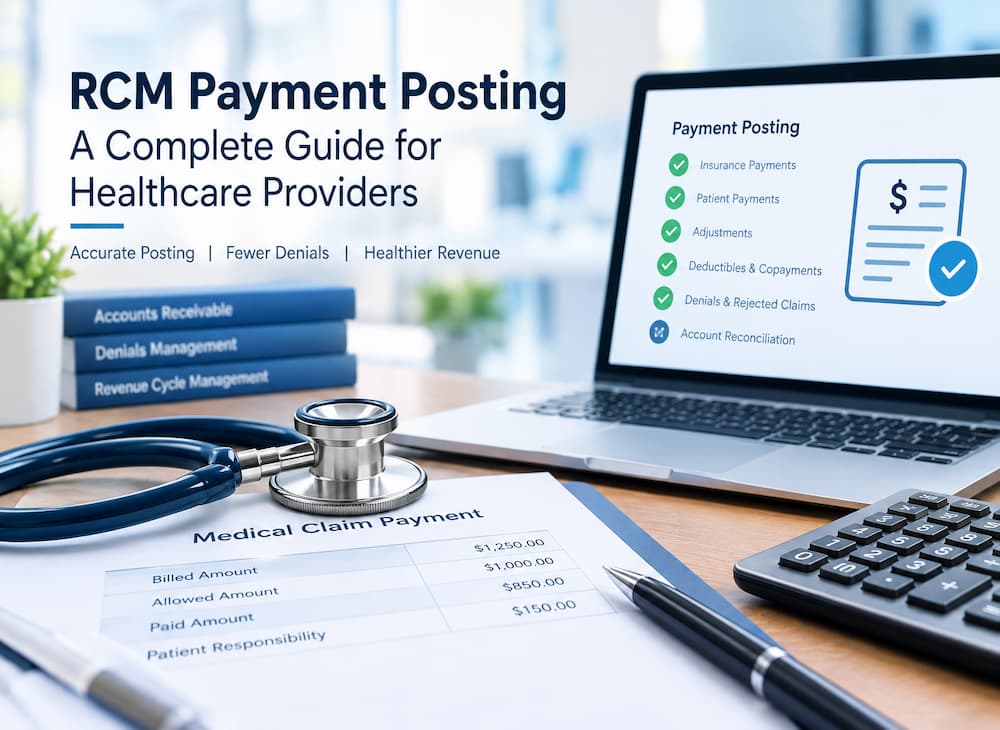
Payment posting is one of the most important steps in the Revenue Cycle Management (RCM) process. It involves accurately recording payments, adjustments, denials, and other financial transactions received from insurance companies and patients. Proper payment posting gives healthcare providers a clear picture of their revenue, outstanding balances, and accounts receivable.
When payment posting is handled efficiently, medical practices can reduce billing errors, identify unpaid claims faster, and maintain accurate financial records.
What Is RCM Payment Posting?
RCM payment posting is the process of entering payments received from insurance companies and patients into a healthcare provider’s billing system. Payments may come through electronic remittance advice (ERA), electronic funds transfer (EFT), paper checks, credit cards, or other payment methods.
The process generally includes recording:
- Insurance payments
- Patient payments
- Contractual adjustments
- Deductibles and copayments
- Coinsurance
- Denials and rejected claims
- Refunds and credit balances
- Other account adjustments
The goal is to ensure that every payment is accurately matched with the appropriate patient account and claim.
Why Is Payment Posting Important?
Accurate payment posting directly affects the financial health of a medical practice. Even when claims are submitted correctly, poor payment posting can create discrepancies and make it difficult to determine which balances are actually outstanding.
Effective payment posting helps healthcare organizations:
Maintain Accurate Patient Accounts
Payments and adjustments must be applied to the correct patient account. Accurate records prevent patients from being incorrectly billed or showing inaccurate outstanding balances.
Improve Accounts Receivable Management
When payments are posted promptly, billing teams can quickly identify unpaid or partially paid claims. This supports more effective
accounts receivable management and follow-up.
Identify Underpayments
Payment posting allows billing teams to compare payer reimbursements with expected amounts. If a payer reimburses less than the contracted or expected rate, the discrepancy can be investigated.
Support Denials Management
Payment posting can reveal denial codes and unpaid claim balances. Billing teams can use this information to prioritize follow-up and appeals.
Improve Financial Reporting
Accurate payment data provides management with reliable information for revenue reports, cash-flow analysis, and performance monitoring.
How Does the RCM Payment Posting Process Work?
A typical payment posting workflow involves several steps.
1. Receive Payment Information
The process begins when payment information is received from an insurance company or patient. Electronic payments may arrive with an ERA, while paper checks generally come with an explanation of benefits (EOB).
2. Review the Remittance
The payment poster reviews the remittance information to understand the amount paid, contractual adjustments, patient responsibility, denial codes, and other details.
3. Match Payments to Claims
Each payment is matched with the appropriate patient account and claim. This step requires careful verification to avoid posting payments to the wrong account.
4. Post Payments and Adjustments
Payments are entered into the practice management or billing system. Contractual adjustments, deductibles, coinsurance, and other applicable amounts are recorded according to the remittance information.
5. Handle Denials and Exceptions
If a claim is denied or underpaid, the issue is identified for further investigation. Depending on the reason, the account may be routed to the denial management or appeals team.
6. Reconcile the Payment Batch
After posting is completed, the total amount posted should be compared with the original payment or remittance. Any discrepancy should be investigated before the batch is finalized.
Common Challenges in Payment Posting
Healthcare organizations can face several challenges when managing payment posting.
Manual data entry: Entering large volumes of payment information manually can increase the risk of errors.
Unapplied payments: Payments that cannot immediately be matched to a patient account can create reconciliation problems.
Incorrect adjustments: Incorrectly applying contractual adjustments can distort account balances and financial reports.
Denials and partial payments: Complex payer rules can make it difficult to determine why a claim was not fully reimbursed.
High payment volumes: Practices handling large numbers of claims need efficient workflows to prevent posting backlogs.
Payer variations: Different insurance companies may use different remittance formats, codes, and payment policies.
Best Practices for Effective Payment Posting
Healthcare providers can improve payment posting accuracy by following standardized processes.
Use Electronic Remittance Advice
ERAs can reduce manual data entry and make it easier to process payment information efficiently. Automated workflows can also help reduce repetitive administrative tasks.
Establish Quality Checks
Regular quality-control reviews can identify incorrect payment applications, adjustment errors, duplicate postings, and unapplied payments.
Reconcile Payments Regularly
Payment batches should be reconciled against bank deposits, ERAs, EOBs, and other source documents to ensure financial accuracy.
Monitor Unapplied Cash
Unapplied payments should be reviewed regularly. Leaving payments unresolved for long periods can make accounts receivable reporting less reliable.
Track Underpayments
Healthcare organizations should compare actual reimbursement with expected reimbursement whenever possible. This can help identify payer discrepancies and potential revenue leakage.
Maintain Clear Workflows
Defined procedures for insurance payments, patient payments, denials, refunds, and adjustments help create consistency across the billing department.
How Payment Posting Supports the Entire RCM Cycle
Payment posting does not operate independently. It connects several stages of the healthcare revenue cycle.
After a claim is submitted and processed by the payer, the resulting payment or denial is recorded during payment posting. The information then helps determine whether the account is closed, requires patient billing, or needs additional insurance follow-up.
For example, if an insurance company pays a claim in full according to the contracted rate, the account can be properly adjusted and closed. If the claim is partially paid, the remaining balance may require additional review. If the claim is denied, the denial reason can be sent to the appropriate team for correction or appeal.
This makes payment posting an important source of information for improving the overall revenue cycle.
Benefits of Outsourcing RCM Payment Posting
Some healthcare organizations choose to outsource payment posting to specialized medical billing and RCM companies. Outsourcing can provide access to trained billing professionals, standardized workflows, quality checks, and scalable support.
Potential benefits include:
- Faster payment processing
- Reduced administrative workload
- Improved posting accuracy
- Better management of unapplied payments
- More consistent reconciliation
- Support for denial identification
- Improved visibility into accounts receivable
- Greater operational efficiency
The right approach depends on the practice’s size, payer mix, transaction volume, staffing, and technology.
Conclusion
RCM payment posting is a critical component of healthcare revenue cycle management. Accurate and timely posting ensures that insurance and patient payments are properly recorded, adjustments are correctly applied, and outstanding balances are clearly identified.
By using standardized workflows, electronic remittance information, regular reconciliation, quality controls, and effective exception management, healthcare organizations can improve financial accuracy and strengthen their overall RCM performance. Whether managed internally or through an experienced RCM partner, efficient payment posting can contribute to healthier cash flow and more effective accounts receivable management.
The information provided in this article is for general informational
and educational purposes only. It is not intended to replace
professional medical advice, diagnosis, or treatment. Always consult
a qualified healthcare professional regarding any medical condition,
symptoms, or treatment decisions.