Physical Address
304 North Cardinal St.
Dorchester Center, MA 02124
Physical Address
304 North Cardinal St.
Dorchester Center, MA 02124

For years, when marketers talked about “search,” they almost always meant Google.
A business owner wanted to rank on Google. An SEO specialist researched Google keywords. A customer searched Google before buying a product or hiring a service.
It was simple.
But things are changing.
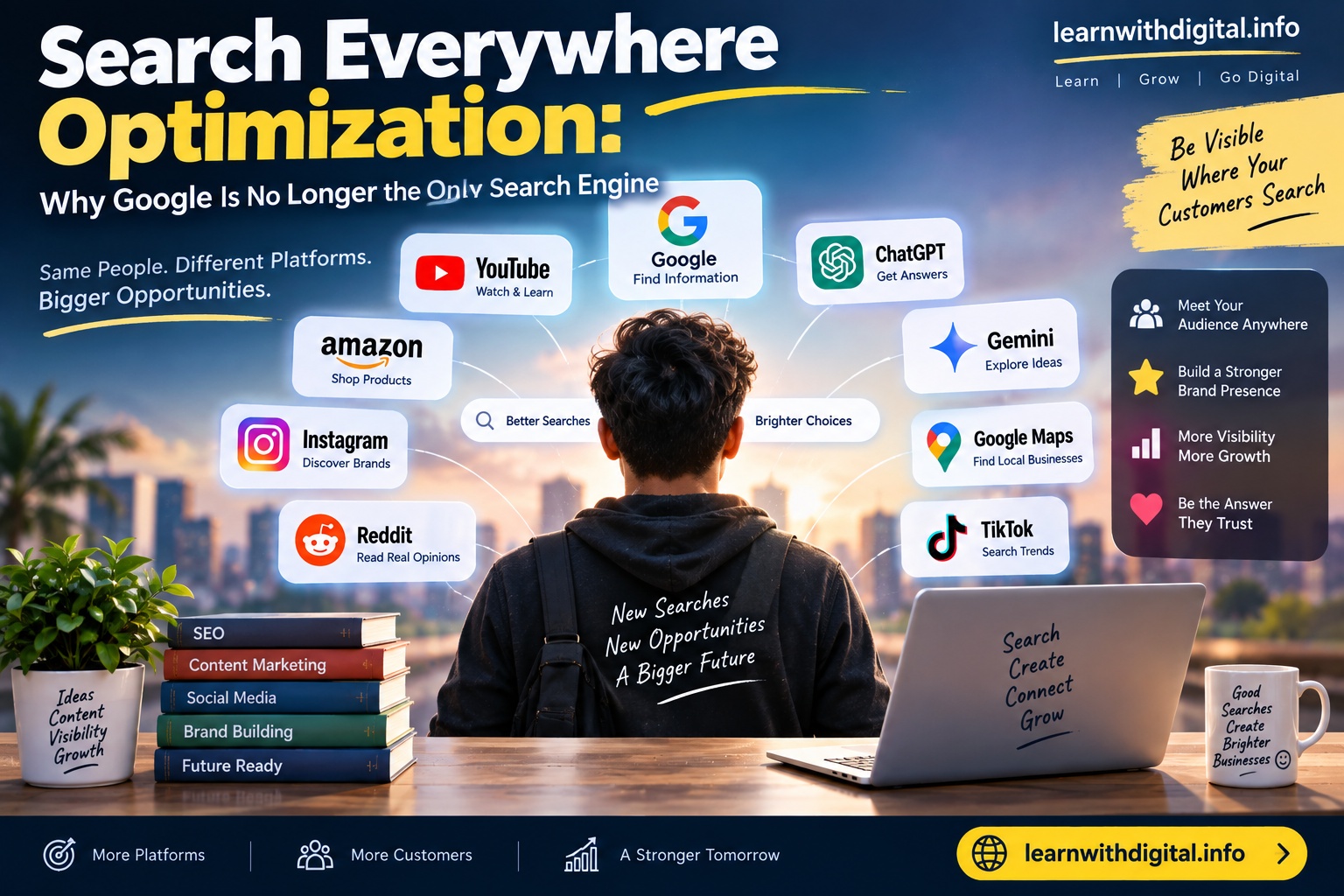
Today, people don’t always go to Google when they want an answer. They search for products on Amazon, watch tutorials on YouTube, look for recommendations on Instagram, ask questions on Reddit, check businesses on Google Maps, and increasingly turn to AI platforms for detailed answers.
This shift has created a new idea in digital marketing: Search Everywhere Optimization.
The concept is straightforward.
Instead of asking, “How do I rank on Google?”, businesses should start asking:
“Where does my audience search, and how can I become visible there?”
That change in mindset could become extremely important for businesses over the coming years.
Let’s make one thing clear first: Google is not disappearing.
Millions of people still use Google every day to find information, products, services, locations, reviews, and businesses.
Traditional SEO remains an important part of digital marketing.
The problem begins when a business depends entirely on Google.
Imagine a customer wants to buy a pair of running shoes.
They might search Google.
But they could also search Amazon to compare products, YouTube to watch reviews, Instagram to discover brands, Reddit to read real experiences, or an AI tool to ask for personalized recommendations.
The customer’s search journey has become fragmented.
And marketers need to follow the customer—not just the search engine.
Search Everywhere doesn’t mean that a business needs to be present on every website on the internet.
That’s neither realistic nor necessary.
It means understanding the platforms where your particular audience goes when they need information.
For one business, Google and Google Maps might be the most important.
For another, YouTube and Instagram could generate more attention.
An e-commerce brand may care heavily about Amazon.
A software company might receive valuable discovery through Reddit, YouTube, review websites, and AI search.
The goal is not to be everywhere.
The goal is to be where your customers are looking.
Many people think of YouTube as an entertainment platform.
It is—but it is also a massive search platform.
People don’t only watch random videos. They actively search for solutions.
They type things like:
“How to learn digital marketing”
“Best laptop for students”
“How to fix a leaking tap”
“SEO tutorial for beginners”
“Best exercises for beginners”
“How to use Excel”
A business that ignores YouTube may be missing an entire group of potential customers.
For example, a digital marketing company could publish tutorials explaining SEO, Google Ads, analytics, website optimization, and social media marketing.
Someone who discovers the company through a helpful video may eventually become a customer.
The important thing is that the customer didn’t necessarily start with a Google search.
They started with YouTube.
Social media is also becoming a discovery engine.
Think about Instagram.
Someone looking for a restaurant might search for local food creators.
Someone planning a trip might search through travel videos.
Someone interested in fitness might explore workout creators and gym pages.
A person looking for fashion inspiration may search directly within Instagram or TikTok.
This is different from traditional search behavior.
Instead of typing a question into Google and reading ten webpages, people can discover an answer through a short video, photograph, creator recommendation, or customer comment.
For businesses, this means social media content should not be created only for existing followers.
It should also be designed to help new people discover the brand.
People often want something that traditional advertisements struggle to provide:
honest opinions.
That’s one reason online communities can influence purchasing decisions.
Someone considering a product may search for experiences from people who have already used it.
They might ask:
“Is this laptop actually worth buying?”
“Has anyone tried this software?”
“Which digital marketing course is genuinely useful?”
“What’s the best gym for beginners?”
These conversations can influence decisions because they feel less like advertising and more like advice from another person.
Businesses should not enter communities simply to spam promotional links.
That usually creates the opposite effect.
Instead, brands should understand the conversations happening around their industry and contribute genuinely useful information where appropriate.
If you sell physical products, Amazon cannot be treated merely as an online store.
For many shoppers, it is a search engine for products.
Someone who already knows they want a particular type of product may go directly to Amazon rather than Google.
They might search:
“wireless keyboard”
and immediately begin comparing products, prices, ratings, and reviews.
That means product titles, descriptions, images, reviews, ratings, and other marketplace information can influence whether someone discovers and trusts a product.
A brand that optimizes only its website but ignores the marketplace where customers actually shop is leaving an important opportunity on the table.
Perhaps the most interesting development is AI-powered search.
People can now ask AI tools detailed questions instead of entering short keyword-based searches.
For example:
“I’m a beginner looking for an affordable digital marketing course. What should I consider before choosing one?”
This is a different type of search experience.
The user isn’t necessarily asking for a list of websites.
They’re asking for help making a decision.
For businesses, this creates another layer of digital visibility.
Your website, reputation, content, reviews, and mentions across the web can all contribute to how clearly your business is represented online.
There is no guaranteed method for making an AI platform recommend a particular brand.
But one thing remains true:
Businesses that provide useful, credible, and easily understandable information give themselves a better foundation for discovery.
For local businesses, Google Maps can be more important than a traditional website ranking.
Think about what happens when someone searches:
“coffee shop near me.”
They’re not necessarily looking for a blog post about coffee.
They want a place they can visit.
Maps provides business names, locations, reviews, photos, opening hours, and directions.
For restaurants, salons, gyms, clinics, repair services, hotels, and countless other businesses, this is a critical discovery channel.
That’s why local businesses should maintain accurate information, collect genuine reviews, upload useful photographs, and keep their business profile updated.
Local search isn’t only about getting clicks.
It’s about getting people through the door.
Here’s an important point marketers sometimes miss.
A customer doesn’t necessarily choose one platform and stay there.
Imagine someone wants to purchase a new smartphone.
Their journey might look like this:
Google → YouTube review → Reddit discussion → Amazon → Instagram
They search for options on Google.
They watch reviews on YouTube.
They read opinions on Reddit.
They compare products on Amazon.
Later, they see the brand again on Instagram.
By the time they make a purchase, they’ve interacted with the brand across multiple platforms.
If the company only measures Google traffic, it may misunderstand how the customer actually discovered and evaluated the product.
This doesn’t mean businesses need to create completely different content for every platform.
Instead, one strong idea can be adapted.
For example, suppose a company creates an in-depth article about:
“How Small Businesses Can Improve Local SEO.”
That one topic could become:
A detailed blog article.
A YouTube tutorial.
An Instagram carousel.
A short video.
A LinkedIn post.
A Reddit discussion answering a genuine question.
An FAQ on the website.
An email newsletter.
The central idea remains the same, but the presentation changes according to the platform.
This approach allows businesses to get more value from good ideas instead of constantly starting from zero.
There is an important difference between repurposing content and simply copying it.
People use different platforms for different reasons.
Someone watching a 30-second video doesn’t want to read a 2,000-word introduction.
Someone searching YouTube may want to see a demonstration.
Someone on Reddit may want a detailed personal explanation.
Someone visiting your website may want pricing, features, and proof.
Understand the platform.
Then adapt the message.
The goal is to make the content feel native rather than recycled.
While your content should be adapted for each platform, your brand identity should remain consistent.
Your business name shouldn’t change randomly.
Your logo should be recognizable.
Your description should communicate the same basic positioning.
Your website and social profiles should point people toward the correct information.
Your tone should feel like the same company.
Imagine discovering a brand on Instagram and then visiting its website.
If the two feel completely unrelated, trust can decrease.
Consistency creates familiarity.
And familiarity can make a brand easier to remember.
One of the biggest mistakes businesses can make is trying to be everywhere immediately.
A business owner hears that a new platform is trending and creates an account.
Then another platform becomes popular.
Another account is created.
After a few months, there are seven abandoned profiles and very little meaningful engagement.
That’s not Search Everywhere Optimization.
That’s simply being everywhere without a strategy.
Instead, identify the platforms that matter most to your customers.
If your audience watches tutorials, prioritize YouTube.
If customers discover your products visually, invest in Instagram.
If you’re selling products, consider marketplaces.
If you’re a local business, prioritize local search.
If customers ask detailed questions about your industry, consider communities and AI-driven discovery.
Focus beats scattered effort.
Traditional digital marketing often focuses heavily on website traffic.
Traffic is useful, but it isn’t the whole picture.
A person may discover your brand on YouTube, remember your name, and visit your website three days later by typing the brand directly into Google.
Your analytics may record that as direct or branded traffic.
The original discovery happened somewhere else.
This is why businesses should look at a broader set of signals:
Brand searches
Website traffic
Video views
Social engagement
Reviews
Leads
Direct traffic
Branded searches
Marketplace performance
Customer enquiries
The goal is to understand how people discover and interact with your brand across the entire journey.
The future of search is unlikely to belong to one platform.
Google will remain important.
But YouTube, social networks, marketplaces, maps, online communities, and AI-powered search will continue to play their own roles.
Customers will move between these platforms depending on what they need.
Sometimes they will want a quick answer.
Sometimes they will want a video.
Sometimes they will want an honest opinion.
Sometimes they will want to compare prices.
Sometimes they will want a recommendation.
Smart marketing will adapt to all of these situations.
If you’re a business owner, you don’t need to completely rebuild your marketing strategy tomorrow.
Start small.
First, identify the top three places where your customers search.
Second, make sure your business information is accurate on those platforms.
Third, create useful content that answers real customer questions.
Fourth, adapt successful content into different formats.
Fifth, collect genuine customer reviews and feedback.
Sixth, monitor where your brand is being discovered.
And finally, keep experimenting.
Digital marketing has never been a fixed field.
The platforms change.
Customer behavior changes.
Technology changes.
The businesses that survive and grow are usually the ones willing to learn and adapt.
For a long time, the goal of digital marketing was simple:
Get found on Google.
Today, that goal is becoming much broader.
Customers can discover your business through Google, YouTube, Instagram, Amazon, Reddit, Google Maps, AI search, and many other platforms.
That doesn’t mean Google SEO is no longer important.
It means Google is no longer the entire search journey.
Search Everywhere Optimization is ultimately about following your audience wherever they look for answers, recommendations, products, and solutions.
The smartest businesses won’t try to dominate every platform.
They’ll understand where their customers spend their time, create genuinely useful content, and build a consistent brand across the places that matter.
Because the future of search isn’t just about one search box.
It’s about being discoverable wherever your customer begins their journey.




