
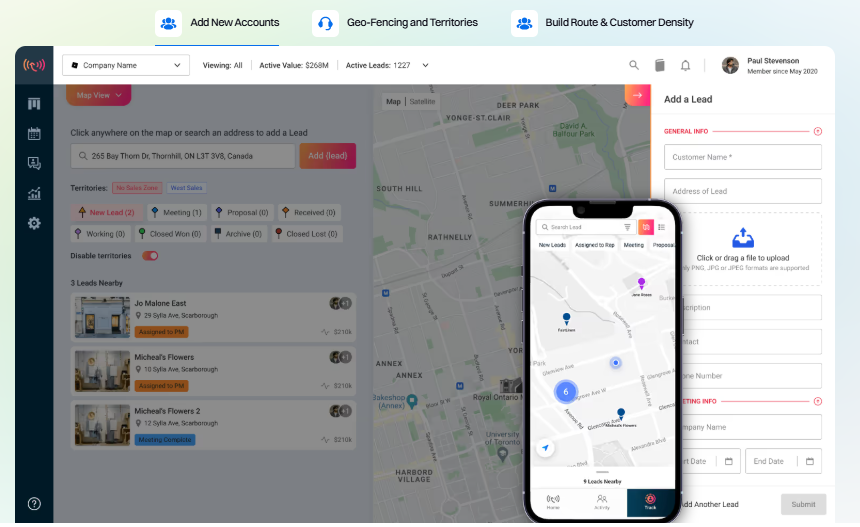

Territory management is an essential part of sales planning that helps businesses organize geographic areas, customer accounts, and sales responsibilities. By assigning the right customers and opportunities to the right representatives, organizations can improve productivity, strengthen customer relationships, and make better use of their resources.
Effective territory management is especially important for businesses with field sales teams, regional sales representatives, multiple locations, or large customer bases. Without a clear structure, sales representatives may overlap their efforts, overlook valuable prospects, or spend too much time traveling between appointments.
A well-designed territory management strategy helps businesses improve sales coverage, balance workloads, and create a more consistent customer experience.
What Is Territory Management?
Understanding Territory Management
Territory management is the process of dividing a market into manageable areas, assigning customers and prospects to sales representatives, and monitoring performance within each area. Territories can be organized according to geography, industry, account value, customer type, or sales potential.
For example, a company may assign one representative to a particular city, another to nearby rural areas, and a third to high-value commercial accounts across multiple regions.
The objective is to ensure that every important market segment receives appropriate attention while sales teams work efficiently toward business goals.
How Territory Management Works
Territory management typically follows a structured process that connects market analysis with sales execution.
The process often includes:
- Market analysis: Identifying potential customers, demand patterns, and competitive conditions.
- Territory design: Dividing the market into practical and measurable segments.
- Representative assignment: Allocating territories based on skills, experience, and workload.
- Goal setting: Establishing realistic sales targets and activity expectations.
- Performance monitoring: Measuring revenue, customer acquisition, retention, and sales coverage.
- Territory optimization: Adjusting assignments as markets, customer needs, and business priorities change.
These steps help organizations make territory decisions based on evidence rather than assumptions.
Why Territory Management Matters
Improving Sales Coverage
Without defined territories, multiple representatives may pursue the same prospects while other potential customers receive little attention. This can create unnecessary competition internally and leave valuable opportunities unexplored.
Territory management establishes clear ownership of accounts and markets. Representatives understand which customers they serve, which prospects they should approach, and how their activities contribute to overall sales objectives.
Clear territory ownership reduces duplicated effort and helps businesses identify underserved markets.
Increasing Sales Representative Productivity
Sales representatives often divide their time between prospecting, customer meetings, administrative work, and travel. Poorly designed territories can increase travel time and reduce the number of productive customer interactions.
A practical territory structure groups customers in ways that support efficient scheduling and manageable workloads.
This allows representatives to spend more time building relationships, identifying opportunities, and helping customers solve problems.
Strengthening Customer Relationships
Customers benefit when they know which representative is responsible for their accounts. Consistent ownership makes communication easier and reduces confusion about who handles questions, follow-ups, and service requests.
Territory management can also help organizations provide more appropriate attention to high-value accounts and customers with specialized requirements.
Types of Territory Management
Different businesses require different approaches to territory design. Some rely on physical locations, while others organize sales responsibilities around customer characteristics or market opportunities.
Geographic Territory Management
Geographic territory management divides markets according to cities, postal areas, regions, states, or countries.
It is particularly useful for field sales teams that conduct in-person meetings, visit customer sites, or deliver services across a defined area.
Benefits include:
- Reduced travel between customer appointments
- Clear regional responsibility
- Easier coordination of local sales activities
- Better visibility into regional market performance
However, geographic boundaries alone may not create balanced territories. Two regions of similar size can have significantly different customer populations and revenue potential.
Account-Based Territory Management
Account-based territory management assigns customers according to their size, revenue potential, strategic importance, or relationship requirements.
For example, a company may assign enterprise accounts to specialized representatives while smaller customers are handled by a regional sales team.
This model is useful when customers differ substantially in purchasing behavior, service needs, or potential contract value.
Industry-Based Territory Management
Industry-based territories organize sales responsibilities around sectors such as healthcare, manufacturing, construction, technology, or retail.
Representatives can develop specialized knowledge of industry challenges, purchasing processes, regulations, and customer expectations.
This approach is especially effective when a product or service requires technical expertise or industry-specific sales conversations.
Hybrid Territory Management
A hybrid approach combines two or more territory models. A company might assign representatives by geographic region while reserving major accounts for industry specialists.
This structure provides flexibility for organizations with diverse customer groups and complex sales operations.
|
Territory type |
Primary basis |
Best suited for |
|
Geographic |
Physical location |
Field sales and regional businesses |
|
Account-based |
Customer value or size |
Enterprise and strategic account sales |
|
Industry-based |
Business sector |
Specialized or technical sales |
|
Hybrid |
Multiple criteria |
Complex sales organizations |
Key Benefits of Effective Territory Management
Better Resource Allocation
Territory management helps businesses distribute sales representatives, marketing activities, and operational resources according to market demand.
Organizations can identify areas with strong growth potential and allocate more attention where it is likely to generate meaningful returns.
It also helps managers recognize territories that may be overstaffed, underserved, or difficult to manage with existing resources.
Improved Sales Forecasting
When territories have clear boundaries and consistent reporting practices, managers can evaluate performance by region, account segment, or representative.
Historical sales, pipeline value, customer demand, and conversion rates can support more informed forecasts.
Reliable territory-level data helps managers identify trends early and make more confident planning decisions.
Greater Accountability
Clearly assigned territories make it easier to define responsibilities and evaluate results.
Managers can compare performance against appropriate targets, review customer coverage, and identify areas where representatives need additional support or training.
Fair accountability requires targets to reflect differences in market potential rather than relying exclusively on identical revenue expectations.
Stronger Market Penetration
Territory planning can reveal customer groups or locations that have received limited sales attention.
By identifying these gaps, businesses can develop targeted prospecting campaigns, improve coverage, and expand into suitable markets.
This is particularly valuable when entering new regions or launching new products.
How to Create and Balance Sales Territories
Step 1: Analyze the Market
The first step is to understand the market that the sales team is expected to cover.
Useful information includes customer locations, prospect counts, historical revenue, purchasing frequency, industry distribution, competitor presence, and estimated growth potential.
Businesses should use reliable and current data whenever possible. Incomplete customer records can lead to territories that appear balanced on paper but perform poorly in practice.
Step 2: Define Territory Objectives
Before drawing boundaries, managers should determine what the territory structure needs to accomplish.
Common objectives include increasing revenue, reducing travel costs, improving customer retention, expanding market coverage, or supporting a new product launch.
These objectives guide decisions about territory size, account ownership, staffing, and performance measurements.
Step 3: Establish Territory Boundaries
Managers can create territories using geographic boundaries, customer segments, revenue potential, or a combination of factors.
Mapping tools may help visualize account locations and identify travel patterns. CRM data can provide additional context about existing relationships, sales opportunities, and customer activity.
Boundaries should be easy to understand and practical to maintain.
Step 4: Balance Workloads and Opportunities
Equal territory size does not necessarily mean equal opportunity. A small urban territory may contain more customers than a large rural area, while a region with fewer prospects may contain several high-value accounts.
A balanced territory should consider:
- Number of customers and prospects
- Estimated revenue potential
- Current account workload
- Travel requirements
- Sales cycle length
- Customer service demands
- Representative experience and capacity
The goal is to distribute realistic opportunities and workloads fairly, not simply to divide a map into equal sections.
Step 5: Assign Representatives and Set Targets
Once territories are established, representatives should be assigned based on their experience, skills, customer relationships, and capacity.
Managers should then set measurable goals that reflect each territory’s potential. Targets may include revenue, new accounts, qualified opportunities, customer retention, or sales activity.
Clear expectations help employees understand how their performance will be assessed.
Step 6: Review and Adjust Territories
Markets change as customers relocate, new competitors enter, products evolve, and representatives join or leave the organization.
Territories should therefore be reviewed periodically rather than treated as permanent assignments.
Managers can use performance data and feedback from representatives to identify imbalances and make necessary adjustments.
Essential Features of Territory Management Software
Territory Mapping and Visualization
Mapping tools help managers visualize customer locations, regional boundaries, account concentrations, and potential coverage gaps.
Advanced platforms may support interactive maps, location-based filtering, and territory comparisons.
These capabilities can help field sales teams organize customer visits and identify opportunities in underserved areas.
CRM Integration and Account Assignment
Integration with customer relationship management software keeps account records, sales activities, and territory assignments connected.
Depending on the platform, businesses may be able to assign accounts automatically using geographic boundaries, industry categories, customer value, or custom rules.
Centralized records also help representatives understand account ownership and review customer history.
Performance Tracking and Reporting
Reporting features help managers monitor territory performance against business goals.
Useful metrics may include revenue, conversion rates, new customers, pipeline value, retention, sales activity, and customer coverage.
Dashboards make it easier to identify differences between territories and investigate the reasons behind them.
Scheduling and Route Planning
For field sales teams, scheduling and route planning can reduce unnecessary travel and improve the number of customer visits completed.
Some tools offer route optimization, appointment planning, mobile access, and location-based workflows.
Businesses should confirm which features are included in their chosen platform and whether additional integrations are required.
Best Practices for Territory Management
Use Data to Guide Decisions
Territory assignments should reflect measurable market conditions rather than relying entirely on intuition.
Managers should review sales history, account potential, customer distribution, and workload before creating or changing territories.
Data should inform decisions while allowing room for practical knowledge from representatives who understand local market conditions.
Communicate Territory Changes Clearly
Changes in account ownership or geographic boundaries can affect customer relationships and employee expectations.
Managers should explain why changes are necessary, when they take effect, and how existing accounts will be handled.
A documented transition plan can reduce confusion and protect continuity for customers.
Establish Consistent Performance Metrics
Territories should be evaluated using clear and relevant measurements.
|
Metric |
What it measures |
|
Revenue attainment |
Progress toward sales targets |
|
Lead conversion rate |
Percentage of leads converted into customers |
|
Customer coverage |
Proportion of target accounts actively served |
|
Customer retention |
Ability to maintain existing relationships |
|
Pipeline value |
Potential revenue from open opportunities |
|
Travel efficiency |
Time or distance required for field activities |
Metrics should be interpreted in context. A territory with a longer sales cycle may need different benchmarks from one that serves customers with short purchasing cycles.
Review Territories Regularly
Businesses should schedule territory reviews at appropriate intervals and whenever major changes affect market conditions.
Reviews can uncover overloaded representatives, underdeveloped markets, declining customer engagement, or new growth opportunities.
Regular assessment allows the territory structure to evolve alongside the business.
Common Territory Management Mistakes
Focusing Only on Geography
Geographic boundaries are useful, but they do not automatically create balanced opportunities. Managers should also evaluate customer value, demand, travel requirements, and sales workload.
Ignoring Representative Feedback
Representatives often understand local customer needs and practical travel challenges better than centralized reports reveal.
Their feedback can help managers identify unrealistic boundaries, account conflicts, and underserved prospects.
Setting Identical Targets for Every Territory
Equal targets may be unfair when territories differ substantially in market size, customer potential, or sales cycle length.
Targets should reflect realistic opportunities while maintaining consistent performance standards.
Neglecting Data Quality
Outdated account locations, duplicate records, and inaccurate sales histories can undermine territory planning.
Businesses should establish clear processes for maintaining customer information and reviewing account assignments.
Frequently Asked Questions
What is the main purpose of territory management?
The main purpose is to organize markets, customers, and sales responsibilities so that businesses can improve coverage, allocate resources effectively, and manage sales performance.
What is the difference between territory management and territory planning?
Territory planning focuses on designing territories, assigning accounts, and setting objectives. Territory management is the broader ongoing process that includes implementation, performance monitoring, communication, and adjustments.
What is territory management software?
Territory management software helps businesses design, visualize, assign, and monitor sales territories. Depending on the platform, it may include mapping, CRM integration, account allocation, reporting, and route planning.
How often should sales territories be reviewed?
There is no universal schedule. Many organizations review territories periodically and whenever significant changes occur in customer demand, staffing, market conditions, or business strategy.
How can businesses measure territory management success?
Success can be measured through revenue attainment, customer coverage, conversion rates, retention, pipeline growth, travel efficiency, and workload balance. The most useful metrics depend on the organization’s sales model and objectives.
Conclusion
Territory management helps businesses organize their sales activities, allocate resources, and improve customer coverage. By combining thoughtful territory design with clear account ownership, measurable targets, and regular performance reviews, organizations can reduce inefficiencies and identify new growth opportunities.
Technology can further support these efforts through mapping, CRM integration, reporting, scheduling, and account assignment tools.
Successful territory management is an ongoing process that balances market opportunity, representative workload, and customer needs while supporting the company’s broader sales objectives.



