Physical Address
304 North Cardinal St.
Dorchester Center, MA 02124
Physical Address
304 North Cardinal St.
Dorchester Center, MA 02124


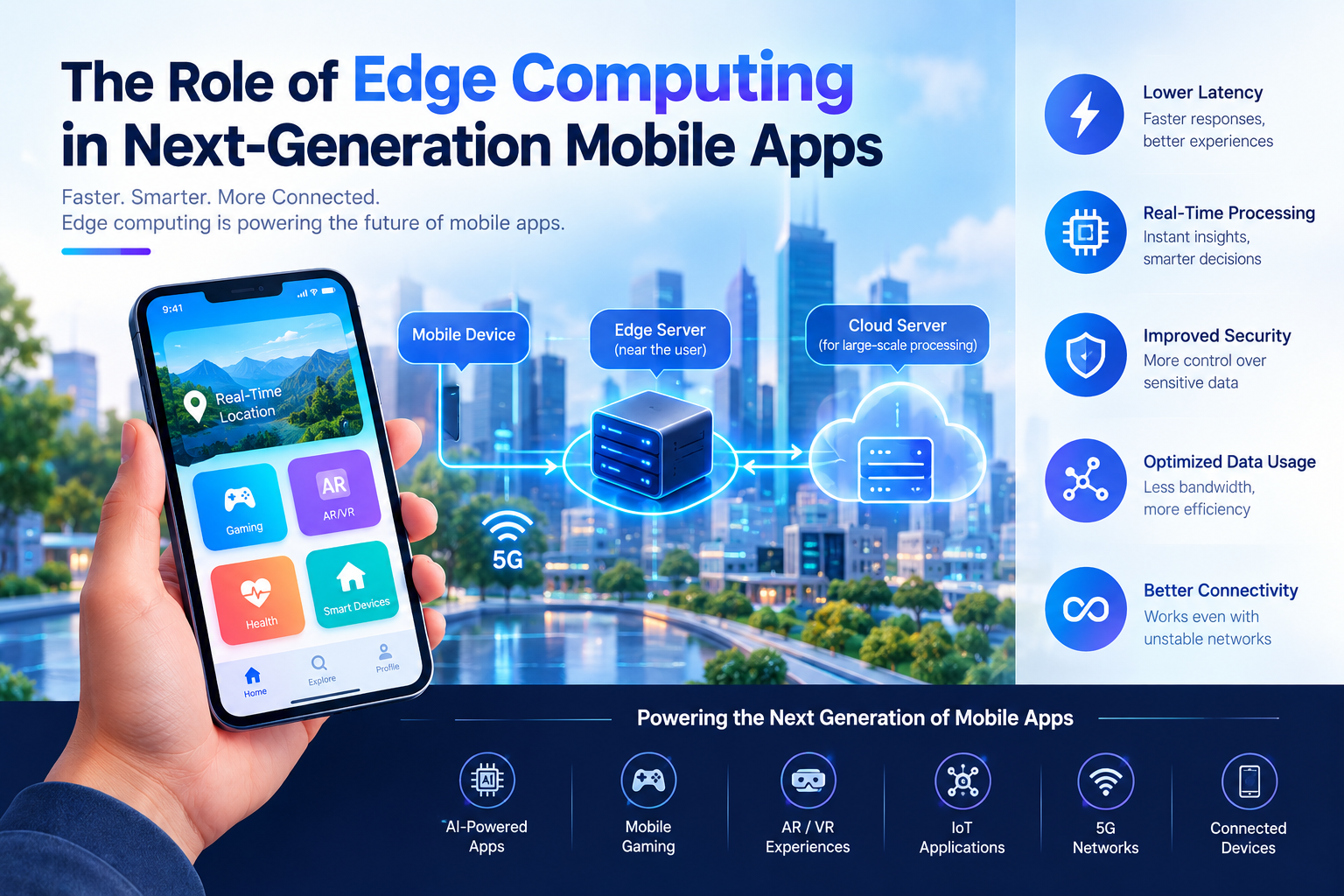
Mobile applications are becoming more advanced, connected, and data-driven. Modern apps development are expected to deliver fast responses, personalized experiences, real-time communication, and reliable performance across different network conditions. Traditional cloud computing has played an important role in supporting these requirements, but sending every request to a centralized cloud server can sometimes create latency and performance challenges.
Edge computing is emerging as an important technology for addressing these challenges. Instead of processing all data in a distant cloud, edge computing processes certain data closer to the user or the device. This can reduce response times, improve application performance, and support real-time mobile experiences.
For next-generation mobile apps, edge computing can become particularly valuable in areas such as artificial intelligence, gaming, IoT, augmented reality, healthcare applications, and real-time communication.
Edge computing is a technology that moves computing and data-processing capabilities closer to where data is generated and consumed.
In a traditional cloud-based architecture:
Mobile Device → Internet → Central Cloud Server → Response
With edge computing:
Mobile Device → Nearby Edge Server → Response
Because processing takes place closer to the user, applications may be able to respond faster and reduce the amount of data that needs to travel to a centralized cloud environment.
Edge computing does not necessarily replace cloud computing. Instead, the two can work together, with the edge handling time-sensitive workloads and the cloud managing centralized storage, large-scale processing, analytics, and other tasks.
One of the biggest advantages of edge computing is reduced latency.
When a mobile app depends on a distant cloud server, data may need to travel across several networks before the application receives a response. Edge computing allows certain processing tasks to happen closer to the user.
This can help applications deliver faster responses, which is particularly important for:
Online gaming
Video applications
Real-time collaboration
Navigation apps
Augmented reality
Financial applications
IoT-based mobile apps
A faster response can also contribute to a smoother overall user experience.
Next-generation applications increasingly depend on real-time data processing. Users expect applications to respond almost immediately when interacting with live information.
Edge computing can process data closer to its source, making it suitable for applications that require quick decisions.
For example, a mobile application connected to smart devices could process sensor information through an edge server rather than sending every piece of data to a distant cloud server.
This can support real-time use cases such as:
Smart home applications
Connected vehicles
Industrial IoT
Wearable devices
Real-time monitoring
Location-based services
Mobile users frequently move between different network environments. Network congestion, weak signals, or limited bandwidth can affect application performance.
Edge computing can reduce dependence on distant servers by processing certain workloads closer to users. This may help applications operate more efficiently when network conditions are not ideal.
When combined with technologies such as 5G, edge computing can provide a strong foundation for applications that require low latency and high-speed connectivity.
Artificial intelligence is becoming an important part of mobile app development. Apps now use AI for recommendations, image recognition, voice processing, personalization, fraud detection, and automation.
Some AI workloads can be processed at the edge instead of sending all information to centralized cloud servers.
For example, an AI-powered mobile application could use edge infrastructure to process certain data closer to the user. This can help reduce delays and support more responsive AI features.
Edge computing can therefore complement cloud-based AI by creating a distributed environment where some processing happens closer to the application.
Mobile gaming is another area where latency and performance are extremely important.
Cloud gaming and multiplayer games require continuous communication between users, devices, and servers. Delays can negatively affect gameplay, particularly in competitive or real-time environments.
Edge computing can place processing resources closer to players, potentially reducing network latency.
This can support features such as:
Real-time multiplayer gaming
Cloud gaming
AR/VR gaming
Interactive gaming environments
Live player interactions
As mobile games become more sophisticated, edge infrastructure could become increasingly useful for delivering responsive experiences.
Augmented reality and virtual reality applications require substantial processing and rapid responses.
For example, an AR application may need to analyze the user’s surroundings, process visual information, and provide digital content in real time.
Processing some of these workloads closer to the user can help reduce delays between user actions and application responses.
Edge computing can therefore support next-generation AR/VR applications used in:
Education
Retail
Gaming
Training
Healthcare
Navigation
Industrial applications
Mobile applications can generate large amounts of data, especially applications involving video, images, sensors, and connected devices.
Sending every piece of information to a centralized cloud server can consume significant bandwidth.
Edge computing allows some information to be processed locally or closer to the data source. Only the necessary results or selected information may then need to be sent to the cloud.
This approach can help organizations manage network traffic more efficiently.
Edge computing can also provide opportunities for improved data privacy.
When certain data is processed closer to the device or within an edge environment, there may be less need to send raw information to a centralized server.
For example, an application could process certain sensor or user information at the edge and transmit only the required results.
However, edge computing does not automatically guarantee security. Edge environments introduce additional devices and infrastructure that must be properly protected through authentication, encryption, access controls, monitoring, and secure software development practices.
The Internet of Things is generating huge volumes of information from connected devices.
Mobile applications often act as interfaces for these devices, allowing users to monitor and control them.
Edge computing can process IoT data closer to where it is generated, reducing the need to send every sensor reading to the cloud.
For example:
IoT Device → Edge Computing → Mobile App → Cloud
This architecture can be useful for smart homes, healthcare devices, connected vehicles, industrial systems, and wearable technology.
The growth of 5G networks is expected to support new types of mobile experiences through faster connectivity and lower latency. Edge computing complements this development by bringing computing resources closer to users.
Together, 5G and edge computing can support applications that require:
Low latency
High bandwidth
Real-time communication
Large-scale device connectivity
Fast data processing
This combination can become particularly valuable for connected vehicles, smart cities, industrial IoT, cloud gaming, AR/VR, and other real-time applications.
Although edge computing offers several potential benefits, developers also need to consider its challenges.
Managing cloud servers, edge infrastructure, mobile devices, and networks can make application architecture more complex.
A distributed environment creates more endpoints that need protection. Strong security practices are essential.
Deploying and maintaining edge infrastructure can require additional investment and technical resources.
Organizations need clear strategies for deciding which data should be processed at the edge and which should be sent to centralized cloud systems.
Developers may need specialized knowledge to design, monitor, test, and maintain applications across distributed environments.
Businesses and developers considering edge computing should carefully plan the application architecture.
Some useful practices include:
Identify latency-sensitive features that can benefit from edge processing.
Use cloud and edge computing together instead of treating them as competing technologies.
Protect data at every layer through encryption and authentication.
Design for unreliable network conditions and provide suitable fallback mechanisms.
Monitor edge infrastructure continuously to identify performance and security issues.
Optimize data transfer by processing unnecessary information closer to the source.
Test applications across different devices and network environments.
As mobile applications become more intelligent and connected, edge computing is likely to play an increasingly important role in application architecture.
Future mobile applications may combine AI, 5G, IoT, cloud computing, and edge computing to create highly responsive digital experiences.
Applications could process more information closer to users while still using centralized cloud platforms for large-scale storage, analytics, and model training.
This distributed approach may be especially important for applications where speed, real-time processing, and continuous connectivity are essential.
Edge computing is becoming an important technology for the development of next-generation mobile applications. By moving selected computing tasks closer to users and data sources, it can help reduce latency, improve responsiveness, support real-time functionality, and optimize data transfer.
From AI-powered applications and mobile gaming to IoT, AR/VR, and 5G-enabled services, edge computing can support a wide range of emerging mobile experiences.
For businesses planning future mobile applications, understanding how edge computing works alongside cloud infrastructure can help them design applications that are responsive, scalable, and prepared for increasingly connected digital environments.




