Physical Address
304 North Cardinal St.
Dorchester Center, MA 02124
Physical Address
304 North Cardinal St.
Dorchester Center, MA 02124

{“success”:false,”data”:”The uploaded file exceeds the upload_max_filesize directive in php.ini.”}
Stable voltage is an important part of reliable industrial operation. CNC machines, motors, compressors, pumps, production equipment and other heavy machinery can be affected when the incoming supply changes frequently during working hours.
The problem is not always visible immediately. A machine may work normally in the morning but start showing alarms when production increases. A large motor may cause a temporary voltage drop when it starts. A CNC controller may stop unexpectedly even though the machine was operating correctly a few minutes earlier.
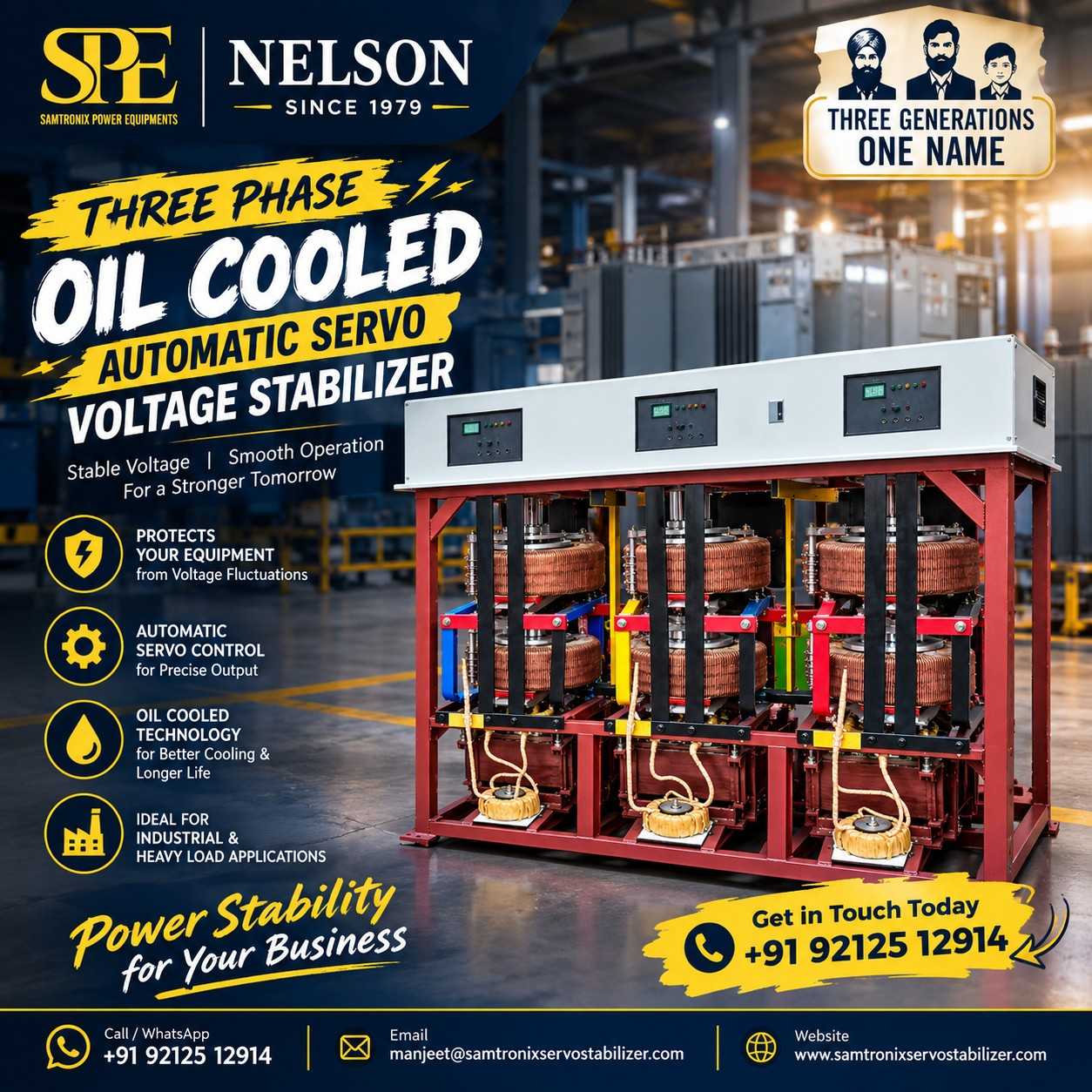
A Three Phase Oil Cooled Automatic Servo Voltage Stabilizer is designed to automatically regulate voltage for industrial three-phase applications. It continuously monitors the incoming supply and makes voltage corrections according to the required output.
Samtronix Power Equipments manufactures industrial servo stabilizer systems for factories, manufacturing units, CNC applications and heavy electrical loads. The actual capacity and configuration should be selected according to the measured electrical conditions.
Before selecting a stabilizer, it is useful to understand exactly how much the voltage is changing.
A factory may have a nominal supply of 415 V, but the actual voltage can change according to the electrical load.
| Factory Condition | Example Voltage |
|---|---|
| Low production load | 412 V |
| Normal production | 400 V |
| Several machines operating | 384 V |
| Large motor starting | 360 V |
| Lower evening load | 405 V |
These figures are only examples.
If a machine begins showing an alarm when the voltage reaches around 360 V, that measurement is useful during the technical assessment.
Instead of simply saying “the voltage is unstable,” recording the minimum and maximum voltage gives a much clearer understanding of the requirement.
A servo voltage stabilizer monitors the incoming electrical supply continuously.
When the input voltage changes, the control circuit detects the variation. The servo motor then operates the correction mechanism connected with the variable transformer.
The transformer adjusts the voltage so that the output remains within the configured range.
| Component | Main Function |
|---|---|
| Voltage sensing system | Measures input voltage |
| Control circuit | Detects variation |
| Servo motor | Operates the correction mechanism |
| Variable transformer | Performs voltage correction |
| Output system | Provides regulated voltage |
The process takes place automatically, so the operator does not need to manually adjust the voltage every time the factory supply changes.
Many industrial machines operate on three-phase power.
CNC machines, large motors, compressors, pumps and production equipment can place significant demand on the electrical system.
For this reason, all three phases should be checked.
For example:
| Measurement | Example |
|---|---|
| R-Y | 410 V |
| Y-B | 396 V |
| B-R | 405 V |
These are sample values only.
If actual readings show a large difference between phases, the reason should be investigated before deciding on the stabilizer.
Unequal loading, electrical connections or other supply conditions can contribute to phase variation.
Industrial voltage stabilizers may operate continuously for several hours under heavy electrical loads.
Electrical components generate heat during operation. Oil cooling helps transfer heat from relevant internal components and provides insulation within the equipment design.
An oil cooled stabilizer for industrial loads can therefore be useful for applications involving substantial loads and long working hours.
However, cooling type is not the only factor that matters.
The stabilizer should also be considered according to its input range, output requirement, capacity, load characteristics and installation conditions.
A machine’s normal running load does not always represent its highest electrical demand.
Motors can draw significantly higher current during starting.
For example, a large motor may operate at a certain current after reaching its normal speed but require considerably more current during startup.
If several motors start together, the temporary demand can increase further.
This is why a voltage stabilizer for heavy machinery should be evaluated using both running and starting conditions.
CNC machines contain electronic controls, drives, motors and other electrical systems that operate according to defined electrical requirements.
When the incoming supply moves outside the permitted range, the machine may show an alarm, interrupt a process or stop unexpectedly.
A servo stabilizer for CNC machine applications can be considered when voltage fluctuation has been confirmed through measurement.
Before discussing a servo voltage stabilizer for CNC machines, check the machine nameplate.
| Machine Detail | Example |
|---|---|
| Supply | Three phase |
| Voltage | 415 V |
| Frequency | 50 Hz |
| Machine rating | 40 kVA |
| Working period | 10 hours/day |
The actual values should always come from the machine.
If several CNC machines share the same electrical source, the combined requirement should also be considered.
Consider a workshop with three CNC machines rated at 20 kVA, 30 kVA and 40 kVA.
The same electrical system also supplies an air compressor and auxiliary equipment.
Selecting a stabilizer only according to the largest CNC machine may not represent the complete electrical requirement.
The combined load needs to be considered.
The timing of the loads also matters. If the compressor starts while all CNC machines are already operating, the electrical demand can temporarily increase.
This information should be shared during a stabilizer enquiry.
A voltage stabilizer for factory applications can be used where several industrial machines operate through the same electrical system.
A manufacturing facility may contain CNC machines, motors, compressors, pumps, control panels and automated production equipment.
The voltage can change as the factory load increases.
For example:
| Production Level | Example Voltage |
|---|---|
| Beginning of shift | 410 V |
| Normal production | 398 V |
| High production | 380 V |
| Peak load | 362 V |
| Reduced production | 404 V |
If the lowest readings repeatedly occur during peak production, recording this pattern can help identify the actual electrical condition.
An industrial voltage stabilizer three phase system should be specified around the actual electrical requirement.
Some useful information includes:
| Parameter | Example |
|---|---|
| Electrical system | Three phase |
| Nominal voltage | 415 V |
| Frequency | 50 Hz |
| Connected load | 100 kVA |
| Minimum input | 350 V |
| Maximum input | 440 V |
| Operating period | 12 hours/day |
These numbers are examples only.
The actual installation should be measured before finalizing the equipment specification.
Manufacturing plants often operate equipment for long production shifts.
If an important machine stops because of an electrical disturbance, it can interrupt the production process.
A servo stabilizer for manufacturing industry applications can be considered where voltage fluctuation has been measured and identified as an issue.
For example, a factory may receive approximately 405 V during low production but around 360 V during peak production.
Recording both readings provides useful information for a technical enquiry.
Samtronix Power Equipments can discuss the requirement using the machine and electrical details provided by the customer.
Customers often search for a 5 kva servo stabilizer, 10 kVA, 25 kVA, 50 kVA or larger equipment.
The correct capacity depends on the actual electrical load.
A machine rated at 5 kVA may also have auxiliary equipment connected to the same supply.
For a complete factory, the combined connected load must be considered.
Starting current, power factor and the operating pattern can also affect the requirement.
The kVA should therefore be selected from actual electrical information rather than simply choosing a commonly searched capacity.
A customer searching for servo stabilizer 5kva price may already believe that a 5 kVA unit is suitable.
Before focusing on servo stabilizer price, the actual machine requirement should be checked.
For example, a machine may have a motor rating plus control and auxiliary loads.
A clear photograph of the machine nameplate can provide useful information about the electrical requirement.
Samtronix Power Equipments can discuss the application based on the details provided.
Industrial machinery can be rated in kW while stabilizers are commonly specified in kVA.
The relationship depends on the power factor.
For example:
| Parameter | Example |
|---|---|
| Apparent power | 100 kVA |
| Power factor | 0.8 |
| Approximate real power | 80 kW |
The actual power factor should be obtained from the machine or electrical system where possible.
This becomes particularly important for motor-driven machinery.
A motor’s running current and starting current can be very different.
Suppose a large compressor operates normally for several hours. When it starts, its current demand can temporarily increase substantially.
If another heavy motor starts at nearly the same time, the electrical system can experience another temporary demand.
This is why customers looking for a voltage stabilizer for heavy machinery should provide motor ratings and starting information whenever available.
A simple voltage record can be very useful.
Take a reading while the machine is working normally.
Take another reading when the machine develops the problem.
If another large machine starts at that moment, record the voltage during that event too.
For example:
| Situation | Example Voltage |
|---|---|
| Normal machine operation | 405 V |
| Large motor starts | 370 V |
| Machine alarm | 358 V |
This information helps establish whether a voltage change is occurring at the same time as the machine problem.
It does not by itself prove that voltage is the only cause.
Machine shutdowns can have several possible causes.
Loose electrical connections can create voltage-related symptoms.
Incorrect cable sizing can cause voltage drop.
Transformer loading can affect the supply.
Phase imbalance may also affect equipment.
A fault inside the machine can produce similar alarms.
Therefore, checking the electrical system properly before finalizing the stabilizer requirement is important.
A voltage stabilizer for heavy machinery may be considered for equipment such as large motors, compressors, pumps, presses and industrial machine tools.
These loads can operate for long hours and may have significant starting requirements.
For example, a factory with a 150 kVA running load should still assess the starting behaviour of its major motors before finalizing the stabilizer capacity.
If additional machinery is planned, future load should also be discussed during the enquiry.
Customers searching for servo stabilizer manufacturers usually need equipment suitable for their specific electrical application.
Important information includes machine type, load, voltage range, phase configuration and working conditions.
Samtronix Power Equipments works with industrial applications involving CNC machines, manufacturing machinery, factories and heavy electrical loads.
Customers searching for servo stabilizer manufacturers in Delhi can share machine specifications and voltage readings for a technical discussion.
As a servo voltage stabilizer manufacturer, Samtronix Power Equipments can review the available electrical information and discuss the required configuration.
A technical enquiry can start with simple information.
| Required Information | Example |
|---|---|
| Equipment | CNC machine |
| Machine rating | 50 kVA |
| Supply | Three phase |
| Nominal voltage | 415 V |
| Minimum voltage | 350 V |
| Maximum voltage | 440 V |
| Working hours | 12 hours/day |
A machine nameplate photograph is also useful.
If the customer does not know the kVA, available kW, current and voltage information can be provided.
This allows the requirement to be discussed without guessing.
The stabilizer should be installed in a suitable location with sufficient space for electrical connections and maintenance.
Proper earthing and suitable electrical protection should be provided.
Cable sizing should be suitable for the actual connected load.
The surrounding environment should also be considered.
Dust, moisture and high temperatures can affect electrical equipment when installation conditions are not suitable.
Oil-cooled equipment should be installed according to its specified installation requirements.
Electrical connection and commissioning should be performed by qualified personnel.
Industrial stabilizers should be inspected according to their working conditions.
Electrical terminals should be checked for loose connections and abnormal heating.
The servo mechanism and control system should be inspected according to the recommended maintenance schedule.
Oil-cooled equipment should have appropriate checks of oil condition and associated components.
A system working continuously under heavy load in a dusty manufacturing environment may require more regular inspection.
Industrial servo stabilizer systems can be considered for several applications.
| Application | Equipment |
|---|---|
| CNC workshop | CNC machines and drives |
| Manufacturing unit | Production machinery |
| Engineering facility | Machine tools |
| Factory | Motors and production systems |
| Heavy machinery area | Large electrical loads |
| Processing facility | Pumps and compressors |
| Automation section | Control equipment |
The final configuration should be based on the actual electrical requirement.
Samtronix Power Equipments works with industrial customers requiring voltage regulation for machinery and factory electrical systems.
Customers can start an enquiry by providing the machine rating, voltage readings, connected load, phase configuration and working hours.
This is particularly useful when the customer is unsure whether the requirement is 5 kVA, 25 kVA, 50 kVA or a larger capacity.
Instead of selecting equipment only from a capacity number, the electrical condition can be discussed first.
For CNC machines, manufacturing equipment, heavy motors and factory applications, Samtronix Power Equipments can discuss the stabilizer requirement according to the information available.
If your factory is facing voltage fluctuations, CNC machines are showing electrical alarms, motors are creating voltage drops or production equipment is stopping during peak working hours, begin by recording actual electrical readings.
Check the minimum and maximum input voltage.
Record the machine rating.
Take a clear photograph of the machine nameplate.
Note the working hours.
Mention major motors, compressors and other heavy loads.
Then share these details with Samtronix Power Equipments.
For customers looking for a Three Phase Oil Cooled Automatic Servo Voltage Stabilizer for heavy loads, CNC machines, manufacturing equipment or factory applications, accurate electrical information helps create a more focused technical enquiry.
Check the voltage during the starting event. The additional load may be creating a temporary voltage drop.
Starting current can be considerably higher than the motor’s normal running current.
First check the remaining capacity and the new machine’s running and starting requirements.
Record all phase readings and investigate the reason for the imbalance before finalizing the stabilizer.
Yes. Send the machine nameplate and available kW, current or voltage information.
Share the machine rating, voltage range, phase configuration, connected load and working hours.
Measure the supply during normal operation and again when the machine develops the actual problem.




