Physical Address
304 North Cardinal St.
Dorchester Center, MA 02124
Physical Address
304 North Cardinal St.
Dorchester Center, MA 02124

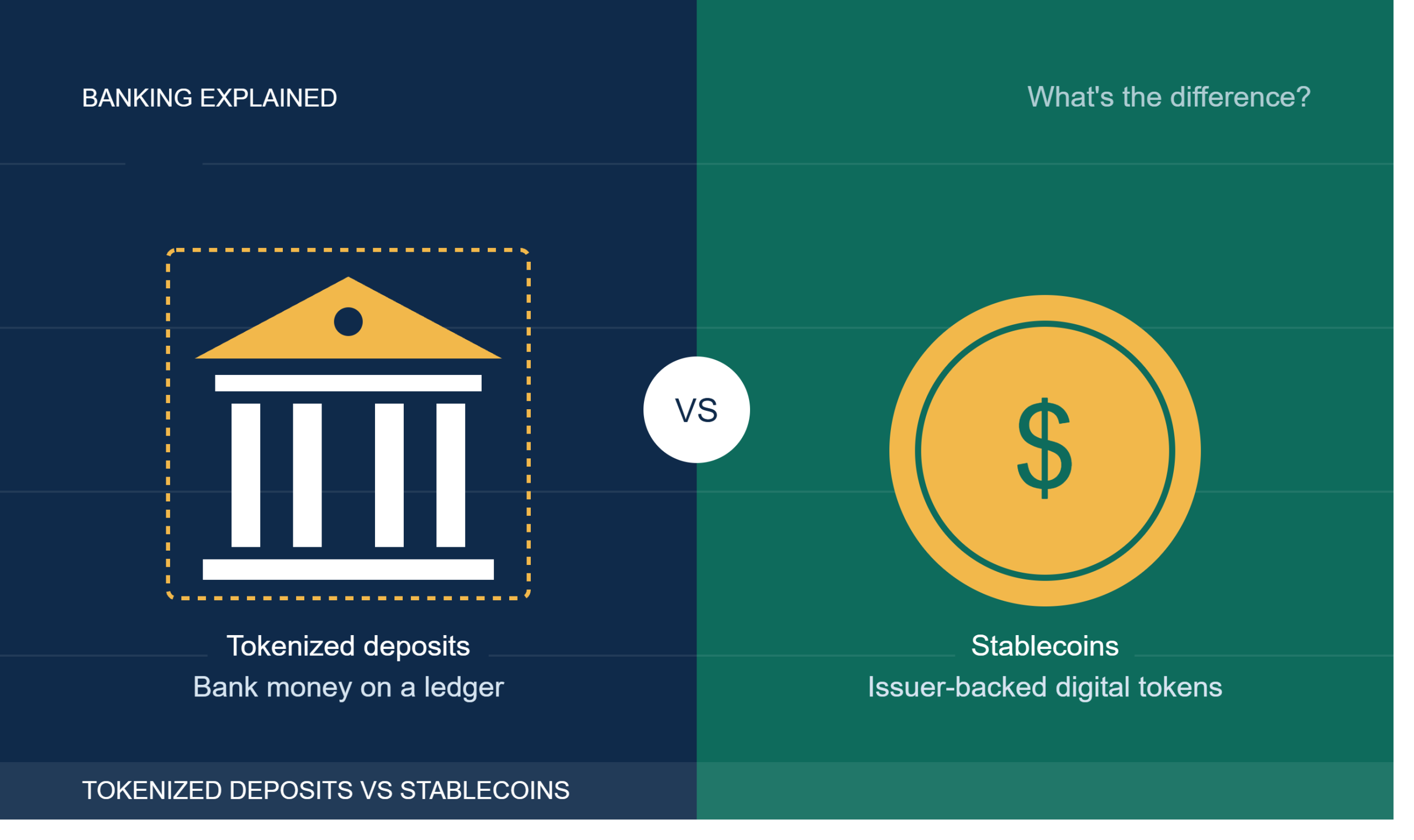
The financial industry is moving toward blockchain-based money and programmable financial infrastructure. Two concepts receiving increasing attention are tokenized deposits and stablecoins. Although both use blockchain or distributed ledger technology to represent digital value, they are fundamentally different in terms of issuance, ownership, regulation, redemption, and risk.
Understanding the difference is important for businesses exploring crypto token development, fintech companies planning blockchain-based payment solutions, and organizations considering how digital assets can support their operations.
Tokenized deposits are traditional bank deposits represented as digital tokens on a blockchain or programmable ledger. The underlying money remains a liability of the commercial bank that issued the deposit.
In simple terms, tokenization changes how a bank deposit is represented and transferred rather than turning it into an entirely new type of money. According to the Bank for International Settlements, tokenized deposits remain commercial bank liabilities and are generally designed to remain redeemable or transferable at par with ordinary deposits.
For example, imagine a company has $1 million deposited with a bank. Instead of transferring that value through conventional banking infrastructure, the bank could represent the deposit through tokens on a permissioned blockchain. These tokens could potentially be used for programmable payments, automated settlement, and other blockchain-based financial applications.
This makes tokenized deposits particularly interesting for institutional payments, treasury management, trade finance, and asset settlement.
Stablecoins are digital tokens designed to maintain a relatively stable value against a reference asset, most commonly a fiat currency such as the US dollar.
Unlike tokenized deposits, stablecoins are generally issued by private entities rather than representing an existing commercial bank deposit. Fiat-backed stablecoins typically maintain their value through reserves such as cash, government securities, or other high-quality liquid assets.
Stablecoins can operate on public blockchains and can often be transferred between digital wallets without using traditional banking rails. This makes them popular in cryptocurrency markets, decentralized finance, cross-border transfers, and blockchain applications.
Their growth has also made stablecoins an important part of the broader tokenization trend. The IMF notes that stablecoins can potentially improve payment efficiency, particularly for cross-border transactions, while also introducing risks related to liquidity, regulation, financial integrity, and financial stability.
While both instruments represent digital value, several important differences separate them.
The first major difference is who issues the digital asset.
Tokenized deposits are issued by commercial banks and represent existing bank deposit liabilities. Stablecoins are generally issued by private stablecoin companies or other eligible entities and are backed by reserve assets.
Therefore, the issuer plays a major role in determining the legal structure and risk profile of each instrument.
A tokenized deposit represents a claim on a bank. If you hold a tokenized deposit, the underlying value is connected to your deposit relationship with the bank.
A stablecoin, on the other hand, represents a token whose value is intended to track a particular currency or asset. The ability to maintain that value depends on the quality and liquidity of its reserves, the issuer’s operations, and the applicable redemption arrangements.
Tokenized deposits are commonly designed for controlled or permissioned environments, particularly when used by financial institutions.
Stablecoins are often issued on public, permissionless blockchains. This allows them to interact with wallets, decentralized applications, exchanges, and other blockchain protocols.
This difference gives stablecoins significant reach within the crypto ecosystem, while tokenized deposits can be better suited to regulated institutional environments.
Tokenized deposits operate within the existing banking framework. Depending on the jurisdiction and structure, traditional banking regulations, prudential requirements, deposit insurance, and resolution mechanisms may apply.
Stablecoins operate under a different regulatory framework. Their protections depend heavily on the issuer, reserve structure, jurisdiction, and applicable stablecoin regulations.
The IMF highlights that tokenized deposits can retain the protections associated with the banking system, while stablecoins may lack some of the stabilization mechanisms available to traditional bank deposits.
Stablecoins are designed to function as transferable digital tokens. A user can typically send them from one compatible blockchain wallet to another.
Tokenized deposits can also support programmable transfers, but their movement may be subject to the rules of the bank, platform, network, and regulatory environment in which they operate.
The result is two different approaches: stablecoins emphasize digital portability and blockchain-based circulation, while tokenized deposits emphasize the tokenization of existing regulated bank money.
For companies entering Web3 finance, understanding the distinction is essential before beginning token development.
A business interested in creating a payment token, digital currency, or blockchain-based financial product needs to determine what the token is supposed to represent. Is it intended to represent a claim on a bank? Is it backed by reserves? Will it operate on a public blockchain or a permissioned network? Who can issue, hold, transfer, and redeem it?
These questions directly influence the technical architecture, smart contract design, blockchain selection, compliance requirements, custody model, and overall development strategy.
Businesses looking to build regulated or asset-backed blockchain solutions may therefore require specialized crypto token development services rather than simply deploying a standard cryptocurrency token.
Understanding how to create a crypto token starts with defining the purpose and economic model of the asset.
The typical development process can include:
For businesses that require specialized architecture, working with an experienced crypto token development company can help connect the technical implementation with the project’s business requirements.
There is no universal answer because the two models serve different purposes.
Tokenized deposits can be attractive for banks, financial institutions, and enterprises that want programmable money while maintaining a connection with the traditional banking system. They can potentially support automated settlement, institutional payments, and financial workflows.
Stablecoins can be more attractive for blockchain-native businesses that need transferable digital value across wallets, exchanges, decentralized applications, and global blockchain networks.
The choice should therefore be based on the project’s purpose rather than simply choosing the technology that is more popular.
Developing a blockchain-based financial token requires more than creating a smart contract. It involves blockchain selection, token architecture, security, integrations, and a clear understanding of how the token is intended to function.
Businesses exploring these solutions can work with a token development company that understands both blockchain technology and the technical requirements of different token models.
KodeGrid Solutions provides specialized blockchain and token development capabilities for businesses building Web3 projects. You can learn more about its crypto token development services and explore how a dedicated development team can help with token architecture, smart contracts, blockchain selection, and deployment.
Depending on the blockchain selected, businesses may also require specialized expertise such as an erc20 token development company for Ethereum-compatible tokens or an ethereum token development company for projects built specifically around the Ethereum ecosystem.
Tokenized deposits and stablecoins may look similar because both bring digital tokens and blockchain technology into the world of money, but their underlying structures are very different.
Tokenized deposits represent commercial bank deposits in a programmable digital form, while stablecoins are privately issued digital tokens designed to maintain a stable value against a reference asset. Their differences extend to issuers, underlying claims, regulation, blockchain environments, transferability, and risk.
For businesses exploring crypto token development, choosing between these models requires a clear understanding of the project’s purpose, users, regulatory environment, and technical requirements. Whether the goal is to build a stablecoin, tokenized deposit infrastructure, or another blockchain-based financial product, careful planning is essential.
As tokenization continues to develop, both models may become increasingly important parts of the digital financial ecosystem. The right approach will ultimately depend on what a business wants its token to represent, how it will be used, and how it needs to interact with the broader financial and blockchain infrastructure.




