Physical Address
304 North Cardinal St.
Dorchester Center, MA 02124
Physical Address
304 North Cardinal St.
Dorchester Center, MA 02124

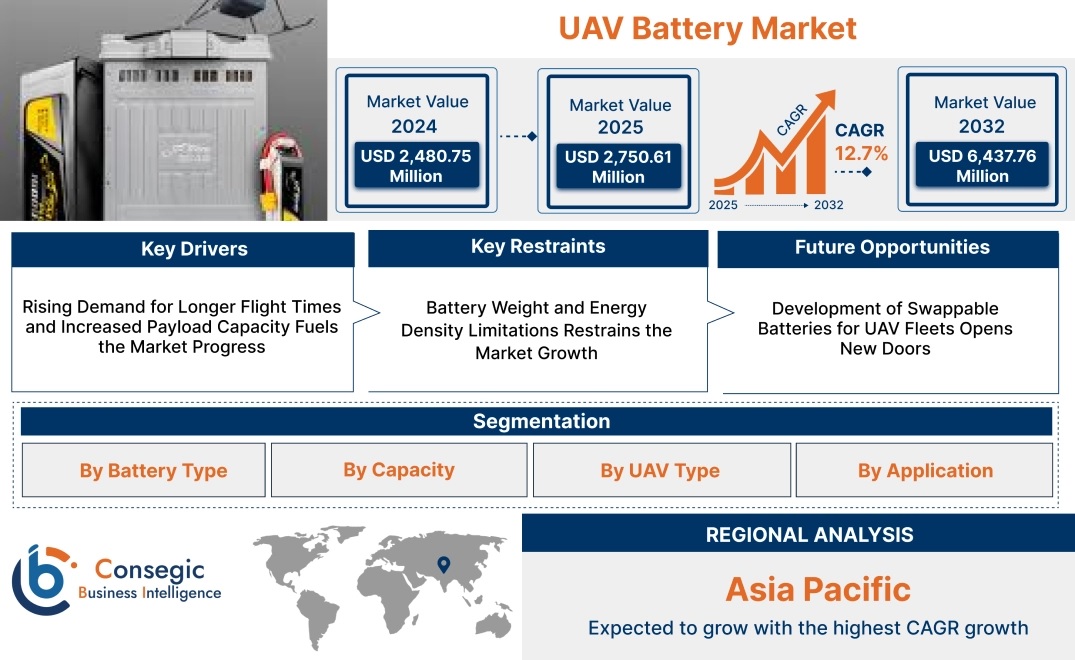
The UAV Battery Market is gaining importance as unmanned aerial vehicles become more capable, autonomous, and widely used across defense, agriculture, logistics, infrastructure inspection, mapping, and emergency response. Battery performance directly affects flight endurance, payload capacity, operating range, charging time, and overall mission efficiency.
Lithium-ion and lithium-polymer batteries remain central to many UAV applications because they provide a practical combination of energy density, weight, and power output. At the same time, manufacturers and researchers are exploring silicon-anode, lithium-sulfur, solid-state, fuel-cell, and hybrid energy systems to address the industry’s need for longer flight times and faster energy replenishment. The broader drone ecosystem is also expanding. The FAA forecasts that the U.S. commercial drone fleet will exceed one million aircraft in 2025 and reach about 1.118 million by 2029.
The UAV Battery Market covers rechargeable and alternative energy systems designed to power unmanned aircraft. These systems include battery cells, battery packs, battery management systems (BMS), charging equipment, thermal-management components, and related power electronics.
Major applications include:
Battery requirements differ according to UAV design. Small multirotor drones typically prioritize lightweight, high-power batteries, while larger fixed-wing and long-endurance platforms require greater energy capacity and efficient power management.
One recent industry estimate valued the global drone battery market at USD 2.8 billion in 2024 and projects it to reach USD 8.9 billion by 2034, representing a 12.3% CAGR.
The expansion of commercial and defense UAV operations is a primary market driver. As drones move from occasional operations toward routine industrial workflows, demand is increasing for batteries capable of supporting repeated flight cycles, reliable power delivery, and rapid turnaround.
Longer flight endurance is another major requirement. Conventional battery limitations can restrict UAV operating time, particularly when aircraft carry cameras, sensors, communication equipment, or delivery payloads. This is encouraging investment in higher-energy-density cells and improved battery architectures.
Battery economics are also improving. The International Energy Agency reported that lithium-ion battery prices fell from approximately USD 1,400 per kWh in 2010 to below USD 140 per kWh in 2023. These cost improvements have strengthened the broader battery manufacturing ecosystem and supported continued research into higher-performance chemistries.
Government investment in drone infrastructure, defense modernization, autonomous systems, and domestic battery manufacturing can further stimulate demand.
Higher energy density is one of the most important trends. UAV designers need batteries that store more energy without adding excessive weight. This has increased interest in advanced lithium-ion architectures, silicon-anode materials, lithium-sulfur batteries, and solid-state concepts.
Lithium-sulfur technology is attracting research attention because it has the potential for high specific energy and reduced dependence on certain critical minerals. However, durability, volumetric energy density, and safety remain challenges before widespread commercialization.
Smart battery management is another important development. AI and Machine Learning (ML) can analyze voltage, temperature, current, charging patterns, and battery health to estimate remaining useful life and identify abnormal conditions.
Automation and digital transformation are also influencing battery production and UAV operations. Smart charging stations, automated battery swapping, and autonomous docking systems can reduce downtime for high-frequency drone operations.
Sustainability is becoming increasingly relevant. Battery recycling, responsible material sourcing, longer battery lifecycles, and circular economy practices can reduce environmental impacts associated with battery production and disposal.
The technology landscape is centered on improving energy density, power delivery, charging speed, safety, cycle life, and thermal stability.
Lithium-polymer batteries remain useful where high discharge rates and flexible form factors are important. Lithium-ion systems offer a strong balance between energy capacity and weight, while emerging chemistries aim to deliver higher specific energy or improved safety.
Battery Management Systems are becoming more sophisticated. These systems monitor cell voltage, temperature, current, state of charge, and state of health. Advanced data analytics can help optimize charging and reduce the risk of battery degradation.
Industry 4.0 is also changing battery manufacturing. Smart Manufacturing combines automation, robotics, sensors, cloud technologies, and real-time data analytics to improve production quality and process control.
IoT integration can connect batteries and charging infrastructure to fleet-management platforms. This can enable centralized monitoring of battery health and support predictive maintenance.
Advanced materials, improved electrode structures, solid-state electrolytes, and better thermal-management systems are also being investigated to improve UAV battery performance.
North America: North America benefits from strong defense spending, established aerospace industries, commercial drone adoption, and extensive research into advanced batteries. Demand is supported by surveillance, logistics, infrastructure inspection, and autonomous UAV programs.
Europe: Europe has a strong aerospace and battery technology ecosystem. Sustainability policies and investment in electric mobility and clean technologies are supporting research into efficient battery chemistries, recycling, and lower-carbon manufacturing.
Asia-Pacific: Asia-Pacific represents a major growth opportunity due to large-scale electronics and battery manufacturing capabilities, expanding drone production, defense modernization, agriculture applications, and commercial UAV adoption. China, Japan, South Korea, and India are important markets for drone and battery technology development.
Latin America: Agriculture, mining, infrastructure monitoring, and environmental applications are increasing the use of UAVs. As commercial drone adoption expands, demand for reliable replacement batteries and charging infrastructure can increase.
Middle East & Africa: Defense, security, energy infrastructure, surveying, and logistics are important application areas. Investments in autonomous systems and drone-enabled services may support regional battery demand.
Investment opportunities exist across battery cells, battery packs, BMS technology, advanced materials, charging infrastructure, battery-swapping systems, and thermal-management solutions.
High-potential areas include:
Long-endurance military UAVs, delivery drones, agricultural platforms, and autonomous inspection systems can create additional demand for advanced power solutions.
Competition in the UAV Battery Market is increasingly focused on energy density, weight, safety, cycle life, charging speed, reliability, and customization. Battery companies are working with UAV manufacturers and aerospace organizations to develop application-specific power systems.
Strategic partnerships can accelerate battery development and testing. Companies are also investing in production capacity, research facilities, new cell chemistries, BMS platforms, and automated manufacturing.
Product launches increasingly emphasize higher energy density and improved discharge performance. Research investments are also targeting silicon-based anodes, lithium-sulfur systems, solid-state batteries, and alternative power architectures.
The UAV Battery Market is expected to evolve as drone missions become longer, more autonomous, and more energy-intensive. Conventional lithium-based batteries are likely to remain important, but advanced chemistries may gradually expand their role where higher energy density or other performance characteristics justify adoption.
AI-enabled battery monitoring, predictive maintenance, automated charging, digital twins, and cloud-based fleet management can improve battery utilization and operational reliability. Automated battery-swapping stations may become particularly relevant for delivery, inspection, and other high-frequency drone operations.
Sustainability will also shape future development. Battery recycling, material recovery, longer service life, and circular economy models can become increasingly important as UAV fleets expand.
Overall, the UAV Battery Market has strong long-term potential through 2034. Growth will depend not only on battery capacity but also on improvements in safety, charging infrastructure, intelligent energy management, manufacturing efficiency, and alternative power technologies.
The UAV Battery Market covers batteries and related energy-storage technologies used to power unmanned aerial vehicles. It includes lithium-ion and lithium-polymer batteries, battery management systems, charging solutions, and emerging technologies such as lithium-sulfur, solid-state, fuel-cell, and hybrid power systems.
Growth is driven by expanding drone use in defense, agriculture, logistics, inspection, mapping, surveillance, and emergency response. Demand for longer flight times, greater payload capacity, faster charging, lower weight, and improved battery reliability is encouraging investment in advanced UAV power technologies.
North America and Asia-Pacific are major regional markets because of strong defense applications, commercial drone adoption, aerospace research, and battery manufacturing capabilities. Asia-Pacific has significant production advantages, while North America benefits from substantial investment in autonomous systems and advanced aerospace technologies.
Key trends include higher energy-density lithium batteries, silicon-anode technology, lithium-sulfur research, intelligent battery management, fast charging, automated battery swapping, AI-based battery analytics, predictive maintenance, and recycling. Hybrid and fuel-cell power systems are also being explored for long-endurance UAV missions.
Opportunities are expected in high-energy-density batteries, advanced battery management systems, automated charging, battery swapping, alternative chemistries, thermal management, recycling, and AI-enabled battery analytics. Long-endurance defense UAVs, delivery drones, agricultural platforms, and autonomous inspection systems may generate additional demand.
About Us
At Consegic Business Intelligence Pvt. Ltd., we empower organizations with actionable market intelligence, strategic insights, and data-driven research solutions that support informed business decision-making. Our comprehensive market research reports provide in-depth analysis of industry trends, competitive landscapes, emerging opportunities, and future growth prospects across diverse sectors.
Contact Us
Consegic Business Intelligence Pvt. Ltd.
Website: www.consegicbusinessintelligence.com
Email: sales@consegicbusinessintelligence.com
Phone: +1-833-313-3130




