Physical Address
304 North Cardinal St.
Dorchester Center, MA 02124
Physical Address
304 North Cardinal St.
Dorchester Center, MA 02124

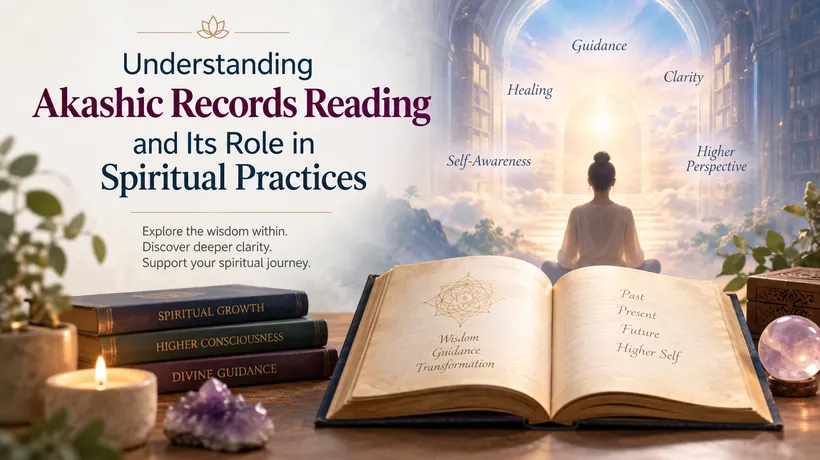
Excerpt:
Akashic records reading is a spiritual practice based on the concept of a metaphysical record connected with experiences and consciousness.
People may explore the practice alongside meditation, mindfulness, journaling, and other forms of spiritual reflection.
Spiritual practices provide different ways for people to reflect on their experiences, beliefs, emotions, and personal values. Meditation, mindfulness, prayer, journaling, energy practices, and other traditions can all encourage introspection.
Akashic records reading is one practice that people explore as part of this wider spiritual landscape. It is based on the concept of the Akashic Records, which practitioners describe in different ways.
Some view the records as a metaphysical source containing information about experiences and consciousness. Others approach the concept symbolically as a framework for personal reflection.
An Akashic reader guides individuals through a session according to their particular spiritual method.
Understanding the history, concepts, process, and limitations of the practice can help beginners approach it with greater clarity.
The Akashic Records are associated with certain spiritual and esoteric traditions.
The term “Akashic” relates to “akasha,” a Sanskrit term commonly associated with space or ether in philosophical and spiritual contexts.
Modern practitioners use the concept in different ways.
Some describe the Akashic Records as a spiritual library containing information about experiences, while others interpret them as a symbolic field of consciousness.
There is no single interpretation shared by all practitioners.
Akashic records reading involves a practitioner attempting to access or interpret information associated with the Akashic Records.
The practitioner may use:
The exact method depends on the practitioner.
The session may focus on personal questions, recurring patterns, relationships, spiritual interests, or personal growth.
People explore Akashic reading for different reasons.
Some feel curious about spiritual traditions. Others want to reflect on their life experiences or recurring patterns.
Common areas of interest include:
The purpose is usually reflective rather than scientific.
Although methods vary, many sessions include several stages.
The individual identifies what they want to explore.
The practitioner may guide meditation, breathing, or visualization.
The client asks questions related to their chosen area of focus.
The practitioner interprets information according to their spiritual framework.
The client and practitioner discuss the themes that arise.
The individual considers how the information relates to their own experiences.
Meditation often plays a role in Akashic practices.
A practitioner may use meditation to create a calm environment before beginning the reading.
Clients can also meditate independently before or after a session.
Meditation provides an opportunity to focus attention and observe thoughts without immediately reacting to them.
Combining meditation with Akashic practices can therefore create a structured period for personal reflection.
Journaling can help people process a session.
After an Akashic reading, write down:
You can revisit these notes later to see whether your perspective changes.
This approach allows the experience to become part of an ongoing reflection process.
Mindfulness encourages people to pay attention to present experiences.
After a reading, mindfulness can help individuals observe whether the themes discussed relate to their everyday thoughts and behaviours.
For example, if a session encourages reflection on communication, mindfulness can help you notice how you communicate during daily interactions.
This keeps the practice connected to real-life observation.
An Akashic reader acts as a guide during the session.
Their role may involve:
Practitioners may have different training and methods.
For this reason, it is important to understand their approach before booking.
When choosing an Akashic reader, consider several factors.
Ask about their background and experience.
Understand how they conduct readings.
Choose someone who explains information clearly.
Review pricing and session details.
Ask how personal information is handled.
Make sure the practitioner respects your independence.
Digital technology has made spiritual consultations accessible from different locations.
Akashic reading online allows clients to participate through video calls or other communication platforms.
Online sessions can provide:
The exact format depends on the practitioner.
If you choose Akashic reading online, prepare your environment beforehand.
Find a location where you can focus.
Check your internet connection, microphone, and camera.
Write down the topics you want to explore.
Ask whether the session is recorded and how information is stored.
Remember that the session follows a spiritual framework.
People may use sessions to reflect on different areas.
You may explore recurring experiences or behaviours.
You may reflect on communication and relationship experiences.
You may consider what matters most to you.
You may explore questions about your personal spiritual beliefs.
You may reflect on lessons you associate with significant experiences.
The reader’s interpretation does not automatically establish an objective explanation for these areas.
For some people, Akashic practices form part of a broader spiritual routine.
They may combine readings with:
Each practice has its own purpose and tradition.
Combining them can provide different opportunities for introspection.
It is important to distinguish spiritual interpretation from established professional knowledge.
Akashic reading cannot scientifically diagnose medical conditions or guarantee future events.
It should not replace:
A responsible practitioner should communicate these boundaries clearly.
Spiritual practices can become more constructive when people maintain their independence.
You should not feel that you need an Akashic reading before making every important decision.
Instead, use the session as one perspective among many.
For important decisions, consider relevant facts, trusted people, and qualified professionals.
You can make an Akashic session more reflective by focusing on questions rather than demanding definitive answers.
Instead of asking only what will happen, consider asking what you can learn from a situation.
This shifts attention toward self-awareness and personal responsibility.
After the session, identify practical steps that align with your own goals.
Beginners can start with a simple approach.
First, learn about the concept and understand that different practitioners interpret it differently.
Next, research an Akashic reader and ask questions about their method.
Then, prepare a few reflective questions before the session.
During the consultation, listen carefully and ask for clarification when needed.
Afterward, take time to decide what the experience means to you.
Akashic records reading is a spiritual practice based on the concept of the Akashic Records. Practitioners interpret this concept in different ways and may use meditation, visualization, intuitive methods, or other spiritual techniques during sessions.
An Akashic reader can guide the process and provide interpretations that encourage personal reflection. People can also choose Akashic reading online for greater convenience and access to practitioners outside their local area.
When combined with meditation, mindfulness, and journaling, Akashic reading can become part of a broader personal reflection routine. The practice should be approached with curiosity and realistic expectations rather than as a source of guaranteed predictions or professional diagnoses.
Understanding the spiritual nature of Akashic records reading allows beginners to explore the practice thoughtfully while keeping personal judgment and appropriate professional guidance at the centre of important life decisions.